AI Developers Just Cloned Photoshop in Days — Subscription Software
A single developer used AI to build seven free Adobe competitors in days. The ArtCraft project isn't ready to replace Photoshop yet, but it signals a structural shift in who can compete with subscription software giants.
The developer who built seven Adobe clones before most people finished their coffee
Brandon Thomas is not a software giant. He’s a veteran developer who got tired of Adobe’s cancellation policy — annual plans billed monthly with hidden early termination fees — and tired of the open-source alternatives that have been the only option for Linux users for decades. GIMP, Krita, Inkscape. He called them the ceiling of what free creative tools had to offer.
So he grabbed Claude, picked Rust as his language, and started building.
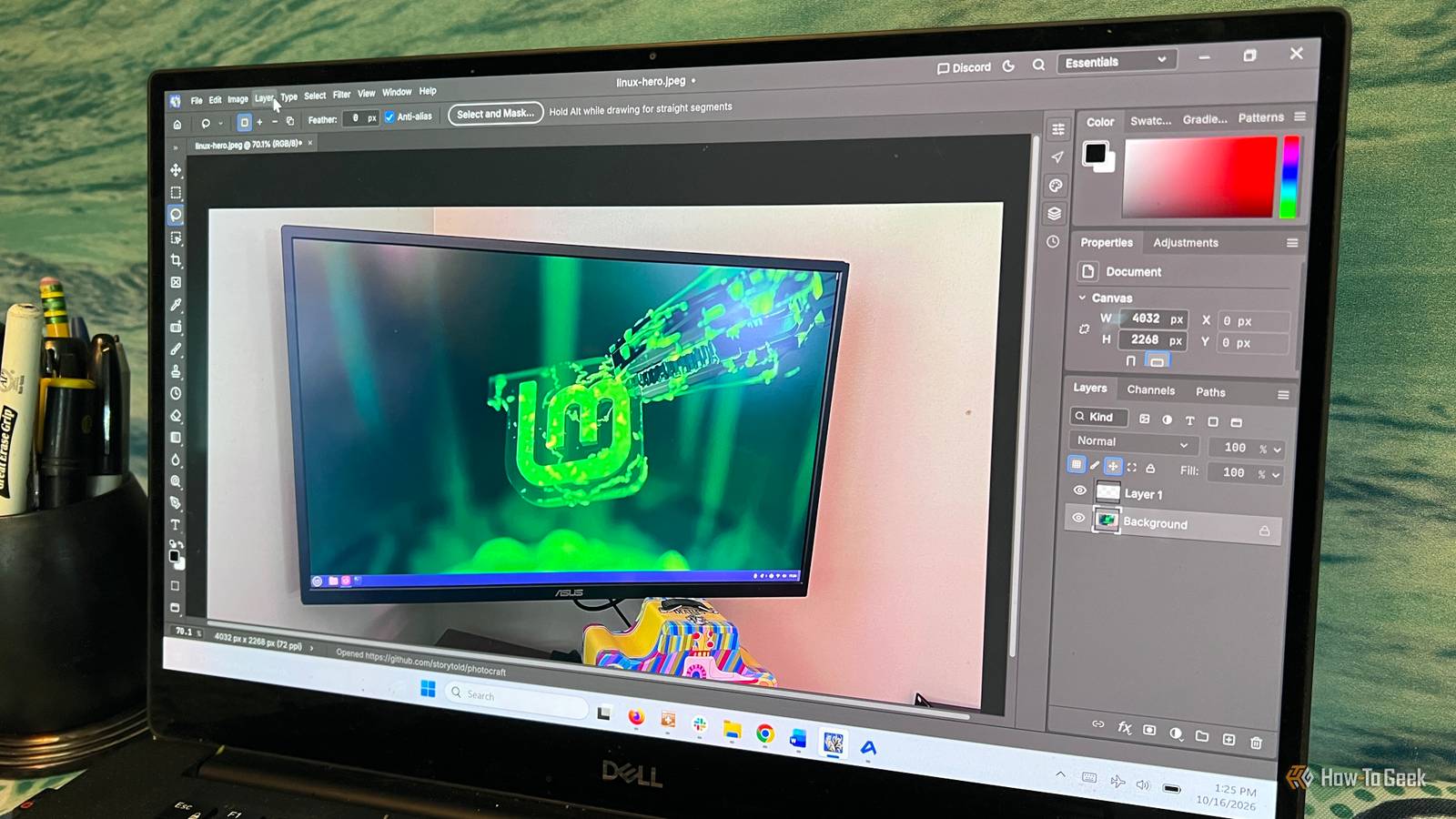
Within days, Thomas and a small team had rough working versions of seven Adobe applications. The project is called ArtCraft. Each clone carries a name that tells you exactly what it’s replacing: PhotoCraft for Photoshop, and the team has already started on WordCraft, GridCraft, and DeckCraft for Microsoft Word, Excel, and PowerPoint.
They’re early alpha software. Far from finished. Thomas has said as much repeatedly. But the direction they’re pointing matters more than the destination they’ve reached so far.
Why this is different from every open-source threat before it
Open-source alternatives to commercial software are nothing new. GIMP has been trying to catch Photoshop since the late 1990s. LibreOffice has competed with Microsoft Office for over two decades. The reason they never caught up is simple: building serious software takes enormous time, money, and headcount. You need hundreds of engineers, years of iteration, and deep domain expertise in areas like color management, typography, and file format compatibility.
ArtCraft is proving that the math has changed.
AI coding assistants can write scaffolding, debug errors, and generate feature implementations at speeds that dwarf traditional development. Thomas didn’t need a team of fifty engineers. He needed a small group of experienced developers who knew what they were building and could direct the AI to do the heavy lifting. The applications exist in functional form now, where building comparable prototypes would have taken a much larger team months or longer.
The technology is not perfect. Users testing PhotoCraft have reported filters that don’t produce expected results, and gaps remain in full Photoshop file compatibility. Adobe’s applications have been refined over decades — professionals rely on that reliability for complex, high-stakes projects. A few days of AI-assisted development is not going to erase that overnight.
But the gap is no longer defined by engineering capacity. It’s defined by time, data, and trust. And those are problems that can be solved.
The real threat to subscription software
The subscription model works because switching costs are high. When your entire creative pipeline is built around Photoshop, when every plugin, every workflow shortcut, every team member’s muscle memory depends on it, paying $55 a month feels like the price of doing business. That’s the moat.
ArtCraft is attacking the moat from below.
These are free. They’re open source. They run on any platform. For anyone who uses Photoshop occasionally rather than professionally, the calculus is already shifting. If a free tool does 80 percent of what you need, why pay $55 a month? Why pay anything?
The same dynamic applies across the broader SaaS ecosystem. Microsoft charges roughly $150 a year per Office 365 user. Many of those subscribers aren’t power users. They use Word for documents and Excel for spreadsheets. If a free alternative reaches reasonable functionality, the value proposition for paying weakens dramatically.
Software companies know this. They’re already feeling it. The broader market is seeing rising churn rates on mid-tier subscriptions as consumers become more selective about recurring payments. ArtCraft gives that pressure a new shape — it’s not just about price sensitivity. It’s about the existence of credible free alternatives that weren’t possible even a year ago.
Who wins, who loses
The winners are anyone who has been priced out of professional creative tools. Students. Hobbyists. Small businesses. Freelancers in markets where Adobe’s pricing assumes US-level income levels. Open-source communities that have long been frustrated by the quality gap between free and paid tools. And developers everywhere, who now see a realistic path to building competition against entrenched software giants.
The losers are the middle tier of the subscription economy. Not Adobe or Microsoft themselves — those companies have diversified revenue streams and deep pockets. But companies that sit in the narrower band of paid creative and productivity software, where the value proposition is functional capability rather than ecosystem lock-in. Those are the businesses most exposed to AI-accelerated replacement.
There is also a class of developers who may find themselves in an unusual position: no longer needing venture capital or large teams to validate a product idea. The barrier to entry for building serious software has dropped in ways that will reshape how startups approach product development over the next several years.
What happens next
Thomas has promised he will keep building. He has also made these projects open source, which means anyone can fork them, improve them, and compete within the ecosystem. That’s a double-edged sword for the original project — it accelerates improvement but also distributes credit and control.
Other developers are already looking at what Thomas did and thinking about which software categories they could attack with the same approach. The ArtCraft project is a proof of concept. Proofs of concept scale.
Adobe and Microsoft will respond. They always do. Adobe has expanded Creative Cloud with AI features through Firefly, tightened integration across its suite, and invested heavily in its ecosystem. Microsoft has woven Copilot into Office and is pushing toward a subscription experience that goes beyond individual applications. These moves address some of the threats ArtCraft represents, but they don’t solve the underlying one: the cost of building competitors just fell.
The subscriptions themselves are not going away. No serious analyst expects Adobe to collapse because seven open-source apps exist in alpha. But the justification for charging $55 a month for software that could be replaced by a free tool is becoming harder to defend in contexts where professional-grade output is not required.
That is a structural problem. And structural problems don’t get solved by adding AI features to your existing product. They get solved by rethinking what you’re selling and why people keep paying for it.
The developers who built ArtCraft in days just handed the subscription software industry a mirror. What happens next depends on whether those companies are willing to look into it.