AI's Memory Hunger Is Finally Hitting Your Device Wallet
Amazon just raised prices on Echo and Kindle devices by up to 60 percent — a tangible sign that AI-driven memory demand is spilling from datacenters into consumer electronics. The chipflation cascade has a new vector.
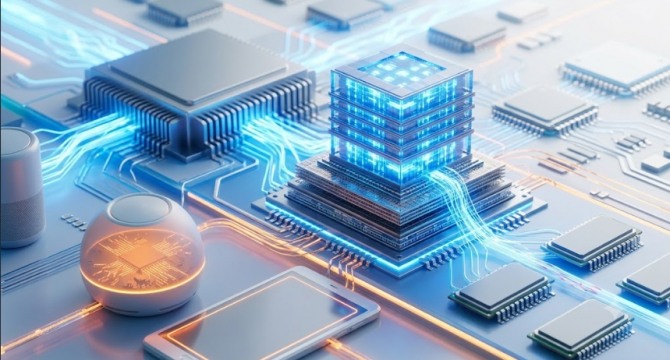
The Echo Dot Just Got Expensive — Because AI Demands It
Amazon raised the price of its Echo Dot smart speaker by 60 percent, from $49.99 to $79.99. The Kindle e-reader, Fire TV, and Eero Wi-Fi routers followed. The reason is not inflation in the ordinary sense — not supply chain friction or currency fluctuation or labor cost creep. It is a shift in who controls the world’s most constrained industrial input, and the leverage has moved decisively.
Memory chipmakers — Samsung, SK Hynix, Micron — are prioritizing high-bandwidth memory (HBM) for AI servers because it commands far higher margins. Producing the same capacity in HBM consumes three times the silicon wafer area compared to standard DDR5, as Micron’s Raghu Sriramaneni noted at Hot Chips 2026. The consequence is mechanical: every wafer diverted to AI accelerators is one fewer wafer for the commodity DRAM and NAND that go into your smart speaker, your e-reader, your home router.
Amazon had been absorbing the cost increases for months. Internal sourcing teams reportedly pushed back against supplier price hikes through early 2026, citing long-term volume agreements and the competitive pressure of retail margins. It could not hold. The company’s own statement acknowledged the pressure, saying consumer electronics brands were facing steep rises in memory and storage component costs and had finally pushed adjustments across product lines. The language was carefully flat. The message was blunt.
A Semiconductor Market Remaking Itself
The scale of the reallocation is enormous. Gartner projects the global semiconductor market will reach $1.56 trillion in 2026, up from $809 billion in 2025 — a 92 percent jump in a single year. Memory alone is expected to account for $837.3 billion, or 54 percent of total revenue. DRAM is projected to grow 246.6 percent and NAND flash 371.9 percent year over year.
This is not incremental growth. It is a reorientation of the entire industry’s center of gravity. Datacenter AI infrastructure is expected to grow from 36.5 percent of semiconductor revenue in 2026 to over 53 percent by 2030. The industry is entering what Gartner’s Ben Lee called a fundamentally new growth phase — one in which the economic returns to memory production are no longer distributed across a wide spectrum of applications but concentrated in a narrow set of AI workloads.
The winners are clear: memory manufacturers. Samsung and SK Hynix dominate global DRAM share and sit at the center of the HBM transition. Their pricing power has never been stronger. Micron and Intel’s memory division benefit from the same tailwind, though on a smaller base. Each earnings call has become a masterclass in margin expansion — Samsung reported HBM revenue surpassing its initial 2026 guidance in Q1, while SK Hynix disclosed that HBM now accounts for over 40 percent of its total memory revenue, up from roughly 15 percent just two years prior.
The losers are the companies and consumers who need commodity memory. Amazon’s hardware division, which operates on thin margins — historically in the low single digits — cannot absorb a tripling of component costs. Consumers buying Echo devices, Kindles, Fire TVs, and Eero routers now face prices that reflect the new reality. The price increase on the Echo Dot alone represents an additional $30 per unit, and at Amazon’s volume, that translates to hundreds of millions in incremental cost that simply cannot be buried in the services ecosystem the way it once could.
Second-Order Effects You Haven’t Considered Yet
The ripple effects extend well beyond Amazon’s product pages. Every device that contains DRAM or NAND — and that is nearly every connected device sold today — is subject to the same allocation pressure. Automotive manufacturers are reporting similar cost escalation. The average electric vehicle now contains more memory than a mid-range laptop, and suppliers like Bosch and Continental are flagging memory cost as a top-three input risk in recent investor calls.
Gaming hardware is next in line. Sony and Microsoft have not yet adjusted pricing on the PlayStation 5 Pro or Xbox Series X, but both companies have signaled in supply chain briefings that component cost pressure is building. When it hits, it will hit hard — a $50 to $100 price increase on consoles would be unusual in a category where price stability is treated as a competitive moat.
Even industrial and medical equipment, sectors traditionally insulated from consumer electronics pricing cycles, are beginning to feel the squeeze. Long-cycle products with multi-year procurement contracts are now renegotiating terms as memory suppliers invoke force majeure provisions tied to allocation prioritization.
Why This Matters Beyond Your Shopping Cart
The Amazon price moves are significant because they make visible a supply-chain cascade that most observers only understand in abstract terms. Chip inflation has been discussed as a macro story — datacenter capex, training costs, GPU shortages. But it is also a story about your living room. It is a story about the thermostat on your wall, the security camera by your door, the fitness tracker on your wrist.
The mechanism is straightforward. HBM production concentrates memory supply, reduces output of standard DRAM and NAND, and shifts bargaining power toward chipmakers. Those chipmakers sell primarily to AI server manufacturers and cloud providers. The remainder — the commodity channel — faces a thinner pie. Component suppliers raise prices. Device assemblers like Amazon, which had previously absorbed increases, hit a ceiling and pass costs through.
Gartner analyst Shrish Pant expects AI server memory demand and HBM growth to sustain memory revenue through at least 2027. That means the squeeze on consumer hardware is not a quarterly blip. It is a structural condition — one that will define the cost landscape for consumer electronics for the better part of a decade.
The Timeline Nobody Is Talking About
TechCrunch reports that memory supply constraints are expected to persist through 2027, with prices peaking and stabilizing only in 2028. That timeline assumes two things: that new fabrication capacity comes online as planned, and that consumer demand does not collapse under rising prices before then.
There is a real risk the opposite happens. If device prices rise fast enough to suppress demand, the downstream effect could be slower inventory turns, reduced orders from assemblers, and ultimately a harder landing for memory prices than currently expected. The dynamic is familiar from previous commodity cycles — demand destruction as a feature, not a bug. It played out in flash memory during the 2022 downturn, when a sharp drop in smartphone and PC shipments left memory producers with excess capacity and prices that fell below the cost of production in some cases.
The counterweight is the sheer velocity of AI adoption. Every new model, every inference workload, every enterprise deployment pulls more HBM into datacenters. The demand curve may simply outpace any capacity expansion in the near term. OpenAI, Google, and Anthropic have all signaled that their 2027 infrastructure plans require memory capacities that exceed current industry output forecasts. That gap is where the price pressure lives.
What to Watch Next
Three variables will determine whether your next Amazon device gets cheaper or more expensive.
First, Samsung and SK Hynix earnings calls. Their guidance on HBM yield rates and DRAM production allocations will signal how deeply the industry is pivoting toward AI memory — and how much commodity output is being sacrificed. Any signal that yield rates are improving faster than expected could ease the squeeze; any hint of production bottlenecks will extend it.
Second, new fab capacity announcements. TSMC, Samsung, and Intel are all expanding advanced memory capacity. The question is timing. If production ramps delay beyond 2028 — and past experience suggests they will — the consumer price pressure extends well into the decade. Intel’s memory fab in Israel, for instance, has faced repeated delays that have pushed its startup timeline into 2028 at the earliest.
Third, Amazon and Apple hardware strategies. Both companies have the margin buffer to absorb moderate increases. If they do not pass costs to consumers immediately, it signals they expect stabilization sooner than Gartner projects. If they do pass them through — as Amazon has — it confirms the shortage is binding. Watch Apple closely: the company has historically absorbed component cost increases rather than risk price sensitivity on iPhone and MacBook lines. A shift in that posture would be a strong signal that the market has tightened further.
The Close
The Echo Dot price hike is a signal, not an anomaly. It is the first visible crack in the wall that separated the AI economy from the consumer economy — a wall that had always been more permeable than anyone admitted. The devices in your home are now priced in a market where AI servers are winning the wafer allocation game. That arrangement will not change until supply catches up with demand, and most industry forecasts suggest that convergence is still two to three years away.
In the meantime, the price you pay for your gadgets is no longer just a reflection of your gadget’s cost. It is a reflection of everyone else’s AI bill — split across the silicon shared by us all.