AI Music Tops Korea Charts Without Fandoms — And That Changes
A human-planned, AI-performed track just hit number one on Melon without any fandom or broadcast play. If copyright rules can't keep up, the entire K-pop business model faces its first real challenger.
The quiet earthquake underneath a number-one hit
In July, Lee Yoo-jin, a 36-year-old logistics manager in Busan, shared a short video of himself driving home after overtime, lips syncing to a rock ballad he had never heard before. Within days, the clip circulated across Naver TV and YouTube Shorts enough times that the original uploader got credited only as “그 사람” — “that person.” By mid-August, the song sitting behind that faceless video sat at the very top of Melon’s daily chart.
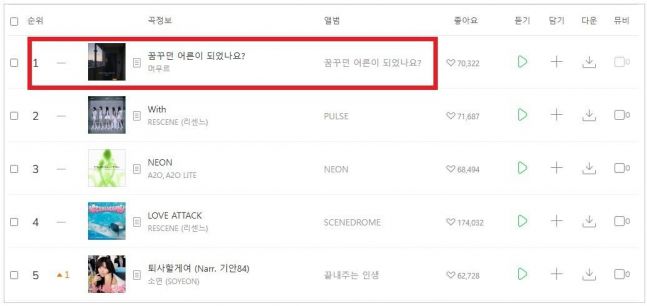
That song is “Dreamt-of Adult? Did You Become One?” (었벽하던 어른이 되었나?), performed by a project called Mumeu (머무). There is no K-pop group behind it. No trainee pipeline. No fan club purchasing albums in bulk. In fact, there is no human vocalist at all. A generative-AI system called Suno produced the melody, arrangement, and singing voice after two veteran producers wrote the lyrics and directed the output through several iterations.
What happened next matters more than the chart position itself. After five months on the platform, Mumeu’s song became the first AI-generated track to reach number one on Melon’s Top 100 since the service began tracking in 2015.
Why this isn’t a novelty act
A single chart peak could easily be dismissed as a curiosity if the demographics around it don’t support broader significance. But they do.
According to Melon’s own listener data, 66 percent of plays come from people aged 30 and 40. That means the audience driving this number is not Gen Z, not the usual K-pop core, and crucially, not anyone who buys into the idol economy. These are workers who have spent two decades inside the very life the lyrics describe: the gap between what they imagined becoming and what they actually became.
The song spread through organic sharing, not agency marketing. It wasn’t placed on a broadcaster’s playlist. There were no music-show appearances. When actor Gong Hyo-jin mentioned she sang the track at a recent fan meeting, the story simply added another inflection point to a wave that was already moving.
This is the difference between a product pushed onto consumers and a product chosen by them. In K-pop, both paths exist, but they almost never cross. An AI song reaching the same height through pure peer-to-peer recommendation is a different mechanism entirely, and it runs without the infrastructure that has guaranteed hits for twenty years.
Who stands to lose when the script flips
The traditional K-pop ecosystem is built on a simple equation: invest heavily in training, marketing, and promotion; build a fandom that buys physical albums and streams on schedule; and dominate the weekly charts. The financial upside is enormous, but so is the risk. Labels routinely lose money on groups that fail to convert initial interest into sustained purchasing behavior.
Mumeu sidesteps every major cost center. Two producers spent time on concept and lyrics. Suno did the rest. There are no costume designers, choreographers, variety-show fees, or travel budgets. The margin structure is radically different, even before you factor in that distribution costs on platforms like Melon are tiny compared to physical production.
For smaller and mid-tier agencies, that comparison cuts sharply. They have spent years trying to manufacture the kind of emotional resonance Mumeu stumbled into accidentally. Now a pair of producers with a Suno subscription can produce something that reaches a demographic almost entirely inaccessible through conventional idol marketing. Younger artists are not the target here; older listeners rarely engage with idol campaigns anyway.
The label system is not going to collapse overnight. Fandom culture generates revenue in ways pure streaming numbers never will — merchandise, concert ticketing, brand partnerships, long-term loyalty. But the chart system, which functions as both cultural barometer and promotional currency, is now open to a new kind of competitor.
The copyright clock ticking under every AI release
The most urgent constraint on this emerging pathway is not artistic competition but legal ambiguity. As of this writing, “Dreamt-of Adult?” holds no deposit registration with the Korea Music Copyright Association. That means the creators receive no standard publishing royalties beyond whatever the platform passes through for stream payouts. If the song is covered, remixed, sampled, or licensed commercially, there is currently no framework guaranteeing compensation to the humans behind the project.
KOMCA published guidance in August attempting to clarify that AI-generated tracks with meaningful human creative contribution should be eligible for deposit registration. The response was sharp criticism from industry figures who argued the criteria lacked transparency. KOMCA subsequently withdrew the announcement. Lawmakers have held parliamentary discussions since, but no binding standard exists.
Glorywave, the production team behind Mumeu, called for a reasoned process rather than blanket restrictions. Their argument is straightforward: the production chain involved deliberate editorial choices, multiple generations of Suno output that were evaluated and refined, and final mastering in traditional digital audio workstations. Reducing that to a binary question “AI or human?” obscures how much modern music production already works this way, with humans curating and selecting among machine-generated options as a routine part of the workflow.
The stakes extend far beyond one viral track. Streaming services are already integrating generative-AI tools into their creation pipelines. If rights remain undefined, platforms may eventually treat these outputs differently — or worse, absorb them into royalty-free back catalogs where creator compensation shrinks to zero.
What happens next
Three outcomes seem plausible over the coming year.
First, a major label acquires or partners with an AI production team on its own terms. The team behind Mumeu already has songwriting credits attached to notable K-pop ballads — songs by Changmo, Gilguboongu, and Kim Jun-su. Their access to the industry is real, not theoretical. A deal structured around co-writing rather than raw AI generation would give them legitimacy while preserving enough commercial control to matter.
Second, regulatory pressure forces platforms and publishers to adopt clearer classification standards, possibly modeled on European approaches currently under discussion at the World Intellectual Property Organization. Until those standards land, AI-originated releases will carry reputational risk in a market where authenticity is a primary selling point for many listeners and advertisers alike.
Third, and most quietly disruptive, independent creators begin releasing AI-polished music directly through distribution aggregators without waiting for label approval or copyright settlement. Every track that reaches the Top 100 without institutional backing makes the next one easier. Algorithmic discovery favors engagement, not pedigree.
The immediate fallout from Mumeu’s number-one finish will be measured in press coverage and internal label meetings. The longer-term consequence will show up in the roster of debut acts over the next eighteen months: fewer large-budget trainees entering visible pipelines, more solo producer credits, more genre-blending releases aimed squarely at older listeners who do not attend fan meetings.
K-pop has always absorbed outside influences and resold them on its own terms. What makes this moment distinct is that the influence does not arrive from another genre or another country. It arrives from a tool that turns the industry’s biggest expense — star-making — into a line item that can be reproduced for free.
Chart dominance has rarely meant ideological dominance. But when an AI song reaches the summit through sheer listener alignment rather than budgetary force, it proves the old mechanism is no longer the only mechanism available.