Science Prize Winner's AI-Generated Video Exposes a Vetting Crisis
An AI-hallucinated microscopy video won Nikon's prestigious Small World in Motion contest, only to be flagged by biologists who spotted synthetic structures that don't exist in real cells. The incident exposes a serious gap in how AI-assisted images enter the scientific record.
When a Hallucinated Video Takes a Science Prize
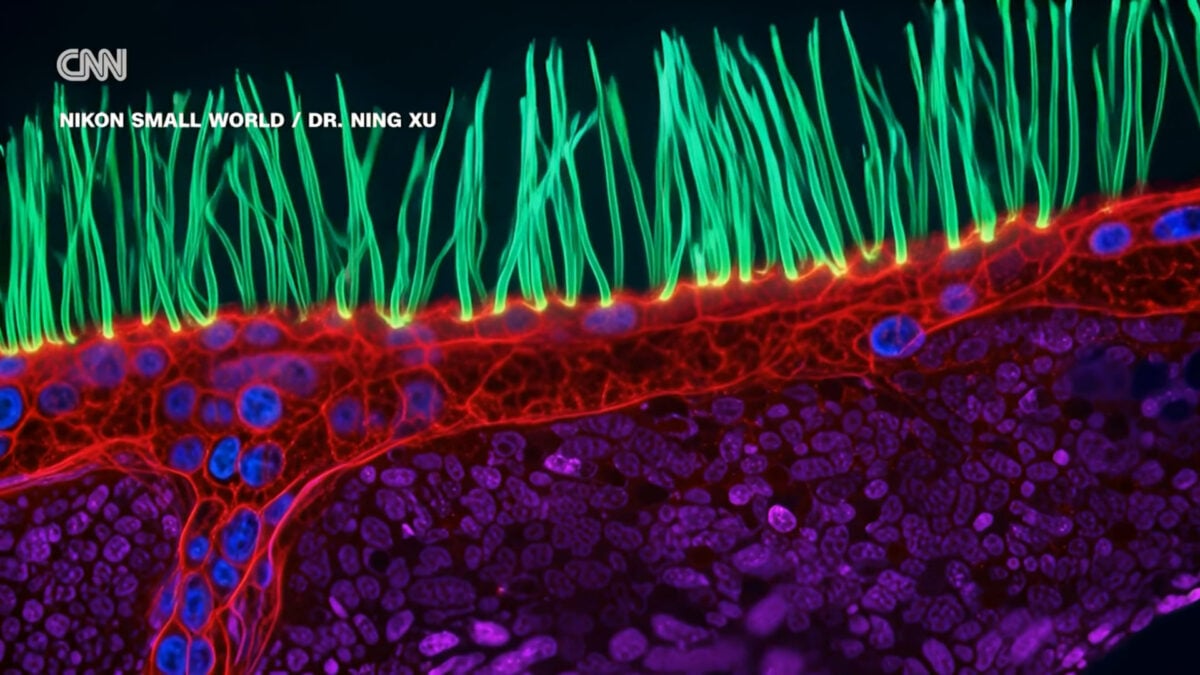
Nikon recently announced that it is re-reviewing the winning entry to its 16th annual Small World in Motion competition after the contest’s top video was found to contain AI-generated structures that have no basis in real biology. The winner, Ning Xu, an optical engineer at the National University of Singapore, submitted a time-lapse video showing cilia beating in lung tissue samples from a child with primary ciliary dyskinesia, a chronic respiratory condition.
The video itself was visually striking. Beneath the cilia, faint red, blue, and purple nodules pulsed and drifted — structures that, it turns out, do not exist in the sub-epithelial layer of human lung tissue. The contest was announced in mid-September. It took roughly a week for scientists to publicly dismantle it.
The Biologists Who Caught It
The takedown was led not by statisticians or computer scientists, but by bioengineers and developmental biologists who recognized that the structures shown were biologically impossible. Edward Phelps, a bioengineering researcher at the University of Florida, wrote on LinkedIn that the purple features resembled mitochondria, but “such a sub-epithelial structure composed of extracellular mitochondria of the same size as cell nuclei does not occur in biology.” He added that the blue nodules looked like nuclei but behaved like nothing he had ever seen, and had no theory for what the red structures were supposed to represent.
Ian Donovan, a PhD student at UT Southwestern Medical Center, raised a separate red flag: the video carried a SynthID watermark, a detection tag pioneered by Google DeepMind that is embedded directly into AI-generated media. SynthID watermarks are one of the few reliable technical markers that can confirm whether an image originated from an AI system. Their presence in a science competition entry should have been disqualifying on its face — or at minimum, a trigger for immediate scrutiny.
What the Rules Actually Say
Patrick Hickey, who placed fifth in the contest, told the BBC that the competition has explicit rules against using generative AI to produce content, and that entries must be captured under a microscope. The 2010 imaging guidelines that permit colorization and staining disclosures were written before generative AI existed, meaning they do not address the question of whether a neural network can fabricate structures that appear plausible without being real.
Xu’s own statements, reported by Nature, walk a narrow line. He says the original microscopy footage of the cilia is genuine. He says an unsupervised neural network was used in post-processing to enhance contrast and visualize features in the grayscale data — but that his team did not intend to make anatomical claims about what the colored structures below the cilia represent. Nikon’s press update acknowledged the neural-network processing but framed it as a visualization tool, not a fabrication engine. The distinction matters, and the jury is still out on whether it holds up.
The Vetting Gap
Here is what the episode exposes: the contest had no formal peer review before the video was awarded. Entries are judged, but the judging panel does not appear to have included independent specialists who would have recognized the biological impossibilities in the image. The entire correction came from unsolicited social-media commentary by working scientists. That is not a robust quality-control system for anything that claims scientific credibility.
Contests like Small World in Motion sit at an uncomfortable intersection. They celebrate the aesthetic power of microscopy, which often involves heavy post-processing, colorization, and interpretive rendering. They also attract a wide audience that may conflate artistic enhancement with empirical evidence. When AI can generate structures that look like real organelles, the line between honest visualization and outright hallucination becomes thinner — and the people most likely to spot the difference are not contestants, not judges, and not the contest organizers. They are people like Phelps and Donovan, scrolling through LinkedIn on a Tuesday morning.
Why It Matters Beyond a Prize
The immediate harm here is limited. No paper was published. No grant was awarded. But the precedent is dangerous. If an AI-hallucinated video can win a contest sponsored by one of the world’s largest optics companies, the same model could produce fabricated microscopy images for a journal article, a conference poster, or a textbook — especially if the processing pipeline is described in vague terms like “unsupervised neural-network method” rather than with the specificity required for reproducibility.
Melanie White, a developmental biologist at the University of Queensland, told Nature that scientific images are data, and that trust in microscopy depends on the assumption that what researchers see is grounded in actual measurement. Andrew Moore, a former judge on the contest, compared Xu’s video to old photographs restored with AI: visually impressive, but unsettling when you realize you are not looking at what was really there.
What Changes Now
Nikon has said Xu is cooperating and has provided detailed documentation of his equipment and methods. Whether that documentation will survive closer inspection is an open question. The contest’s organizing team has not issued a public statement about revoking the award or revising its rules. That silence, in itself, is a signal: the organization that built the platform has little incentive to admit its vetting process failed, and the pressure to move on may outweigh the pressure to dig deeper.
Several concrete changes would help. First, all entries should be required to disclose any AI-assisted processing, with the scope and nature of that processing described in detail. Second, the contest should establish an independent review panel with domain expertise for each category, so that entries are evaluated by people who can spot biological impossibilities. Third, the guidelines that currently permit colorization and enhancement should be updated to address the generative-AI era explicitly — not just the interpretive kind.
The Small World in Motion contest has long celebrated the beauty of light microscopy. Beauty is not the enemy of science. But when AI can manufacture beauty from noise, the cost of mistaking the two falls on everyone who trusts what they see through a lens.