Alibaba's AI chip bet exposes the real cost of US export controls
Alibaba's homegrown AI chip and tease of a 10-trillion-parameter model signal China's accelerating self-reliance push—and a widening gap in the global AI race that export controls may have widened rather than narrowed.
The chip that Washington didn’t want to see
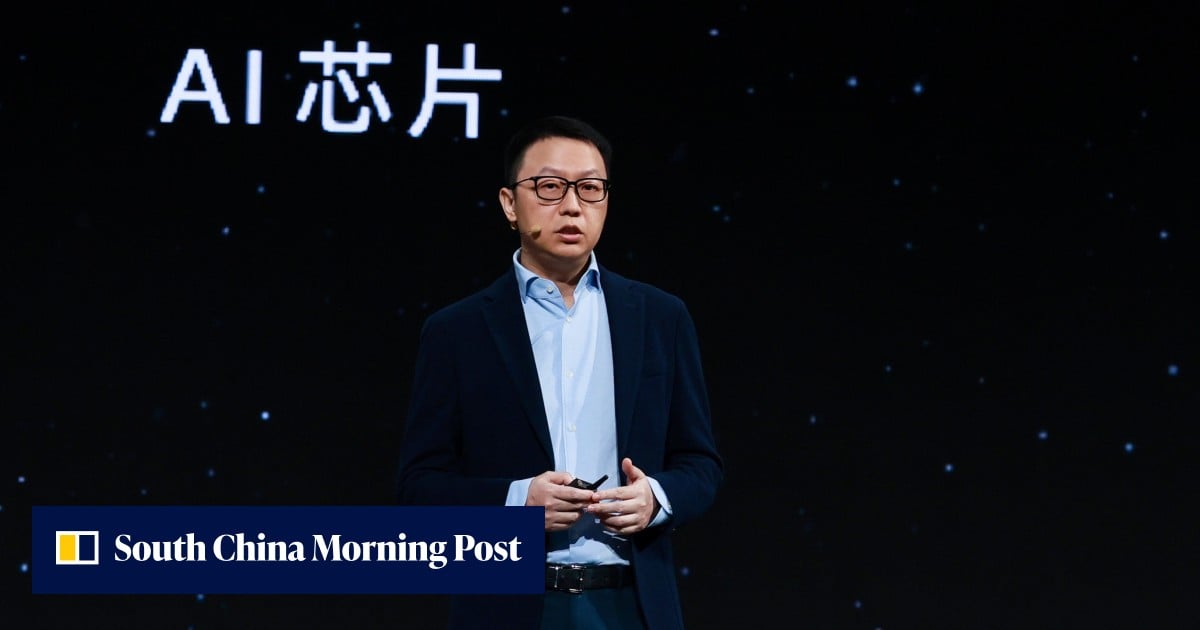
Alibaba’s announcement at its Apsara Conference in Hangzhou carries more weight than a single product launch. It is a statement of intent from China’s largest tech company: the era of waiting for American permission to build world-class AI infrastructure is over.
The company unveiled what it called China’s most powerful AI chip and hinted at plans to train a model with up to 10 trillion parameters. Both moves target the same question that has haunted Beijing since Washington imposed export restrictions on advanced semiconductor sales: can China build AI on its own terms?
Joe Tsai, Alibaba’s group chairman, did not mince words. “Alibaba is firmly investing in building full-stack AI … to let AI move from a technological breakthrough to value creation,” he said during the opening of the three-day event.
Full-stack. That word choice is deliberate. It signals a rejection of the fragmented approach that American controls effectively forced on Chinese companies—buy what you can, substitute what you cannot, hope the gaps close before the competition moves further ahead.
The numbers behind the threat
The scale Alibaba is targeting is staggering. Its current flagship model, Qwen 3.8-Max, sits at 2.4 trillion parameters and ranks as the second-highest-scoring Chinese system on the Artificial Analysis Intelligence Index. The proposed Qwen 5 model would be four times larger.
For context, Moonshot AI’s Kimi K3—currently China’s largest open-weight model—boasts 2.8 trillion parameters. Alibaba is planning to leapfrog that by a wide margin.
To train a 10-trillion-parameter model, you do not need just chips. You need a cloud infrastructure that can sustain the training workloads for weeks or months. Here too Alibaba is betting big: CEO Eddie Wu Yongming outlined a plan to scale Alibaba Cloud’s global data-centre capacity to more than 20 gigawatts by 2032.
Twenty gigawatts. That is roughly the electrical output of a medium-sized nuclear power plant, dedicated entirely to AI training and inference. No Chinese company has anything close to that capacity today. But the ambition itself matters. It tells international investors, developers, and governments that Alibaba sees itself as the backbone of China’s AI stack—not just another app layer built on top of somebody else’s hardware.
What export controls actually did
The conventional wisdom in Washington was that cutting off China’s access to advanced chips would slow its AI progress. The evidence so far suggests the opposite effect is stronger: it is accelerating a domestic substitution cycle that would have happened anyway, only more slowly and under different terms.
Before the restrictions, Chinese companies could have purchased HBM-equipped GPUs from American suppliers and integrated them into their existing supply chains. That option is now closed. The result is a captive market for Chinese chip designers and a funding stream—both direct and indirect—that would not exist at this scale otherwise.
Alibaba’s move is the clearest signal yet. By committing to full-stack development, the company is no longer trying to patch around the restrictions. It is building a parallel architecture that assumes American hardware will remain unavailable indefinitely.
That changes the calculus for everyone. For OpenAI, Google DeepMind, and Anthropic, the question is no longer whether they lead the frontier but whether the Chinese frontier converges on a different architectural path—one optimized for domestically produced chips rather than NVIDIA’s CUDA ecosystem. That path may eventually underperform on raw benchmarks. It may also prove more resilient to geopolitical disruption, which is a different kind of advantage entirely.
Who wins, who loses
Alibaba wins if it executes. The company already has the capital, the developer base, and the cloud infrastructure to make this bet. A 10-trillion-parameter model trained on homegrown silicon would be the most significant demonstration of Chinese AI self-sufficiency to date.
American chipmakers lose the Chinese market entirely. That is not new—NVIDIA and AMD have already accepted the erosion. What may be newer is the speed at which Alibaba and other Chinese firms are closing the performance gap. Even if they never match the most advanced American chips, they need only reach a threshold where Chinese AI systems are competitive enough to serve the world’s second-largest economy and influence emerging markets.
The global AI community loses a shared stack. The CUDA ecosystem has been the de facto standard for frontier model development. A successful Chinese full-stack alternative fragments that standard, potentially creating two divergent AI development tracks with different tooling, different optimization strategies, and different priorities.
Chinese developers and researchers gain something unexpected: incentive. When your hardware constraints are visible and unavoidable, you design differently. You optimize for efficiency rather than brute force. Some of those optimizations may prove valuable even outside China.
What happens next
The most important detail in Alibaba’s announcement was not the chip itself but the timeline. Twenty-gigawatt capacity by 2032. Qwen 5 still in development. These are multi-year commitments, not quarterly surprises. The real test will come in 2026 and 2027, when we should see whether the first wave of models trained on Alibaba’s domestic hardware can credibly compete with frontier systems built on American chips.
If they cannot, the self-sufficiency project stalls. If they can, the assumptions that underpin Western export controls unravel completely.
Either outcome reshapes the global AI race. The only outcome that does not is staying quiet about what this announcement means.
Alibaba is not shouting. It is laying out a blueprint. The question for the rest of the world is whether it is already too late to change the trajectory.