AMDs RDNA 5 Gamble: Can It Finally Break NVIDIAs High-End Stranglehold?
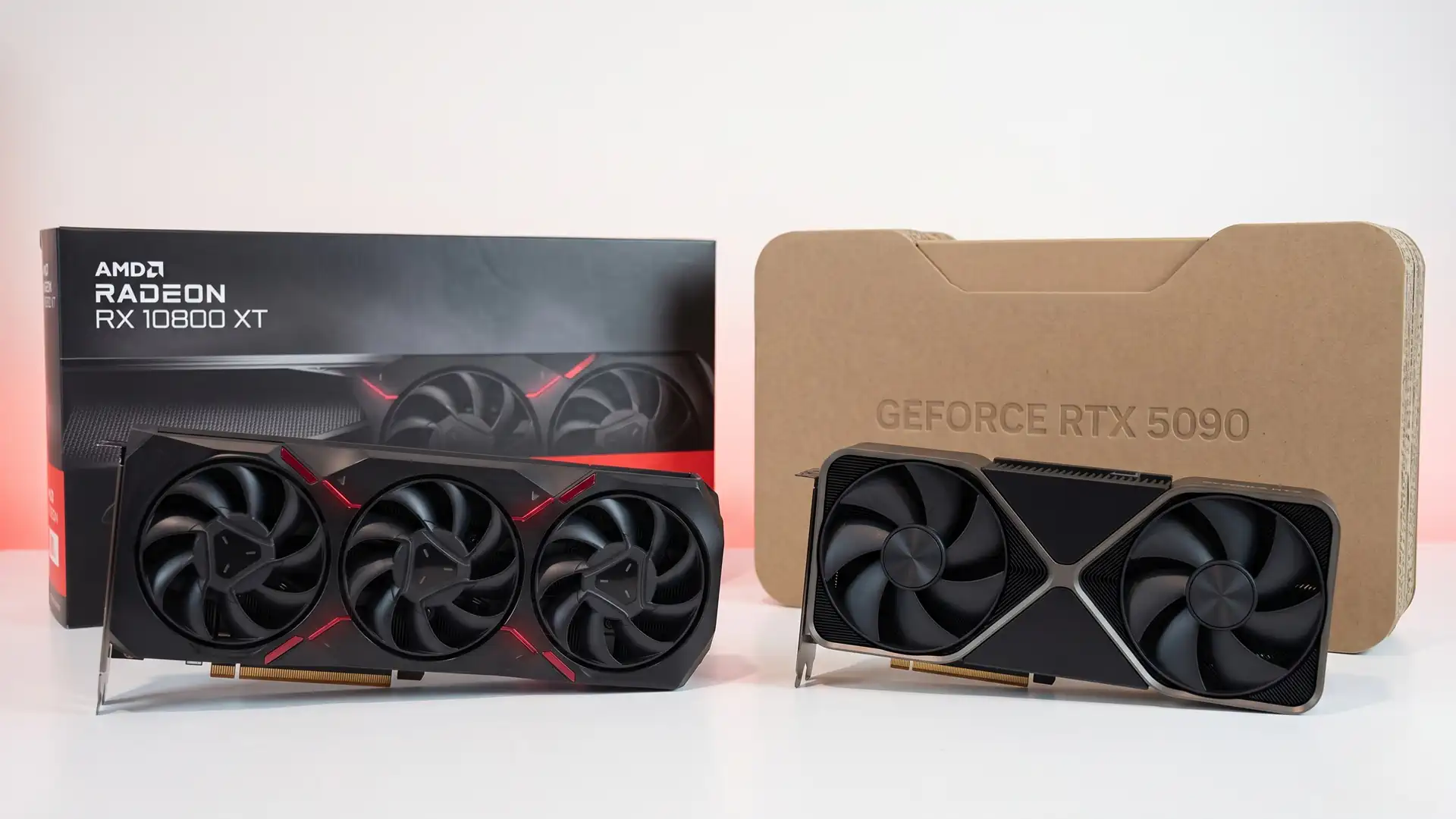
AMD claims its RDNA 5 architecture, with up to 200 compute units and a chiplet design, could outperform NVIDIA RTX 5090 in real gaming. But whether this translates to market share gains depends on execution, pricing, and whether NVIDIA addresses its scheduling weaknesses.
The Scheduler Gap
NVIDIA’s Blackwell architecture — the foundation of the RTX 5090 — carries a structural weakness that AMD’s RDNA 5 is explicitly designed to exploit: the absence of a hardware scheduler. In environments where high-specification games push realistic graphics settings to their limits, this omission degrades overall computing efficiency on NVIDIA’s flagship solution. The claim comes from analysts covering AMD for Moore’s Law Is Dead, and it frames the RDNA 5 launch not as incremental improvement but as a targeted strike at NVIDIA’s most expensive product.
The scheduler issue is not abstract. When modern titles like Alan Wake 2, Avatar: Frontiers of Pandora, and the upcoming Unreal Engine 5 showcases strain the GPU, workloads queue unevenly across streaming multiprocessors. Without a hardware-level dispatcher to balance the load dynamically, NVIDIA relies on driver-level software patches to mitigate stutters and frame-time inconsistencies. These patches have improved over successive generations, but the fundamental architectural gap remains. AMD’s RDNA 5 architecture incorporates a dedicated hardware scheduler directly into the compute block design, allowing workloads to be dispatched and balanced at the silicon level rather than deferred to software layers that introduce latency. The result should be more consistent frame pacing, especially inCPU-bound scenarios where the GPU waits for the processor to prepare draw calls.
The numbers support the ambition. The Radeon RX 10800 XT, built on RDNA 5, reportedly supports up to 200 compute units, a 512-bit memory bus, and up to 48GB of VRAM capacity. For comparison, NVIDIA’s RTX 5090 uses the GB202 chip with 21,760 CUDA cores, 512-bit bus, 32GB of GDDR7 memory, and 1,792 GB/s of bandwidth — at a recommended price of $1,999 and a 575W power envelope.
AMD appears willing to accept slightly lower headline specifications for its flagship if architectural efficiency delivers better real-world results. A variant with 24GB VRAM and a 384-bit bus could still outperform the RTX 5090 in gaming workloads through optimized architecture and higher compute unit density. That’s the argument, at least. The implicit bet is that raw core counts matter less than how efficiently those cores receive and execute instructions. If the scheduler advantage translates into even a five to eight percent performance uplift in real gaming scenarios, AMD has a credible case — particularly at resolutions where VRAM capacity and memory bandwidth become bottlenecks.
Chiplet Strategy as Cost Leverage
Perhaps more important than raw specs is AMD’s approach to manufacturing. The company plans to use an integrated chiplet design that links discrete graphics processors with mobile APUs and chips destined for Xbox consoles. This creates supply chain flexibility that NVIDIA doesn’t currently match — allowing AMD to optimize production costs across multiple product lines simultaneously.
The chiplet approach is not new to AMD — the company pioneered it successfully with Ryzen desktop processors and the MI300 data center accelerators. But applying that philosophy to a high-end GPU represents a significant manufacturing gamble. Discrete chiplets introduce interconnect overhead through the UCIe or AMD’s proprietary Infinity Fabric links, and any latency or bandwidth penalty from those connections could erode the performance gains from the scheduler improvements. If AMD can keep the interconnect efficient enough, however, the yield advantages are substantial. A defective region on a large monolithic die renders the entire chip unusable. With chiplets, only the affected tile needs to be discarded, and the rest of the package can still function. This dramatically improves overall yield rates, which matters enormously when producing at the scale and margin pressure that TSMC’s current node economics demand.
TSMC’s rising silicon wafer production costs are pressuring the entire industry. The transition to more advanced nodes, increased demand from AI accelerator manufacturers, and geopolitical supply chain disruptions have all contributed to a competitive foundry environment. AMD’s chiplet architecture offers a way to maintain margins while scaling production. The strategy is pragmatic: if one component faces yield issues, others can compensate. It’s also why AMD expects the mid-range RX 10600 to land between $650 and $750, with the flagship RX 10800 XT priced between $2,000 and $2,500.
This pricing puts AMD directly in NVIDIA’s crosshairs. The RX 10800 XT would undercut the RTX 5090 if it lands at the lower end of its predicted range — a bold move if AMD believes its architectural advantages can justify competing at NVIDIA’s door. More significantly, the mid-range positioning creates a second-order competitive effect. A competitive RX 10600 forces NVIDIA to defend not just its flagship but its entire product stack, potentially diluting resources that would otherwise focus on countering AMD’s high-end push.
What This Means for NVIDIA
The RTX 5090 launched with a 575W TDP and a $1,999 price tag — positioning it as the ultimate high-end gaming GPU. But power consumption and pricing alone don’t guarantee market dominance. If RDNA 5 delivers the performance AMD promises while addressing the scheduler inefficiency that plagues Blackwell, the 5090’s value proposition weakens considerably. The 575W power envelope alone has drawn criticism from reviewers and enthusiasts who note that the energy-per-frame efficiency lag compared to previous-generation designs undermines the performance-per-dollar calculation. Consumers paying premium prices for a GPU that draws nearly as much power as a small space heater are increasingly sensitive to alternatives that deliver comparable or better performance at lower power.
NVIDIA’s response will likely involve software optimizations and driver updates targeting the scheduler gap. The company has historically relied on software to compensate for hardware limitations, particularly in AI and compute workloads. The DLSS and Reflex technologies demonstrate NVIDIA’s willingness to augment raw hardware with intelligent software layers. Gaming is a different arena, though — and one where AMD has been closing the gap for years. Software-based fixes for hardware architectural deficiencies have diminishing returns, especially when the competition is designing around those deficiencies from the ground up.
The timing raises questions. RDNA 5 discussions are moving through Korean tech outlets ahead of typical English-language coverage, suggesting AMD may be testing market positioning before NVIDIA’s next earnings report. Whether this is strategic early messaging or genuine engineering confidence remains unclear. What is clear is that AMD is no longer playing defense. The company has spent four generations attempting to close the performance gap with NVIDIA’s flagship offerings, and the RDNA 5 positioning suggests a shift from catching up to competing on equal or superior terms in specific workloads.
Second-Order Effects on the Market
Beyond the direct GPU comparison, RDNA 5’s arrival could reshape broader market dynamics. The presence of a credible high-end alternative to NVIDIA’s offering pressures the entire segment. Mid-range and enthusiast GPUs that currently sit in NVIDIA’s shadow may see accelerated feature adoption as both companies race to differentiate. Ray tracing performance, mesh shading support, and memory management techniques that were once NVIDIA-exclusive features could become standard across both ecosystems within a generation or two.
The power efficiency narrative also carries weight beyond individual purchase decisions. Data centers, cloud gaming providers, and esports organizations that operate at scale feel the impact of every watt. If AMD delivers gaming-class performance with better performance-per-watt ratios, it opens pathways for the technology to bleed into adjacent markets where NVIDIA currently enjoys near-total dominance. Even modest inroads in these segments would represent significant revenue diversification for AMD beyond the consumer graphics card business.
Additionally, the chiplet strategy’s success or failure will influence AMD’s broader product roadmap. If the approach proves viable for high-end GPUs, it could accelerate adoption across the company’s data center and consumer processor lines, potentially compressing development cycles and reducing per-unit costs industry-wide. Conversely, if interconnect overhead proves more problematic than anticipated, it could constrain AMD’s ability to scale performance in future architectures and cede ground to monolithic designs.
Who Wins and Loses
Consumers win if AMD delivers on its promises. A competitive high-end GPU market benefits everyone — lower prices, faster innovation, and alternatives to NVIDIA’s dominance. The mid-range RX 6000 series starting around $650 could pressure NVIDIA’s 40-series offerings, forcing price adjustments across the board. Enthusiasts who have long lamented the lack of meaningful competition at the top end may finally see that dynamic reverse, which historically drives the kind of generational leaps that benefit the entire ecosystem.
NVIDIA loses market share in the high-end segment if the RX 10800 XT outperforms the RTX 5090 in real gaming scenarios. The company’s AI and data center businesses remain strong, but gaming is where brand loyalty and marketing spend translate into sales volume. A perceived decline in flagship gaming leadership could gradually erode the halo effect that sustains NVIDIA’s premium pricing across its entire product line. The company cannot indefinitely rely on AI dominance to offset weakness in the consumer graphics market.
AMD wins if execution matches ambition. The chiplet design and scheduler improvements are theoretically sound. Manufacturing execution, driver quality, and market reception will determine whether this analysis becomes reality or remains speculation. The company has faced credibility challenges in previous generations when announced specifications did not fully materialize in real-world performance. Delivering on RDNA 5’s promises requires not just architectural innovation but the operational discipline to produce stable drivers and consistent quality at scale — areas where AMD has improved significantly but where the stakes are higher than ever.
The Verdict Hangs in the Balance
The GPU market stands at an inflection point. RDNA 5 could represent the beginning of AMD’s sustained challenge to NVIDIA’s high-end dominance — or it could fade into another generation of promising-but-unrealized specifications. The scheduler advantage is real in theory, the chiplet strategy offers genuine manufacturing leverage, and the pricing positions AMD to apply pressure at every level of the market. But theory and strategy mean little without execution.
The coming months will tell whether AMD’s gambit pays off. Enthusiasts and analysts alike will be watching for independent benchmarks, driver stability reports, and — perhaps most critically — actual retail pricing and availability. If the RX 10800 XT ships at or below the projected $2,000 range and delivers on the scheduler and efficiency claims, NVIDIA’s high-end stranglehold may finally be cracking. If not, the status quo persists another generation, and AMD’s most ambitious architectural pivot since RDNA 2 becomes another footnote in a long history of nearly-there moments.