AMD RX 9070 XT Benchmarks Expose the PS5 Pro's Hard Ceiling
AMD's RX 9070 XT is benchmarking 50–80% faster than the PS5 Pro in both rasterization and ray tracing, a gap that stems from raw power limits, not software. As Korean GPU prices surge toward 10 million won, the console's pricing advantage may finally be closing.
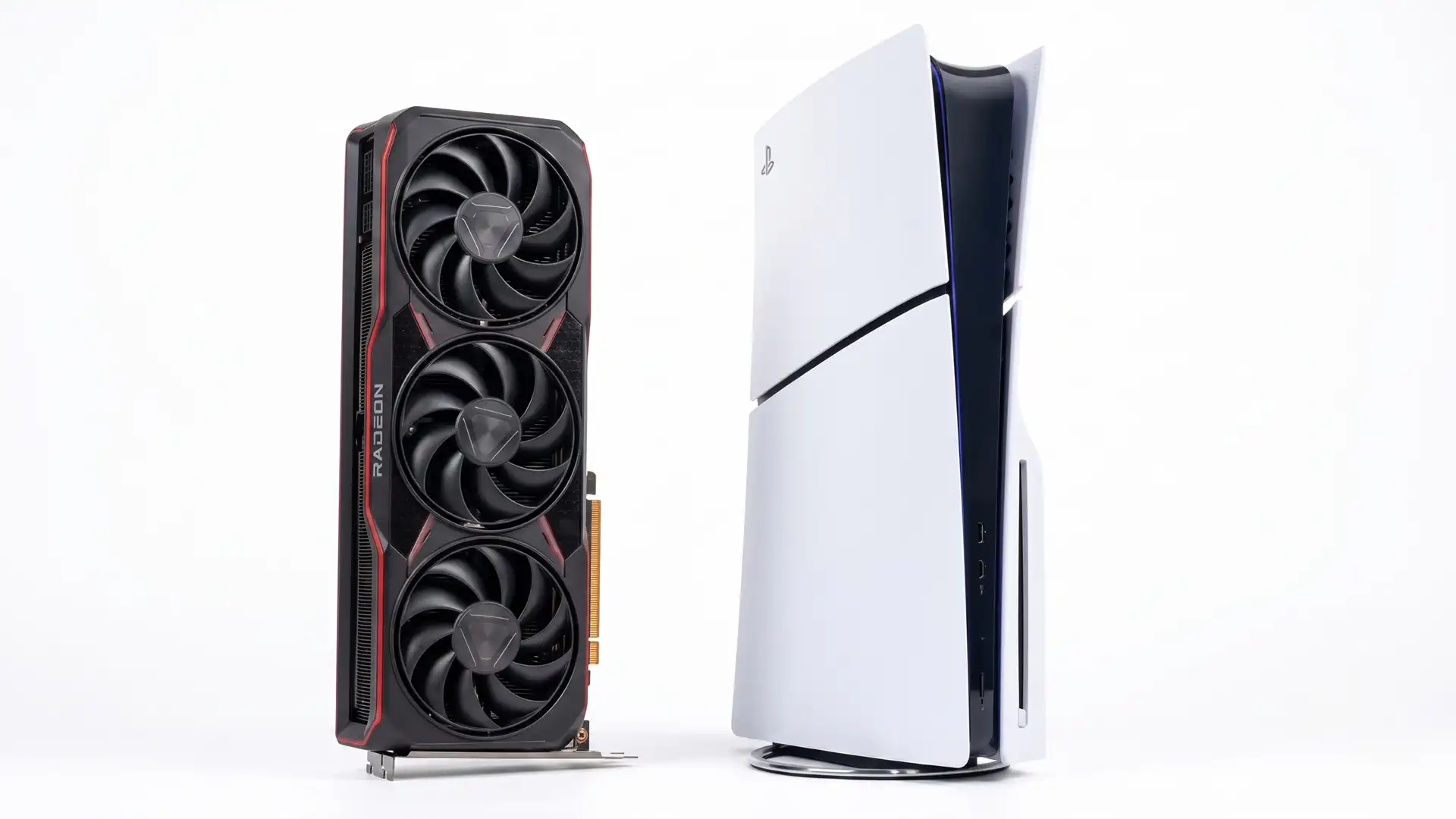
The gap isn’t closing. It’s yawning.
AMD is claiming the Radeon RX 9070 XT delivers up to 80% better rasterization and ray-tracing performance than the PlayStation 5 Pro. That number, whether you accept it at face value or temper it with healthy skepticism, tells you something important about where the PC and console camps sit relative to each other right now—and where they’re headed.
This isn’t a marginal lead. It’s the difference between two different classes of hardware meeting in the same generational conversation. And the reason for the gap is bluntly physical: watts.
A 232-watt ceiling
The PS5 Pro’s custom AMD SoC runs inside a strict 232-watt envelope for the entire console—including CPU, GPU, memory, and all the supporting silicon. Heat has to be shared. Clocks have to be managed. The graphics cores inside that chip can only go so far before Sony’s thermal and acoustic targets get compromised.
The RX 9070 XT, by contrast, draws well over 300 watts and runs at higher frequencies with no requirement to share power with a CPU or system RAM. It also benefits from Zen 4-era desktop architecture refinements that simply don’t exist in a sealed console board. The result, according to user evaluations and the technical specifications cited by the discussion, is a desktop card that dominates both pure rasterization and complex ray-tracing workloads by a comfortable 50–80% margin over the console chip.
For context, the community had already flagged that the PS5 Pro’s integrated GPU sits somewhere between an RX 7700 XT and an RX 6800 in raw raster performance—remarkably close for a console iGPU, but not in the same weight class as a current-generation flagship desktop card.
Who wins, who loses
The winner here is anyone who already owns a mid-range or high-end PC from the past couple of years and has been sitting on the fence about upgrading. The RX 9070 XT offers a verifiable, sizeable leap that makes the case for a desktop build substantially stronger than it did during the PS5 Pro launch window.
The loser is more complicated. It’s the console buyer who expects their $700 machine to stay competitive for five or six years. Consoles have always won on price-per-frame because the hardware ships subsidized and locked to a fixed target. But when a $400–$500 desktop GPU can deliver double the performance of the console’s silicon—and the next console generation costs more, not less—that subsidy math starts to look thinner.
The PS6 price problem
What makes this particularly interesting for markets outside Japan and North America is what happens next. Forum participants previewing the PlayStation 6 noted thatSony’s next console will likely carry “considerable computational power”—but by the time it ships, desktop GPUs will have moved significantly further ahead. More importantly, the cost pressure coming from fast memory and rising silicon wafer prices could push the PS6’s retail price into the $1,100–$1,500 range, according to user projections cited in the source discussion.
If that price band materializes, the console’s traditional value advantage collapses in several key markets. In South Korea, where GPU prices have already surged toward the 10 million won mark on some models, a $1,500 console becomes a harder sell against a used or refurbed desktop rig that may already exceed its gaming performance.
The timing matters. Console cycles are long—seven to eight years—and buyers commit early. If the PS6 launches at $1,300 or higher, many consumers will calculate that the same money buys a desktop system with headroom for three or four years of new releases without the compromise of a locked frame target.
What English-language readers miss
Most Western coverage of console-vs-PC debates focuses on exclusive titles or game pass economics. The hardware performance story gets buried under narrative spin. But the Korean gaming hardware community is tracking these numbers with a precision that reflects a market where PC gaming dominates and console ownership is a choice, not a default.
The RX 9070 XT vs PS5 Pro comparison isn’t just a benchmark flex. It’s a signal that the performance floor for consoles is rising—because the silicon they use is getting more expensive and more constrained by thermal envelopes—while the desktop ceiling is rising faster. The gap between what a console can do at launch and what a PC can do today is measurable, real, and growing.
What happens next
Look for three trends over the next 12 months:
First, Sony and Microsoft will likely lean harder into AI-assisted upscaling and software tricks to narrow the visible gap, since the raw silicon gap won’t close quickly. FSR 4.0 and whatever AMD’s next-gen counterpart carries will be critical.
Second, console prices will stay elevated. The wafer and memory cost pressure isn’t going away, and the shift to advanced node processes for next-gen chips will only deepen it. Expect the $1,000+ console to become normal, not exceptional.
Third, the enthusiast PC market in Asia-Pacific will see increased demand for mid-range cards like the RX 9070 XT. Buyers who can’t justify a top-tier card yet will find this tier hitting a sweet spot—well above console performance, below the stratospheric pricing of flagship parts.
The console business model hasn’t died. But the assumption that it will always offer dramatically better price-to-performance than PC gaming? That’s the thing that’s starting to look obsolete.