Why More Cores Won't Speed Up Your Next AI Chip
Adding CPU cores doesn't mean faster chips. A 1967 rule from IBM and a 2009 visualization called the Roofline Model explain exactly where multicore computing hits its wall — and why it matters for every AI accelerator being shipped today.
The core-count fallacy
In the mid-2000s, chip designers hit a ceiling. Pushing single-core clock speeds higher wasn’t delivering proportional performance gains — thermal density, power budgets, and leakage currents made another gigahertz nearly impossible without redesigning the entire package. So the industry pivoted. Instead of one fast core, pack many slower ones onto the same silicon die. Dual-core became quad-core, then octa-core, and servers marched toward dozens of cores per socket.
It was the obvious solution. It was also not simple enough to solve the problem.
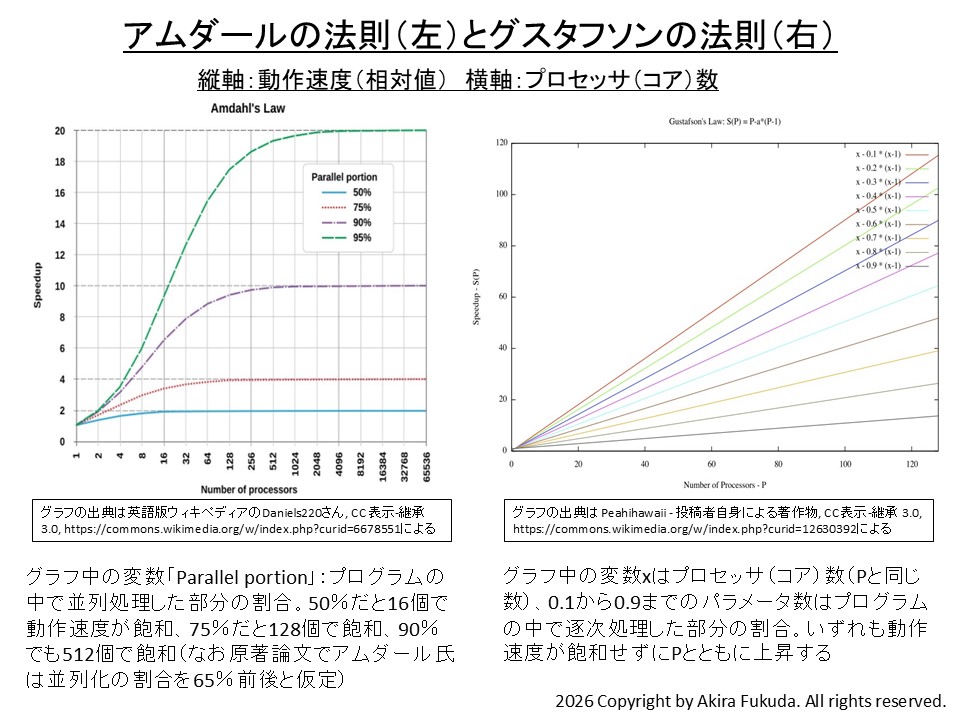
The resistance came from a law proposed by IBM researcher Gene M. Amdahl in 1967, long before consumer chips went multicore. His paper, titled “Validity of the Single Processor Approach to Achieving Large Scale Computing Capabilities,” argued forcefully against multiprocessing. Not because parallel execution was meaningless — but because the fraction of a program that cannot be parallelized acts as a hard throttle on overall speedup. If 35 percent of any workload runs sequentially, no matter how many cores you add, the best-case improvement caps at roughly three times. In practice, the ceiling is lower.
Amdahl himself framed this as a warning against throwing processors at the problem. He was right. His reasoning was later refined, reshaped, and arguably corrected — but the core mathematical constraint never went away.
Gustafson’s rebuttal, and why it didn’t rescue CPUs
In 1988, John L. Gustafson of Sandia National Laboratories published “Reevaluating Amdahl’s Law” in Communications of the ACM. His argument was elegant and practical. Amdahl assumed a fixed problem size — run the same program on one core or one hundred, measure the speedup. But real users don’t do that. When you give them more cores, they run bigger problems, longer simulations, finer models. Gustafson showed that under that assumption, adding processors scales almost linearly with core count.
The two laws aren’t really contradictory. They describe different assumptions about what happens when you change hardware. Amdahl fixes the workload and varies the machine. Gustafson fixes the machine type and lets the workload grow.
Intel understood this distinction early. By 2018, Justin R. Rattner, then Intel’s chief technology officer, told peers that future applications would naturally shift toward larger problem spaces, making Amdahl’s limitation less binding over time. The company had already bet heavily on core proliferation, shipping Skylake-SP server chips with 28 monolithic cores at ISSCC in 2018.
AMD, notably, was far more cautious about multi-core expansion during the same period. Both philosophies coexisted for years. And then something unexpected happened: the market bifurcated along the very lines Gustafson and Amdahl described.
Where the two laws live today
Roughly speaking, conventional CPUs now operate closer to Amdahl’s world — fewer cores, complex out-of-order execution, heavy reliance on sequential performance per core. GPUs and tensor accelerators live in Gustafson’s world — tens of thousands of simpler cores designed for massively parallel workloads where the problem itself grows with the hardware.
This split isn’t accidental. It reflects an industry-level realization that you cannot general-purpose your way out of a fundamental bottleneck. Some workloads are inherently memory-limited. Others are computationally bounded. Designing for both simultaneously means designing well for neither.
The Roofline Model makes the invisible visible
If Amdahl and Gustafson debated theory, the Roofline Model gave engineers a scoreboard. Published in April 2009 by Stephen Williams, Andrew Waterman, and David Patterson at Lawrence Berkeley National Laboratory and UC Berkeley, the model reduced all of multicore complexity down to two numbers: peak operational performance and memory bandwidth.
The trick is the horizontal axis — operational intensity, measured in operations per byte of data moved. An algorithm that does massive computation on each fetched value sits far to the right. An algorithm that spends most of its time shuffling data between DRAM and cache sits far to the left.
Plot the ratio of peak FLOPS to memory bandwidth on that axis, and you get a ridge point. To the left of that point, memory bandwidth caps your performance — you are memory-bound, idle cycles pile up waiting for data. To the right, compute throughput is your limit — your arithmetic units are fully saturated. The shape resembles a roof, hence the name.
The model’s power is in its simplicity. Four chips tested in the original paper — Intel’s Clovertown Xeon, AMD’s Barcelona Opteron, Sun’s Niagara 2 UltraSPARC T2+, and IBM’s Cell Broadband Engine — produced identical predictions using only publicly available specs. The math worked regardless of architecture, process node, or marketing claims.
Why this matters for AI chips right now
The Roofline Model was extended throughout the 2010s to cover GPU architectures, hierarchical caches, and eventually deep learning accelerators. Those extensions landed at exactly the moment generative AI created a new class of benchmark problems — large language model training and inference that are brutally sensitive to both memory bandwidth and arithmetic precision.
NVIDIA’s H100, AMD’s MI300X, and Google’s TPUs can all be analyzed through the same lens. Their operational intensity profiles determine whether they are bottlenecked by HBM bandwidth or by matrix multiply throughput. For attention-heavy inference workloads, bandwidth dominates. For pre-training at scale, compute dominates. The same chip behaves differently depending on the workload’s position relative to the roofline’s ridge point.
What Amdahl’s original insight predicts, and what Gustafson qualified, is playing out across every major AI chip roadmap. Adding more tensor cores helps only until the memory subsystem cannot feed them. Doubling bandwidth helps only until the arithmetic units saturate. There is no free lunch, and the Roofline Model draws the boundary precisely.
Japanese semiconductor analysts have been circling this reality for years, often framing it through the Amdahl-Gustafson tension. The observation is straightforward: Japan’s historical strengths in specialized embedded processors and memory-centric architectures aligned with Amdahl-style sequential optimization, while the global pivot toward parallelism demanded a different geometry entirely. That misalignment explains much of the competitive drift.
What comes next
The 2009 Roofline paper validated its model on chips that are now two decades old. Its predictions held, then aged gracefully. Extensions into cache-aware and GPU-specific variants proliferated after 2015. The logic carries directly into today’s landscape of heterogeneous computing, chiplet-based packaging, and domain-specific architectures.
More cores will not save you if your algorithms sit on the wrong side of the roofline. Better memory bandwidth will not救済 you if your arithmetic units are underutilized. The constraint is structural, not incremental. Any chip design that treats core count as the primary metric is repeating the same mistake Amdahl warned about in 1967 — confusing quantity of execution units with quality of utilization.
The race ahead is not about who packs the most transistors into a die. It is about whose memory hierarchy, interconnect topology, and workload mapping keep their hardware operating closest to the ridge point. That is the real contest, and the graph makes it visible.