Anthropic's $83 IPO Tests Whether AI Demand Is Real or Just Hype
Anthropic's $83 IPO pricing beats expectations and tops SpaceX's record — but AI stocks are already stumbling. What this opening tells us about whether enterprise demand matches the buzz.
The $83 Number That Could Define the AI Cycle
Anthropic set its IPO price at $83 per share — well above the initial guidance range of $70 to $78 — and raised roughly $81.3 billion by selling about 980 million shares. By every public metric, it is already the largest IPO in history, surpassing the Space Exploration Technologies Corp. listing earlier this year.
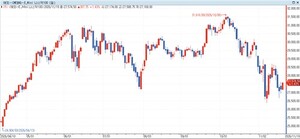
The immediate market response was predictable. The E-mini Nasdaq 100 futures climbed 1.44% to 27,577.75 in early Asia trading, while the S&P 500 futures rose 0.72%. Investors saw an AI-native company commanding a premium valuation and interpreted it as confirmation that capital still believes in the long arc of artificial intelligence.
But reading the futures movement as proof that the AI bull case is intact would be a mistake. The more useful signal sits in the stocks that are already struggling.
When the IPO Premium Meets a Bleeding Sector
The iShares AI Innovation and Tech Active ETF — which tracks a basket of AI-focused companies — has fallen roughly 11% since the start of the month. CoreWeave, the cloud infrastructure firm often described as the closest pure-play proxy for AI compute demand, is down about 13% over the same period. Nvidia, the company whose earnings power underwrites nearly every AI narrative, dropped 26% after CEO Jensen Huang stepped aside.
These moves do not exist in isolation from Anthropic’s upcoming debut. They reflect the same tension the IPO itself exposes: there is massive appetite to invest in AI vision, but far less certainty that those investments will convert into durable revenue streams.
Callie Cox, head of investment strategy at PlanCo, put it bluntly. She said investors need “a signal that Wall Street still believes in AI’s long-term potential” beyond the current elevated expectations. What she is describing is a credibility gap — not a lack of funding, but a lack of visible commercial proof that the funding is justified.
Pricing the Narrative vs. Pricing the Enterprise
An $83 IPO price above the expected range suggests strong institutional appetite among the book-run syndicate. That is valuable data for anyone tracking where capital is flowing. But it is also easy to confuse order-book strength with enterprise conviction.
Private-market fundraising rounds for AI startups routinely price at premiums well ahead of realized revenue. Those rounds lock in optimism before earnings discipline applies. By the time an IPO hits the public markets, the scrutiny shifts. Public investors care about margins, unit economics, customer concentration risk, and the pace at which generative-AI tooling moves from pilot to production budgets.
If Anthropic opens strongly on day one, the headline will be straightforward: AI demand is alive. If it cracks within weeks, the lesson will be equally stark — narrative momentum does not equal sustained enterprise purchasing power.
The broader market is already paying attention to this distinction. Korean and Japanese equity indices reacted to the Nasdaq futures move, but the longer answer lies in how major U.S. cloud providers and hyperscalers translate AI compute spend into contracted revenue. Until those financial statements show repeatable uptake, individual IPO outcomes will remain event-driven rather than structural.
Why Korea Matters Here
South Korea’s exposure to this episode runs deeper than sentiment tracking on Nasdaq futures. The country’s semiconductor supply chain — dominated by Samsung Electronics and SK Hynix — supplies high-bandwidth memory and advanced packaging that AI training clusters depend on. When AI capex forecasts shift, Korean electronics earnings estimates shift with them.
The recent pullback in Nvidia and CoreWeave has already rippled into regional expectations for semiconductor-cycle timing. An Anthropic price action that disappoints on listing could reinforce a risk-off posture toward AI-capex-sensitive names in Seoul and Tokyo. One that surprises to the upside tends to lift the entire halo around AI infrastructure names, even when their own fundamentals have not changed.
For Korean institutional portfolios, the practical takeaway is narrower than the macro soundbites suggest. Focus on who signs the long-term memory contracts and who carries the inventory risk, not just who announces the newest partnership.
The Bigger Warning in Plain Sight
Cox also cautioned against over-interpreting any single popular IPO as a market directional signal. Her point deserves weight here. Several competitive forces are compressing the margin available to new public AI entrants. Every publicly traded company now needs an AI strategy, which means limited venture capital is being bid up across a shrinking pool of differentiated pitches. In that environment, strong first-day pop becomes more common while follow-through sustains less often.
That dynamic does not make Anthropic a bad investment. It makes the IPO outcome a diagnostic tool — useful for observing where confidence lives right now, not for projecting certainty forward.
Meanwhile, U.S. Treasury yields edged higher across the curve: the 10-year moved up 0.8 basis points to 5.0780%, the 2-year gained 0.9 basis points to 4.8170%, and the 30-year rose 0.5 basis points to 5.4170%. The dollar index dipped negligibly by 0.01% to 103.773. None of that moves dramatically, but the direction matters. Higher yields tighten the discount rate against which all AI growth narratives must justify themselves.
Who Wins, Who Loses
Short-term winners in this setup tend to be the underwriters capturing record fees, the early-stage venture funds exiting onto a favorable window, and the hyperscale partners whose names appear in Anthropic’s filing. Short-term losers are the speculative AI capex positions priced for a smooth roll-out and the retail buyers arriving late to confirm that the next wave is already underway.
The slower-moving question — whether Anthropic’s revenue growth trajectory justifies the valuation over two to three years — has not yet been answered by the IPO mechanics alone. That judgment will come from subsequent quarterly earnings calls, customer disclosures, and competitive pricing pressure from other frontier-model vendors.
Until then, the $83 price tag is a snapshot, not a verdict.