Anthropic IPO Protests Reveal AI Boom's Deep Fault Lines
Anthropic's Nasdaq debut hit $111.50 — 34% above its opening price — before sellers pushed it back down. The day also saw Wall Street crater, anti-AI demonstrators gather outside, and major AI-linked stocks unravel worldwide. What does this triple signal mean?
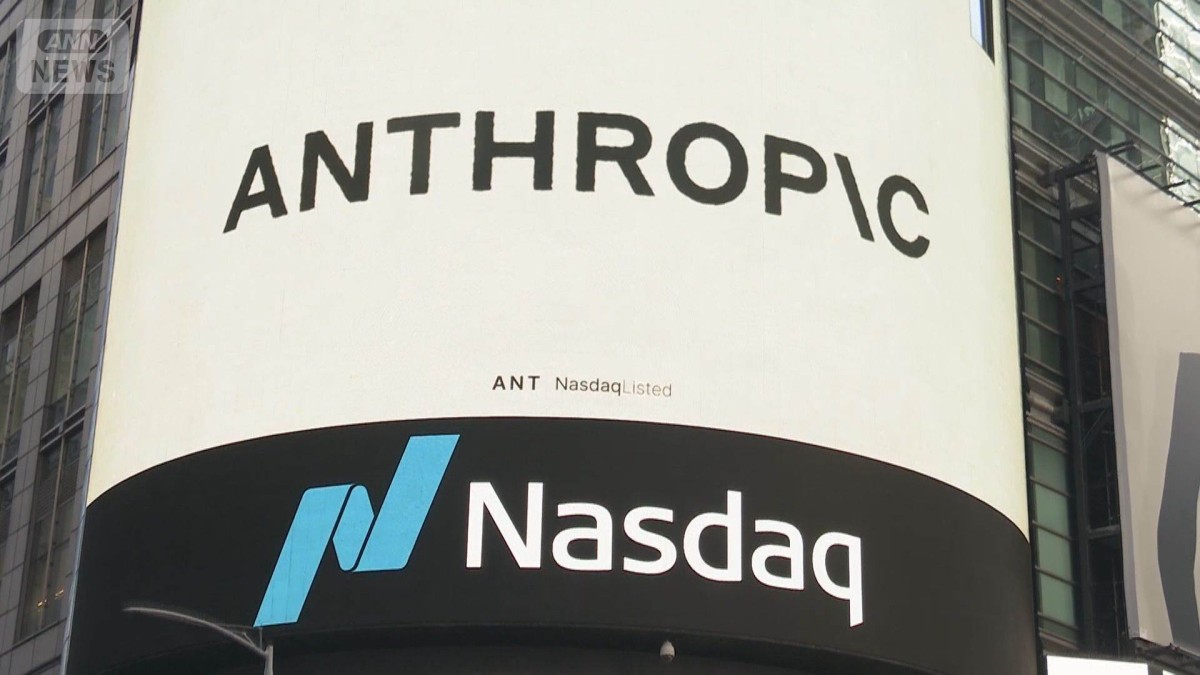
A Triple Signal From One Day
Anthropic opened at $111.50 on Nasdaq — 34% above its $83 public offering price — and briefly flashed a $2 trillion market capitalization, roughly ¥319 trillion. Then sellers took over and the stock retreated into the low $90s.
That was only the most visible part of a day that carried three separate signals firing at once.
Wall Street itself fell apart. The Dow Jones industrial average dropped more than 1,000 points at one stage, breaching the 50,000 level. The Nasdaq, heavily weighted toward technology, turned lower alongside it.
Outside the exchange, people gathered to protest. Demonstrators raised concerns that society would lose control of artificial intelligence, that the technology would be weaponized militarily, and that the water and energy demands of new data centers were imposing environmental costs the industry had not accounted for.
The three events — a star IPO stalling, a broad market selloff, and street-level opposition — were happening simultaneously by design, not coincidence. Taken together they mark the moment when the AI boom’s financial, social, and regulatory tensions started cracking open at the same time.
Why Anthropic’s Day Mattered Beyond the Ticker
This was the first time a major pure-play AI developer listed publicly in the United States. That alone made the day a reference point for every company that follows. But the significance goes further.
The offering sized up to roughly $81.3 billion — about ¥13 trillion — across nearly one billion shares. No recent tech listing has come close to those numbers. Investors were putting their money where the narrative had been loudest for years.
The fact that the shares spiked 34% at the open and then gave back most of those gains in a matter of hours said something honest about where institutional appetite actually sits right now.
Capital is still willing to pay a premium for AI exposure at the starting line. But it is far less certain about holding those positions when the novelty fades and the fundamentals come due.
The Bigger Market Was Selling Everything
The broader sell-off makes Anthropic’s stumble harder to blame on company-specific factors. This was not a case of one overvalued name getting corrected. It was a sector-wide repricing.
In Japan, Kioxia — the former Toshiba memory division now trading independently — fell roughly 80% from its mid-year peak, even as the company reported strong earnings driven directly by AI demand. The gap between solid results and falling valuations suggests investors are looking past the current cycle and pricing in structural doubt about whether the hardware build-out will keep pace with expectations.
Nvidia, the dominant chipmaker behind much of the AI infrastructure story, saw its shares plunge after CEO Jensen Huang resigned amid a personal scandal. The move reminded the market that corporate risk in the AI space is not limited to technology — leadership and governance vulnerabilities are now material price factors too.
The Protest Was Not Peripheral
Anti-AI demonstrations have occurred in various forms before, but anchoring them to an IPO day gave them a different kind of weight. The timing turned abstract concerns into a visible event precisely when the industry was celebrating its biggest financial milestone yet.
The three main grievances — loss of human control over autonomous systems, military deployment without adequate oversight, and the environmental footprint of training large models and building data centers — map onto policy debates that are already moving.
Data center regulation is one concrete area. If Democratic gains in upcoming midterm elections translate into stricter zoning, environmental review, or permitting hurdles for new facilities, the cost assumptions behind every AI model scale-up become questionable. Operators have been assuming cheap land, generous power allocation, and fast construction timelines. None of those are guaranteed.
Semiconductor export controls represent another front. Washington has been tightening rules on chips destined for China, and further restrictions would squeeze the very companies powering the AI build-out. The impact is indirect but real: any constraint on chip access changes margin projections and delays deployment schedules for the entire chain.
Who Won, Who Lost, Who Is Still Deciding
Public shareholders who bought near the opening price absorbed immediate paper losses. Private investors and early backers who participated in earlier funding rounds remain deeply underwater on a mark-to-market basis if the stock holds in the low $90s. The company’s talent brand may benefit from being a Nasdaq-listed employer, but that advantage carries obligations quarterly earnings calls force you to defend.
Wall Street banks that structured the offering earned fees regardless of where the stock settles. Their reputational risk is limited; their next mandate is to advise the next client through whatever comes.
Competitors like OpenAI remain private and insulated from daily stock pressure, which gives them room to plan on longer horizons — at the cost of having no liquidity event for their own investors to realize gains.
The protest movement gained a photo op and a headline cycle. Whether it translates into policy pressure remains an open question, but it established a template: anchor opposition to a tangible financial moment rather than floating it as general criticism.
What Comes Next
The most useful read from this day is not that the AI boom is over. It is that the boom’s assumptions are under simultaneous stress from three directions — pricing, politics, and public opinion — and those pressures do not move in lockstep. Sometimes they align, as they partially did here, producing a louder signal than any single indicator would suggest.
Upcoming earnings season will show whether the hardware side — chipmakers, cloud providers, infrastructure builders — can convert installed capacity into revenue growth sufficient to justify today’s valuations. Corporate customers deploying AI tools will reveal whether adoption is moving beyond pilot programs into budgeted spend.
Regulators in Washington and London are watching export rules and safety frameworks closely. Any formal policy shift will ripple through IPO pipelines, secondary market valuations, and the cost of capital for the next wave of AI startups.
Anthropic’s listing was supposed to be a high-water mark. Instead, it became a stress test. The market passed some parts — the opening surge showed conviction was still alive — and failed others, notably the ability to sustain gains against ordinary selling pressure. The protests added a third dimension that neither bankers nor traders fully price in.
The AI sector will keep raising capital and keep building faster models. But days like this make clear that momentum alone does not guarantee staying power. When finance, policy, and public sentiment all turn at once, even the most hyped listings feel the ground shift.