Apple's iPhone Duo Cooling Is a Playbook for Foldables
Apple's A20 Pro chip abandons stacked memory for Mac-style layout, a thermal breakthrough that reveals how the company plans to make foldable iPhones viable at scale—and why the pricing tells a bigger story.
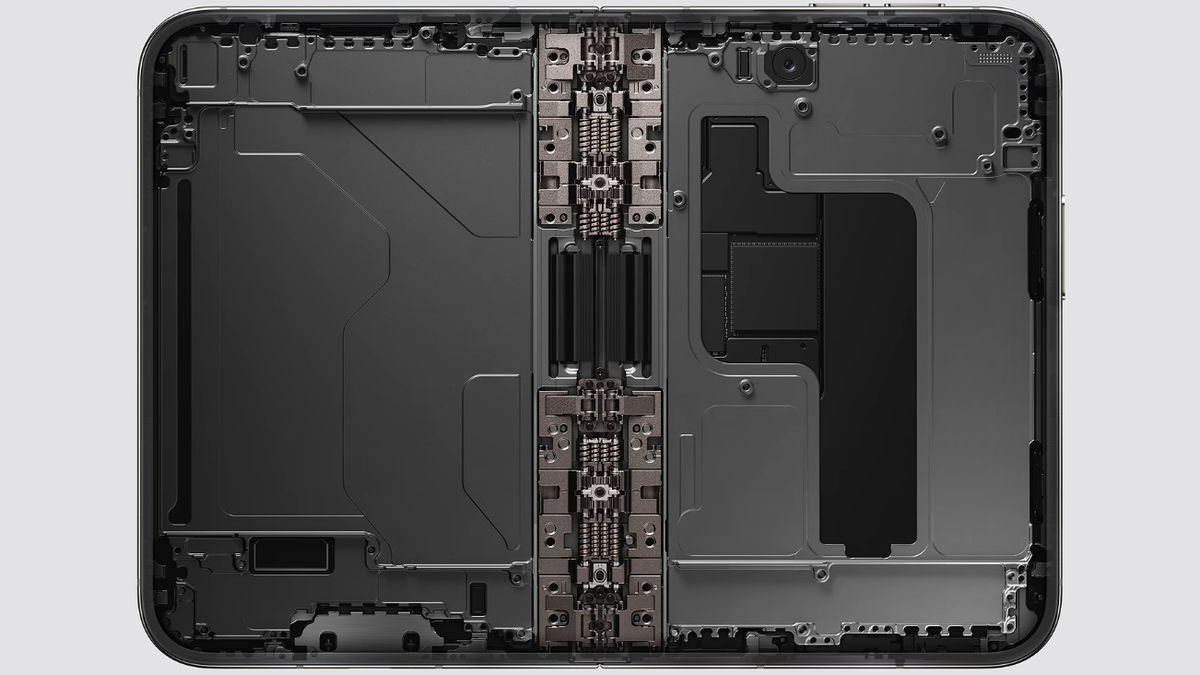
Apple solved the foldable heat problem by building an iPhone like a Mac.
The A20 Pro chip inside the iPhone Duo and iPhone 18 Pro represents one of Apple’s most aggressive structural pivots in a smartphone processor. For years, the company stacked DRAM directly above the System on Chip in a package-on-package configuration that saved lateral space but created a thermal chokepoint. The memory sat on top of the processor like a lid on a pot — trapping heat exactly where Apple needed it to move.
Dan Murray, Apple’s vice president of Silicon Engineering, described the shift in a PCMag interview published Wednesday. Instead of stacking, the A20 Pro places DRAM beside the processor — the same layout Apple uses in its M-series Mac chips. The package is slightly wider, but the system engineering team redesigned the phone’s internal structure to accommodate it. The result is a fundamental rethinking of how heat exits a smartphone silicon stack.
Banafsheh Barabadi, Apple’s senior manager of Thermal Products, called it a turning point. “For the first time, we were able to connect silicon directly to a thermal solution,” she said. The change was not incremental. It was architectural.
The four pillars of Apple’s new thermal strategy.
Barabadi outlined four components of the redesign. The first is the DRAM relocation described above. The second is a new thermal interface material Apple calls “metal over foam,” which fills the gap between the A20 Pro and the vapor chamber with a substance that conducts heat more efficiently than previous compounds.
The third pillar is the largest single upgrade: the vapor chamber itself is three times the surface area of the one in the iPhone 17 Pro. Vapor chambers move heat by evaporating and condensing liquid inside a sealed plate, spreading it across a wide area. Apple introduced them in the iPhone 17 Pro, and the Duo and 18 Pro refine that foundation for higher thermal loads.
The fourth is a material Apple has not used in a smartphone display before — nano-twin copper. Applied as a display metal plate layer, it combines mechanical rigidity with thermal conductivity that traditional smartphone display substrates cannot match. Paired with high-conductivity graphite, it spreads heat across the entire screen rather than letting it pool in localized hot spots.
Together, these changes produce what Apple claims is a 35 percent improvement in sustained GPU performance compared to the iPhone 17 Pro. In independent testing, the iPhone 18 Pro Max also earned a PCMag Lab Award for battery endurance, which Apple attributes partly to the same thermal efficiency gains — less wasted heat means less energy lost to cooling overhead.
The foldable hinge is the harder problem.
The Duo presents a geometry Apple has never engineered around before. In the open position, the device is extremely thin. When folded, the thickness roughly doubles, which compresses the available thermal pathway and doubles the heat density in a smaller volume. Apple’s solution runs through the hinge itself.
A flexible graphite pipe passes through the hinge mechanism, conducting heat between the two halves of the device and effectively turning the hinge into a passive heat bridge. This increases the total surface area available for dissipation without adding bulk to either panel. Barabadi noted that the material must maintain thermal conductivity, preserve structural integrity over the product lifecycle, and survive thousands of hinge cycles — a requirement that forced the thermal and mechanical design teams to co-engineer the component from the start.
This is the kind of cross-disciplinary dependency that typically slows hardware development. The fact that Apple shipped it suggests the Duo’s thermal architecture was a priority, not an afterthought.
What the pricing tells you about demand.
Pre-orders opened in Japan at 9 p.m. on October 16, with the Duo shipping on October 23. Prices are steep: the 256 GB model starts at 36,480 yen, the 512 GB at 39,980 yen, the 1 TB at 46,980 yen, and the 2 TB at 57,480 yen. The 2 TB variant alone exceeds $3,500 at current exchange rates.
These prices have two functions. The first is selection. Apple is not trying to sell millions of Duo units at launch — it is selling to the cohort that will define the category’s ceiling. The second is supply management. Reports from Japanese outlets indicate the device is already selling out, with some delivery dates extending into 2027. The pricing filters demand to match constrained initial production.
That constraint is worth watching. If Apple cannot scale Duo production within the next six months, the product risks becoming a proof-of-concept rather than a platform. The thermal engineering is impressive, but thermal performance is only one variable in foldable adoption. Battery density, hinge durability, and app ecosystem adaptation are equally decisive.
Why Japan matters first.
Japanese media outlets are publishing technical details about the Duo’s cooling architecture weeks before English-language trade press typically breaks similar stories. This is not unusual for Apple hardware, but it does reinforce a pattern: Japan remains the market where Apple’s most significant product signals surface first. The pricing, the availability timeline, the engineering revelations — they all land there before they reach Western desks.
For readers outside Japan, the implication is straightforward. If you want to understand Apple’s next hardware direction, watch what Japanese consumers and Japanese tech media report first. The Duo is the clearest example yet.
The broader bet.
Apple’s thermal redesign reveals something about how seriously it is taking the foldable form factor. The company did not bolt a vapor chamber onto an existing smartphone architecture and call it a day. It redesigned the silicon layout, the display substrate, the hinge, and the thermal interface materials as a single system. That level of integration suggests Apple sees the Duo not as a experimental variant but as a legitimate product category — one worth rebuilding from the transistor up.
The 35 percent sustained GPU gain is a headline number, but the real story is what it enables. AI workloads that previously throttled on thin phones can now run longer. Video recording and gaming can sustain peak performance without thermal penalties. The Duo’s thermal headroom is what makes it a daily-use device rather than a novelty.
Whether it scales to volumes that justify the engineering investment is the question Apple’s supply chain will answer over the next twelve months. The technology is ready. The market is the unknown.