Apple's iPhone Duo Proves It Can Fold — But Can It Beat Samsung?
Apple's first foldable phone impressed at launch with an almost invisible crease and thoughtful dual-screen features. But it's heavier, thicker, and slower than Samsung's decade ahead. The real story is what Apple's arrival changes for everyone else.
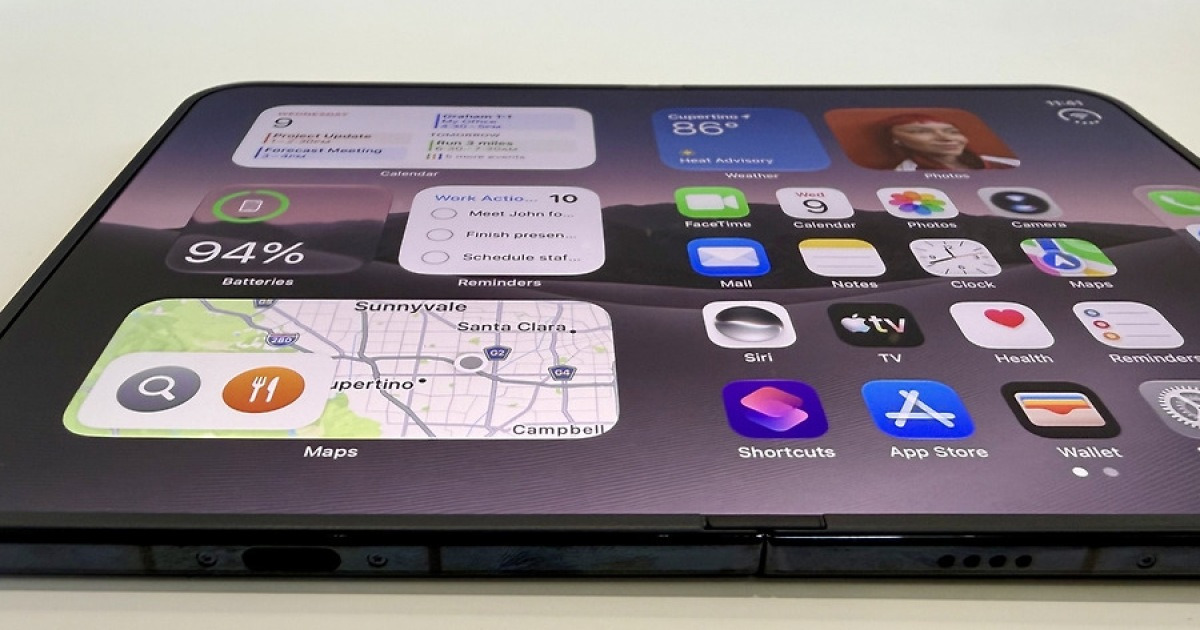
Apple finally folded. The hinge is good. The rest tells a different story.
The first thing you notice about the iPhone Duo is what isn’t there. The crease — that familiar valley running down the center of every foldable screen Samsung has shipped since 2019 — is nearly invisible. At multiple angles under stage lighting at Apple Park, the fold line disappeared entirely. Running a finger across it produced barely a whisper of texture, far less than the obvious ridge on any Galaxy Z Fold device I’ve used.
Apple’s engineers clearly spent more time on the hinge than on anything else. The result is a fold that doesn’t announce itself. That matters because the crease has been the single most consistent complaint about foldables for seven years. Consumers accept thickness and weight before they accept a screen that looks broken in the middle. Apple removing that visual defect — the thing that makes a foldable look like a foldable — is a deliberate branding move.
The dual-screen features are where Apple actually wins
Apple didn’t just fold the iPhone and call it a day. The dual-screen architecture is baked into the software in ways that feel native rather than appended.
The outer 5.4-inch display and inner unfolded screen can be used simultaneously, and Apple built specific features around that. During photo sessions at the event, the outer screen served as a live preview when taking selfies or group shots — a small detail that eliminates the guesswork of pointing a camera at your own reflection. Parents can play animations on the outer display to keep children looking at the lens during photos. FaceTime splits front and rear camera feeds onto the expanded inner screen. These aren’t gimmicks; they’re solutions to problems that only exist because the phone folds.
Typing on the unfolded display is noticeably better than on any current foldable. The virtual keyboard gains width and individual keys swell larger. Fold the screen to roughly 90 degrees and the keyboard splits naturally left and right, preserving reachability without sacrificing key size. This is the kind of ergonomics work Apple has always done well.
The hardware trade-offs are real
The iPhone Duo weighs 254 grams. That makes it the heaviest iPhone ever made — heavier even than the iPhone 18 Pro Max at 249 grams. For context, Samsung’s Galaxy Z Fold8 weighs 201 grams and the Z Fold8 Ultra weighs 215 grams. Apple’s foldable is 39 to 53 grams heavier than the category leader’s closest competitor. That difference is immediately apparent in the hand.
Thickness follows the same pattern: 11.3 millimeters folded, 5.2 millimeters unfolded. Samsung’s Z Fold8 opens thinner in both configurations. Apple attributed the extra bulk to a vapor chamber for thermal management — a component Samsung removed from its latest Fold8 series. This could mean Apple is prioritizing sustained performance over pocket presence, or it could mean the company simply has less experience packing heat dissipation into a hinged form factor.
The inner display uses a nano-texture coating that reduces reflections. Apple calls it out specifically at the event. The trade-off is a slight increase in surface friction, which explains the tactile difference between the smooth outer cover screen and the textured inner panel. Some users will prefer the anti-glare properties. Others will miss the glassy slickness of a standard display.
Face ID is gone. That’s a calculated risk.
Perhaps the most consequential decision Apple made for the iPhone Duo is the omission of Face ID. The outer display uses Touch ID only. This will split users immediately. Face ID is one of the few biometric features that non-Samsung iPhone owners consider indispensable. Removing it from Apple’s first foldable — the device intended to attract a new segment of buyers — signals that Apple believes the form factor demands a different approach to authentication.
It may also reflect engineering constraints. The hinge mechanism occupies space that traditionally houses the TrueDepth camera array. Samsung solved this on the Z Fold series by placing the camera module in the upper portion of the inner display. Apple appears to have gone a different route, sacrificing facial recognition entirely on the outer screen.
This is the kind of compromise that determines whether a product feels like a genuine evolution or a cautious experiment.
What this means for Samsung — and the rest of the market
Samsung has dominated the foldable category since the original Galaxy Fold shipped in 2019. The company has iterated through five generations of foldable flagships, refining hinges, thinning chassis, and building software that actually uses the form factor. By the time Apple entered this space, Samsung held roughly 70 percent of the global foldable market.
Apple’s arrival changes the math only if it convinces people who never considered a foldable to buy one. The near-invisible crease and dual-screen software integration are genuine improvements over Samsung’s best offering. But Samsung’s Z Fold8 is already a mature product with an ecosystem of fold-optimized apps, third-party developer support, and consumer trust built over years of iteration.
The real threat to Samsung isn’t the iPhone Duo itself — it’s what Apple’s participation validates. Every major Android manufacturer will now accelerate its own foldable plans. Huawei, Xiaomi, OPPO, and vivo all have foldable prototypes in various stages. Apple’s entry signals that the foldable segment has crossed a threshold where premium buyers will take it seriously. That lifts the entire category, including Samsung’s competitors.
The question isn’t whether Apple can fold — it’s whether it can compete
The iPhone Duo is a competent first attempt. The hinge quality exceeds what Samsung achieved in its first three generations. The dual-screen features are thoughtfully designed. The thermal management suggests Apple is thinking about long-term reliability rather than just launch-day impressions.
But competence isn’t dominance. Samsung’s foldable lineup has been shipping refined hardware for seven years. Apple is entering with a device that is heavier, thicker, and missing a flagship biometric feature. The question now is whether Apple’s brand gravity can compensate for those gaps in the first critical year — and whether Samsung can respond quickly enough to keep the advantage.
The foldable market is about to get much more interesting. And for consumers who have been waiting for Apple to enter, the wait was worth it — even if the prize isn’t quite what anyone expected.