Aramco CEO Warns of 2-Year Oil Recovery as Global Reserves Collapse
Aramco's CEO says global oil inventories are at dangerous lows, with a two-year recovery timeline. Strategic reserves are emptied and commercial stocks are thinning, leaving the world's energy system dangerously exposed.
The Two-Year Warning Most Readers Are Missing
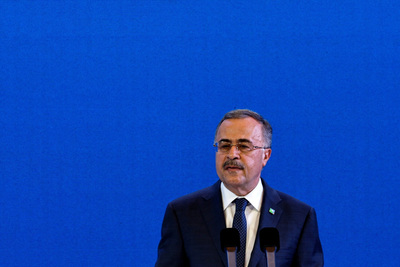
While London and Washington have been dissecting the latest Hormuz disruptions in breaking news cycles, a far more significant signal came from a ballroom in central London on October 5th. Amin Nasser, the CEO of Saudi Aramco, stood before the 2026 Energy Intelligence Forum and delivered a message that is simple, stark, and almost certainly underpriced by global markets: the world is running out of room to breathe.
Nasser did not mince words. Global oil inventories, he said, are at dangerously low levels. Refilling them could take up to two years. That single timeline is the kind of statement that shifts risk premiums, reshapes central bank inflation forecasts, and forces energy-importing governments to recalibrate their strategic thinking — yet it has received a fraction of the attention given to tactical shipping disruptions along the Strait of Hormuz.
The scale of the drawdown is what makes this warning carry weight beyond the usual corporate caution. Over the past seven months of war in the Middle East, Nasser estimated that 3 billion barrels of oil supply have disappeared from the region. The Financial Times calculated that figure represents roughly half of the crude and refined products that would normally transit the Hormuz Strait in the same period. This is not a minor dip in global supply. It is a structural shock to one of the world’s most critical energy chokepoints.
How the World Has Been Borrowing From Its Own Future
The response to the supply disruption has followed a familiar but increasingly desperate pattern: governments and companies have been draining their buffers. Since the Iran war escalated in late February, the world has drawn down more than 1 billion barrels from petroleum reserves. Of that total, approximately 300 million barrels came from official strategic petroleum reserves — the emergency stocks that governments maintain specifically to absorb shocks of this magnitude.
But the remaining 700 million barrels did not come from government vaults. Nasser was explicit about where that volume originated. It came from commercial inventories held by oil companies — the working capital of the global energy system. Those commercial stocks, he said, now sit below 6 billion barrels. And critically, a large portion of what remains is not easily accessible for rapid deployment. This is inventory tied up in long-term contracts, in storage at remote terminals, or in product forms that cannot be quickly converted into the refined fuels that markets actually demand.
“The buffer capacity that supports supply chain resilience has become dangerously thin,” Nasser told the forum. “The current system itself is already under significant pressure.”
The Refining Bottleneck Most Analysts Are Overlooking
What Nasser’s inventory figures do not fully capture is a secondary crisis that may prove even more constraining in the months ahead: the refined products deficit. Sheikh Nawaf Al-Sabah, the CEO of Kuwait Petroleum Corporation, painted a parallel picture at the same event. He estimated that the world is short roughly 6 million barrels per day of refined petroleum products — a gap that cannot be closed simply by resuming normal flow through the Hormuz Strait.
The reason is structural. Even if Middle Eastern refineries return to full operation tomorrow, global refining capacity as it currently stands cannot absorb that shortfall instantly. The world has underinvested in refining for years, and the wartime disruption has further degraded operational capacity in the region. The result is a compound problem: insufficient crude supply meets insufficient refining throughput, and the gap between what the global economy consumes and what it can produce is widening, not narrowing.
This is why Nasser’s two-year recovery estimate deserves more scrutiny than it is receiving. The number is not arbitrary. It reflects the time required to rebuild both crude inventories and refined product margins to levels that restore meaningful buffer capacity — a task made harder by the fact that new drilling and refining investment takes years to come online.
The Data Tells a Story of Partial Recovery
There is one data point that complicates the gloom, and it deserves attention. Kpler, the Belgium-based shipping analytics firm, reported that Gulf export volumes in September averaged 15.5 million barrels per day — more than 80 percent of pre-conflict levels. That is a significant recovery, and it suggests that some of the worst disruption has passed, at least for crude flowing out of the Persian Gulf.
But the Kpler figure and Nasser’s inventory warning are not actually in tension. Higher export volumes today do not erase the fact that the world has consumed 3 billion barrels of buffered supply over the past seven months. Running the tap harder right now simply means drawing down whatever residual stockpiles remain. The recovery in throughput is real but incomplete, and it does not address the underlying depletion that Nasser is flagging.
A Weaponized Information Environment
Nasser also raised a concern that cuts across both energy and security policy. He warned that modern information infrastructure — satellite imagery, vessel tracking data, open-source intelligence — is increasingly being weaponized to target energy assets. In an era when commercial satellite operators can resolve objects as small as a meter on the ground and AIS transponders reveal the movements of virtually every commercial tanker, the informational transparency that once served as a market stabilizer has become a vulnerability.
Adversaries no longer need intelligence operatives on the ground to identify and strike energy infrastructure. Publicly available data serves the same purpose. This dynamic changes the calculus for how governments and companies insure against supply disruption and how they position critical assets geographically.
Who Wins, Who Loses, and What Comes Next
The immediate market implication is a risk premium that is likely to persist and expand. Oil prices already embed a war-time discount in some scenarios — the possibility that Hormuz could shut down entirely — but they do not yet fully price in the inventory depletion that Nasser is describing. A two-year recovery timeline means elevated prices, elevated volatility, and elevated inflation risk for import-dependent economies across Europe and Asia.
Saudi Arabia, paradoxically, occupies the most powerful position in this environment. Aramco’s production capacity far exceeds its actual output, giving Riyadh the largest spare capacity of any major producer. In a world where inventory buffers are thinning, that spare capacity becomes a geopolitical instrument. The kingdom can stabilize prices or withhold supply — and it will likely face intense pressure to do the former from consuming nations that have little else to fall back on.
China and India, the two largest Gulf importers, will feel the squeeze hardest. Both economies run on Middle Eastern crude and refined products, and neither has strategic reserves anywhere near the depth of the United States or Japan. Their industrial output and inflation trajectories will be directly shaped by how quickly global buffers recover — and whether any meaningful recovery occurs within Nasser’s two-year window.
The European Union faces a compounding problem. Having recently decoupled from Russian pipeline gas, Europe is now more exposed than at any point since the 1970s to Middle Eastern supply disruption. The bloc’s energy security architecture, built around LNG diversification, does not adequately address the refined products gap that Al-Sabah identified.
Japan and South Korea, the two countries most immediately affected by Hormuz disruption, should treat Nasser’s warning as a strategic alarm. Both nations hold significant strategic reserves but have been drawing them down aggressively. The question is no longer whether they need to replenish those reserves — it is whether they can afford the time it takes.
The broader takeaway is this: the global energy system is operating with thinner margins than at any point in decades, and the political discourse around the Middle East conflict has been so focused on immediate tactical developments — ship strikes, port closures, fleet reroutings — that the slower, more dangerous story of inventory erosion has gone largely untold. Nasser’s two-year estimate is not a forecast of crisis. It is a forecast of a world that will remain fragile long after the cameras move on.