An asteroid that defies basic physics is rewriting what we think we know
A 710-metre space rock spinning once every 1.88 minutes should not exist by the rules of rubble-pile physics. Its discovery by the Vera C. Rubin Observatory could force a major rethink of how asteroids are held together.
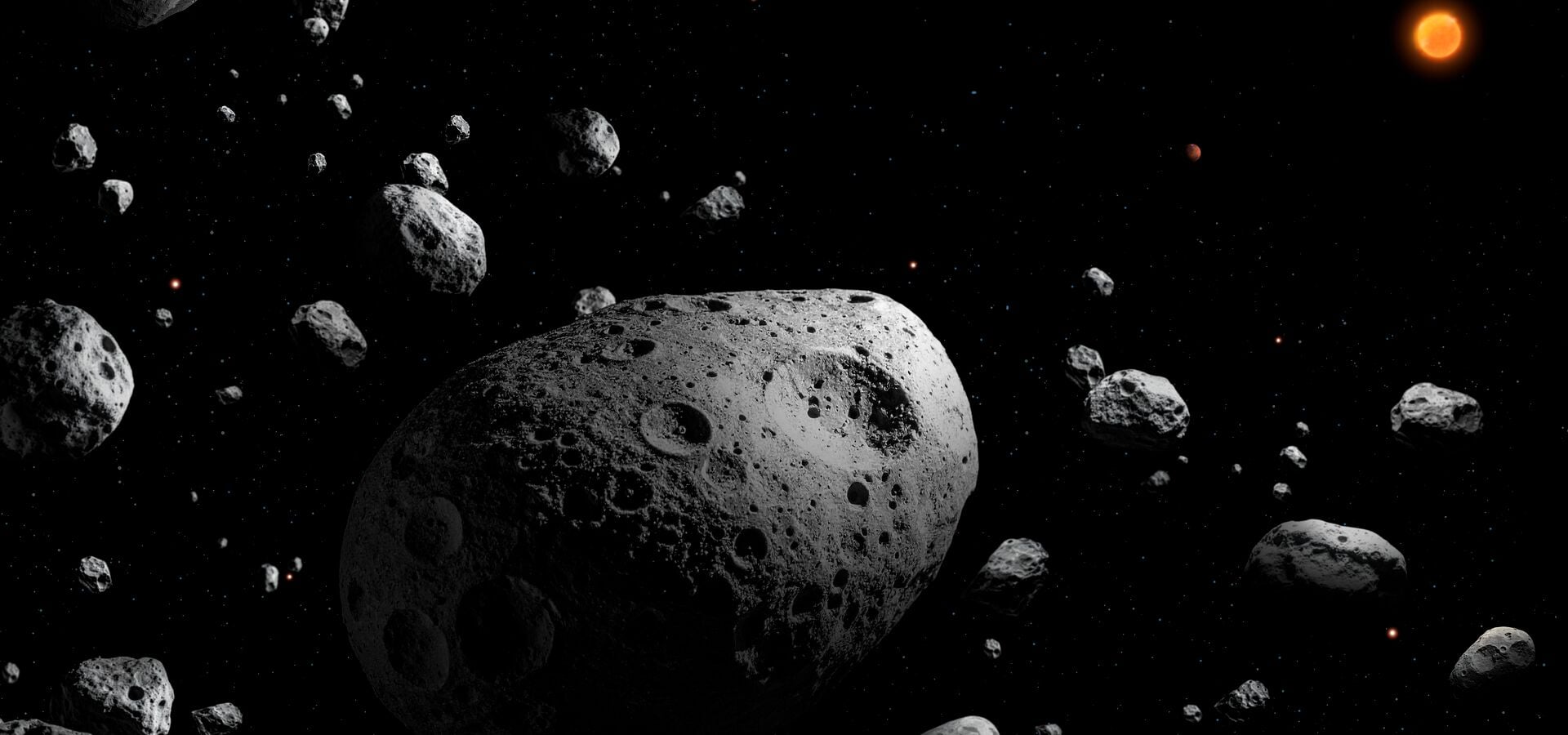
The asteroid that shouldn’t exist — and what it means
Astronomers have long treated the 2.2-hour spin barrier as a near-firm law of the asteroid belt. For rubble-pile bodies larger than roughly 150 metres, observations consistently show that rotating faster than about two hours and a dozen minutes will tear them apart. Gravity alone is too weak to hold a loose collection of boulders and dust together at such speeds. Break past that limit and the object either deforms, sheds material, or shatters entirely.
That is precisely why 2025 MN45 is so unsettling. Estimated at 710 metres across — nearly eight football fields side by side — it completes a full rotation every 112.8 seconds. At roughly 70 times faster than the theoretical limit, this object should, by every conventional model, be impossible. And yet it is there, confirmed by repeated lightcurve measurements that resisted every standard check for observational artifacts.
The discovery, reported by Sarah Greenstreet and colleagues in The Astrophysical Journal Letters on 7 January 2026, did not come from a decade of follow-up. It came from nine nights of commissioning data collected between 21 April and 5 May 2025 by the Vera C. Rubin Observatory in Chile — a instrument not yet officially surveying the sky.
Rubin’s unexpected advantage
The Rubin Observatory entered its ten-year Legacy Survey of Space and Time on 30 June 2026, and its design is unlike any previous sky-mapping instrument. A 3.2-gigapixel camera sweeps the southern sky every 40 seconds, capturing images orders of magnitude deeper and faster than earlier systems. Commissioning runs like the one that found MN45 were never designed to produce definitive catalogs. They were meant to calibrate the instrument and identify operational issues. The fact that they also revealed a population of extreme rotators suggests the final survey may fundamentally change our picture of the asteroid belt.
During those nine nights, Rubin recorded approximately 340,000 measurements and identified 2,103 new asteroids. Of the 76 objects for which reliable rotation periods were obtained, 19 crossed the 2.2-hour barrier. Three rotated in under five minutes. Among them were the roughly 120-metre 2025 MJ71 at 1.92 minutes and the roughly 540-metre 2025 MK41 at 3.78 minutes. But MN45 stands apart: it combines the shortest observed period with a size well above half a kilometre. That combination is what makes it the most serious challenge to existing models.
The lightcurve analysis is robust. Fifty-one7 observations over 12 days recovered the same 0.031-hour period when the data were separated by observing night and by colour filter. Two independent techniques produced the same result. An extreme rotation period can easily masquerade as an alias — a false signal created by the spacing of observations rather than by the object itself. This one survived every sensible attempt to make it disappear.
The cohesion problem
The researchers calculated that keeping MN45 intact would require internal cohesion of roughly 9 megapascals. For context, that is comparable to the tensile strength of strong clay or solid sedimentary rock. A true rubble pile held together by gravity alone cannot approach that number. Something else is happening.
Several important caveats exist. The 710-metre diameter is an estimate derived by converting the asteroid’s brightness into a size assuming a spherical shape and an albedo of 0.15. If the surface is darker than assumed, the object is larger and the required cohesion even higher. If it is brighter, the object is smaller and the calculation shifts. The bulk density of 1,700 kilograms per cubic metre used in the strength model is nominal, not measured. Change the shape, density, or internal structure and the conclusion softens. But the core inference is difficult to dismiss: self-gravity alone cannot explain how an object of this estimated size survives a rotation period of 112.8 seconds.
The “solid rock” language used in the paper is an inference, not a direct measurement. No sample has been returned. No radar imaging has resolved its shape. But the gap between what the object is doing and what gravity predicts it should be doing is too large to ignore.
Why this matters beyond asteroid folklore
There is a tendency to treat discoveries like MN45 as curiosities — interesting exceptions that reinforce the rule. The real concern is that the rule itself may be wrong. Rubble-pile models have been foundational for decades. They inform impact-risk assessments, mission-design parameters, and deflection strategies. If a significant fraction of main-belt asteroids are more coherent than previously assumed, the mechanical consequences for planetary defense are immediate and concrete.
A deflection attempt — kinetic impactor, gravity tractor, or explosive charge — depends critically on understanding whether the target behaves like a loose pile of rocks or a more rigid body. Hit a rubble pile and energy dissipates through internal rearrangement. Hit something with 9 MPa of cohesion and the momentum transfer is drastically different. Ignoring that difference could mean misjudging the outcome of any future attempt to alter an asteroid’s trajectory.
The statistical implication is equally important. Nineteen superfast rotators appeared among only 76 reliably measured periods in a commissioning run. If that fraction holds across the full survey population, cohesive fragments are not rare anomalies but a substantial component of the asteroid belt that has been systematically undercounted because earlier instruments lacked the cadence and sensitivity to detect them.
The road ahead
MN45 and its companions are too new to settle into textbook canon. Follow-up observations are essential. Thermal infrared data could disentangle diameter from albedo without relying on assumed reflectivity. Additional lightcurves would constrain the object’s shape and spin axis. Spectroscopy could identify surface minerals and offer clues about composition. Each technique would sharpen the picture without directly probing the interior, which will remain inferred for the foreseeable future.
What is already clear is that Rubin’s commissioning phase revealed more than anyone expected. The instrument was never supposed to produce a definitive census of asteroid rotators. Yet in nine nights, it found evidence that a basic assumption about how asteroids hold themselves together may need revision. The pattern of results — multiple fast rotators, including several well above the size threshold where gravity should dominate — points toward a systematic effect rather than a single freak object.
The most consequential thing about 2025 MN45 may be how cleanly it exposes the boundary between two regimes that planetary scientists have treated as distinct. Self-gravity governs the behaviour of most asteroids larger than a few hundred metres. Material strength dominates the smaller ones. MN45, at an estimated 710 metres, sits squarely in the gravity regime by every conventional classification. It should be falling apart. Instead, it keeps turning.
Unless follow-up work overturns the period or substantially revises the physical assumptions, astronomers will have to accept that this asteroid is doing something gravity alone cannot manage: holding itself together. That is not a small thing to concede in a field built on the assumption that the rules of rubble piles apply broadly and predictably. It is a sign that the asteroid belt still has surprises buried in its brightness curves.