Beijing's Flood Response Reveals a Calculated Playbook for Information Control
China has released its first country-by-country breakdown of the 261 missing foreigners in Tibet, but the selective timing and accompanying rumour crackdown suggest information is being managed as carefully as rescue operations.
A Disaster, Delivered in Doses
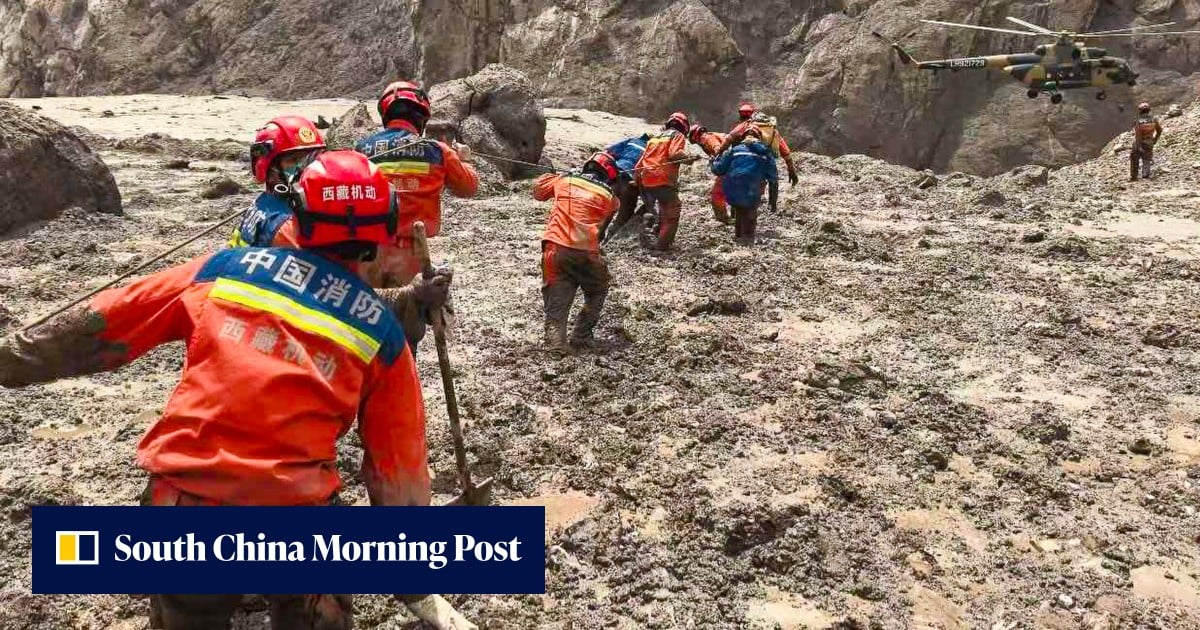
China released its first detailed breakdown of the foreigners missing after the glacier collapse in Tibet’s Gyirong county on a Sunday evening — timed, analysts noted, to minimize coverage during Western news hours. The list was methodical, almost bureaucratic in its precision: 104 Nepalese, 49 Indian, 33 Latvian, 18 American, 15 British, six Canadian, six Australian, four South African, three each from Malaysia, Germany, and Russia. The remaining came from smaller counts across Ireland, Estonia, France, the Netherlands, New Zealand, Kazakhstan, Finland, Lithuania, Portugal, Ukraine, Spain, and Hungary.
The enumeration itself was notable. China had not previously disclosed which nationalities were among the 546 missing in the Tibetan portion of the disaster, nor the separate death tolls across the border in Nepal, where at least 788 people have died and more than 2,500 remain unaccounted for. Satellite imagery comparison showing rivers swallowing settlements was equally new — visual evidence that bypassed the usual wait for ground-level verification.
What was not new was the framing. Alongside the release, authorities reminded the public that online rumours about the disaster were being targeted. Weibo posts discussing casualty figures, sharing unverified photos, or questioning the government’s response were swiftly removed. The message carried familiar weight: information would flow on Beijing’s timetable, and those who speculated ahead of official channels would face consequences.
Who Wins and Who Loses
In crisis communications, the side that controls the narrative controls the room. China has learned that lesson long ago — and refined it further through repeated practice. For the 23 countries with citizens missing in Tibet, the delayed disclosure is both a practical and diplomatic problem. Families do not learn who is missing all at once. They learn when Chinese authorities decide they should. Diplomatic missions were notified, officials said, but notification is not transparency. Embassies in Beijing received individualized briefings rather than a public database, creating information asymmetries between capitals that have ties to China and those that do not.
Nepal faces a harder equation. Its own death toll already dwarfs Tibet’s, yet the cross-border nature of the disaster means Kathmandu cannot speak authoritatively for its citizens inside China. Many of the 104 missing Nepalese were seasonal laborers crossing into Tibet for construction work — migrants whose movements are rarely tracked with precision by either government. Tibet is restricted territory even for Nepalese diplomats. Access for independent journalists, international Red Cross observers, or third-country verification teams remains effectively nonexistent. The implication is stark: Nepal’s government cannot fully account for its own people.
The 33 Latvians deserve a moment here. The European Union is China’s largest trading partner, but Latvia — a small Baltic state with its own security anxieties about Russian influence — has limited leverage. The missing-number puzzle becomes a quiet stress test for EU-China relations, one that Brussels will likely address through back channels rather than public pressure. Internal EU coordination on the issue will reveal fault lines between member states with strong economic ties to China and those prioritizing human rights concerns.
India occupies the most complicated position. With 49 citizens missing and an already tense border relationship with China, New Delhi faces competing imperatives: demand answers for its nationals while avoiding escalation on the Himalayan frontier. The Tibetan dimension adds another layer — India has historically viewed Tibet through a strategic lens, and any disaster there carries geopolitical undertones that go beyond humanitarian concern. Indian officials have not publicly criticized China’s handling of the information, suggesting that strategic caution outweighs transparency demands.
The Rumour Suppression Playbook
The rumour crackdown is the telling detail. China has not once in recent memory allowed a major domestic or border disaster to play out without accompanying internet management. The pattern is consistent: official information moves slowly, rumours are declared everywhere, and those who spread unverified details face consequences. This time, the suppression appears more coordinated than usual. Multiple platforms — Weibo, WeChat, Douyin, and Baidu Tieba — simultaneously enforced new content filters targeting keywords related to the glacier collapse, foreign casualties, and rescue failures.
This matters for several reasons.
First, it shapes what the world knows and when. Rescue operations in remote Tibetan terrain are inherently slow. Satellite imagery, access limitations, and language barriers mean that even cooperative information sharing takes time. When Beijing fills that vacuum with silence or selective disclosure, speculation grows — and the state then defines speculation as rumour. Foreign correspondents based in Delhi and Kathmandu have become the primary信息来源 for international audiences, creating a dependency on secondhand reporting from regions with their own political constraints.
Second, it isolates the disaster from broader narratives. Tibet is not merely a geographic location in Chinese discourse; it is a political one. A glacier collapse that kills foreigners and invites international attention risks becoming a story about environmental degradation, infrastructure vulnerability, or border-region governance — none of which fit comfortably within the official frame. Rumour suppression is partly about preventing accidents from becoming narratives. The alternative story — that climate change is making Himalayan disasters more frequent and more deadly — is one Beijing has little incentive to amplify when it cannot control the framing.
Third, it sets a precedent for future cross-border climate disasters. As glacial lakes in the Himalayas continue to expand and destabilize under warming temperatures, events like this will recur. The question is whether the information playbook will evolve or harden. Observers note that previous incidents — the 2015 Nepal earthquake, the 2020 COVID-19 origins investigation — established templates for information management that are now being refined and repeated with increasing sophistication.
Second-Order Effects
The disaster’s ripple effects extend beyond immediate communications control. Insurance companies are already reassessing risk models for travel to the region, potentially affecting tourism revenue for both Tibet and Nepal. Trekking operators who had built businesses around the Gyirong corridor face cancellation waves that could persist for years, regardless of how the information narrative resolves.
Humanitarian organizations report that restricted access is complicating aid delivery. International NGOs with operations in Nepal are finding it difficult to coordinate with counterparts on the Chinese side, where foreign staffing is limited and communication channels are monitored. The information blackout extends, implicitly, to operational coordination.
Diplomatically, the episode may recalibrate expectations among affected countries. Nations with fewer citizens missing may quietly reduce public engagement, accepting Beijing’s information timeline as the new normal. Those with larger constituencies — particularly India and Nepal — may seek alternative channels, including private diplomacy through intermediaries like Switzerland or Norway, rather than confronting Beijing directly.
What Happens Next
China has so far confirmed 16 deaths in Tibet. That number will rise. The missing count — 546 in Tibet alone, with 261 foreign nationals — suggests a significant portion of those unaccounted for may be in the tourist-heavy Gyirong corridor, an area that saw growing visitation in the years before COVID and continues to attract trekkers and climbers.
The diplomatic notifications are a procedural step, not a commitment to sustained transparency. Expect families to receive periodic updates, but not real-time access. International media will face continued restrictions on independent reporting from the Tibetan side of the border. Social media monitoring in China will intensify in the coming weeks, with particular attention to coordinated campaigns by diaspora communities or advocacy groups seeking accountability.
Nepal, meanwhile, is managing a far larger catastrophe with fewer resources. Its domestic crisis may absorb the international spotlight, leaving Tibet’s missing foreigners in a secondary tier of global concern — precisely the outcome that suits Beijing. Kathmandu’s overwhelming domestic priorities may also prevent it from pressing Beijing aggressively on information access, even for its own citizens.
The Version That Survives
The glacier collapse is a climate event. The information response is a political one. Both tell you something important about the world we are in: disasters no longer arrive as pure misfortune. They arrive as opportunities — for states to demonstrate capability, for critics to find fault, and for governments to decide which version of events survives.
China has chosen its version carefully. So far, it looks like the one Beijing prefers. But the silence itself becomes data. The countries left waiting, the families without answers, the narratives suppressed — these absences will accumulate. In future crises, when the next glacier fails and the next list of missing is compiled, other governments may look at what happened here and adjust their own strategies. Some will follow Beijing’s playbook. Others will prepare alternatives — private diplomatic channels, encrypted communication networks for affected families, parallel reporting structures that bypass state-controlled information flows.
The information control on display is effective in the short term. Its long-term cost is a world that increasingly produces parallel truths about the same events — versions that survive in different ecosystems, never converging, never reconciled. That is not a new phenomenon. But disasters like this accelerate it, turning every crisis into another node in a fragmenting information landscape.