Belgorod Shopping Center Attack Signals New Ukrainian Escalation
A Ukrainian drone strike hit Belgorod's MegaGRINN shopping complex, killing one civilian and injuring 14. The attack coincides with Ukraine's Starshield restoration and signals a shift toward striking softer civilian targets deeper inside Russia.
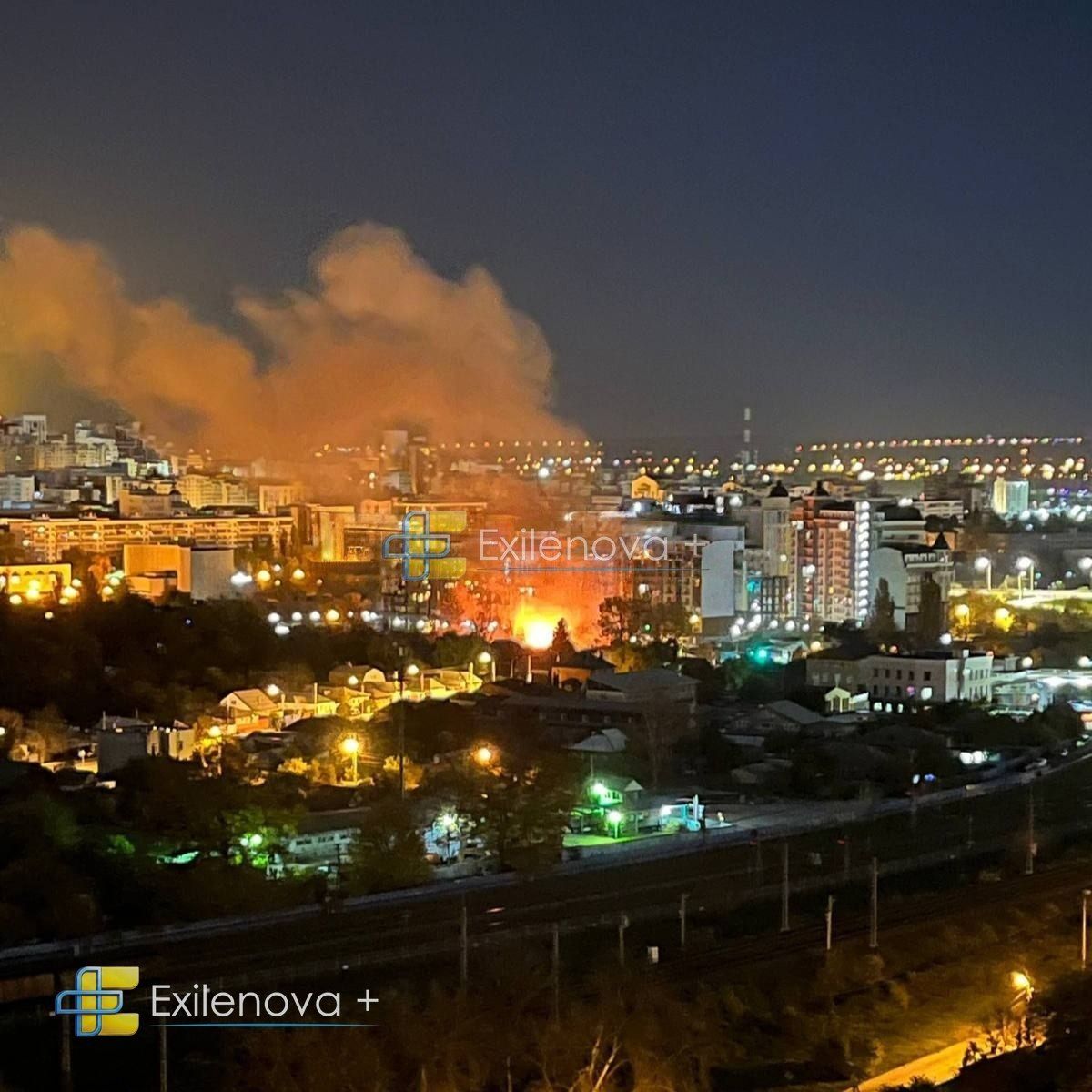
Belgorod Burned
The MegaGRINN shopping complex in Belgorod does not appear to be a military target. It is a retail center — 163,000 square meters of store space, a cinema, restaurants, a supermarket. It was empty when the drones hit overnight on October 25. It was not designed to withstand an attack. That is precisely the point.
One civilian died. Fourteen were injured. At least 30 apartment buildings, 35 vehicles, four houses, three administrative buildings and eight commercial properties were damaged, according to local authorities. Eyewitness footage shows fires and explosions over the city center, and air defense systems lighting up the night sky.
Belgorod sits just 34 kilometers from Ukraine’s border and roughly 70 kilometers from Kharkiv. It has been a frequent target for years — energy infrastructure, logistics warehouses, facilities belonging to the Russian e-commerce giant Ozon. But striking a civilian shopping complex, even one unoccupied at the time, crosses a threshold that is difficult to un-cross.
What makes this strike distinct from previous operations is not just the target itself but the method. Reports indicate a coordinated swarm rather than a single glide bomb or precision-guided munition. Swarm tactics require multiple autonomous or semi-autonomous platforms communicating in real time, navigating around air defenses, and converging on a common objective. Executing that kind of coordination at this range depends on reliable satellite connectivity and robust data links — exactly the capabilities Starshield provides.
The Timing Is Not Coincidental
Ukraine confirmed on October 24 that its Starshield system had been restored to full operational speed. Starshield is the military application of Elon Musk’s Starlink satellite internet constellation, and since October 14 it had been operating at drastically reduced capacity. The restriction — unexplained by SpaceX or the Ukrainian government — disrupted drone coordination, impaired Ukraine’s ability to shoot down Russian jet-powered drones, and quietly degraded a critical enabler of Kyiv’s long-range strike operations.
For ten days, Ukrainian operators worked around a narrower bandwidth, prioritizing frontline communications over deep-strike coordination. The operational consequence was measurable: fewer drones reached their intended targets beyond the immediate combat zone, and Russian air defenses faced less pressure from the rear.
The Belgorod attack came less than 24 hours after that capability returned to full strength. Ukraine’s military is signaling that Starshield is back online — not with a press conference, but with a swarm of drones over a Russian city.
This is how information warfare works now. The target may be physical, but the message is layered: Ukraine has restored its communications backbone; it can coordinate complex strikes again; and it is expanding the scope of what it considers legitimate. The timing suggests the restored connectivity was not simply resumed for existing missions but was used to pursue new ones that had been postponed or deprioritized during the downtime.
Analysts monitoring the strike noted that the attack pattern — multiple drones hitting from different vectors, targeting a structure chosen for symbolic weight rather than military necessity — is consistent with post-restoration test flights and operational rehearsal. In other words, Ukraine may have been waiting for Starshield’s return to execute exactly this kind of operation.
Who Wins and Who Loses
Ukraine wins visibility. Every drone that reaches Belgorod — a city that has felt the war but rarely at this scale and in this kind of location — reinforces the message that the conflict is not contained behind a line on a map. It tells Russian civilians that proximity to the front no longer guarantees safety. It tells Kyiv’s Western partners that Ukrainian precision strike capability is growing, not fading.
There is also a domestic political dimension. Ukraine has endured years of Russian strikes on energy infrastructure, residential areas, and civilian sites. Demonstrating the ability to bring the war to Russian soil — even selectively and symbolically — bolsters morale and legitimizes the military’s strategy in the eyes of a population that has absorbed disproportionate damage without reciprocating at equivalent ranges.
Russia loses control of its own narrative. Belgorod is not a frontline city in the traditional sense. It is an administrative and residential hub, home to roughly half a million people. The attack undermines the Kremlin’s central claim that it is protecting Russian citizens from a war that began on Ukrainian soil. That claim has always been the moral centerpiece of Moscow’s invasion. When a shopping center catches fire, the abstraction of “denazification” and “protecting compatriots” starts to sound hollow even to people who supported the war.
The psychological impact extends beyond Belgorod. Residents of Voronezh, Kursk, and other regional centers now face a recalibrated risk assessment. The assumption that large cities deep inside Russia remain insulated from direct attack is eroding. Insurance markets, property values, and local economic activity in border regions will reflect that recalibration within months.
The one civilian killed and the fourteen injured are real human beings. Their suffering is not a tactical variable. But in the calculus of total war, casualties on the other side of a border that Moscow itself helped blur are being counted by both sides as part of the same ledger.
Second-Order Effects
The consequences of this strike will ripple outward in ways that are difficult to predict but clear in direction. Russian airspace management will tighten. Expect more restrictive flight corridors, expanded no-fly zones around civilian infrastructure, and accelerated deployment of electronic warfare systems designed to disrupt drone communications — the very links Starshield now reinforces.
On the Ukrainian side, the success of the Belgorod operation may accelerate plans for deeper strikes. If a shopping complex 70 kilometers from the border fell to a coordinated drone swarm, there is no structural reason why larger facilities, military logistics hubs, or command centers further inside Russian territory remain out of reach. The restored Starshield capacity removes the bottleneck that had constrained such operations.
Western suppliers face a diplomatic complication. The United States and its allies have drawn lines around what Ukrainian forces may strike with donated weapons, typically excluding purely civilian targets deep inside Russia. Belgorod tests those boundaries. A shopping complex is not an oil refinery or a munitions depot, but it is also not a military installation. Where that line falls — and whether different capitals draw it differently — will shape Ukraine’s operational options for months.
Russia’s retaliation may not come immediately. Moscow often stages delayed responses to maximize political impact, and the Kremlin may be assessing whether to escalate against Ukrainian energy infrastructure, ports, or urban centers rather than simply reinforcing air defenses. The pattern of previous retaliatory strikes suggests anything is possible.
What Happens Next
Belgorod is likely not the last time a Ukrainian drone reaches deep into Russian civilian territory. Starshield’s return removes a constraint that had been silently shaping Ukraine’s operational choices. With full satellite throughput restored, drone coordinators can plan larger swarms, more complex routes, and strikes further from the border without losing connectivity.
Russia will respond. Expect tighter air defense coverage around major cities, more evacuation orders for border regions, and likely retaliatory strikes — possibly against Ukrainian energy infrastructure or civilian targets in a way that escalates the pattern rather than breaking it. The Kremlin has repeatedly threatened retaliation for attacks on Russian soil, though its track record for proportional response is inconsistent.
The West will watch closely. Strikes on purely civilian infrastructure, even in occupied or contested border regions, risk complicating the political debate over long-range weapon allowances. Some Western capitals have already drawn lines around what Ukraine can use their weapons to hit. Belgorod tests whether those lines hold when the target is a shopping complex rather than a military base.
For ordinary Russians in Belgorod and nearby cities, the psychological impact will outlast the physical damage. The war has moved from rumors and distant explosions to something that can crack a parking lot. That shift matters more than the square footage of a burned retail center.
The Strategic Calculus
Ukraine’s strategy is clear: make the cost of this war visible to Russians who have long believed it was happening somewhere else. The Belgorod attack says, in the most direct language available, that it is not.
But visibility alone is not strategy. The deeper objective is to force a recalibration of Russian behavior — to make the cost of continuing the war feel immediate and personal to the civilian population that the Kremlin claims to protect. If successful, that dynamic creates political pressure that may limit Moscow’s willingness to sustain certain military operations or intensify its own strikes against Ukrainian cities.
The question now is whether Russia responds with restraint or with a wider campaign — and whether the West, watching from a distance, redraws its boundaries or lets them stand. The Belgorod strike is not a turning point in the war. But it is a marker of where the war has moved, and a signal that the next phase will be defined not by contested front lines but by contested assumptions about who is safe from the blast.