BIGBANG's 100K Goyang Crowd Signals a K-Pop Touring Shift
BIGBANG drew over 100,000 fans across three days in Goyang without a single safety incident — a reminder that legacy K-pop groups retain extraordinary global touring power. Their success raises questions about where the next big K-pop tour revenue will come from.
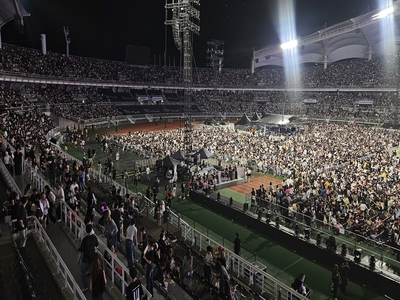
BIGBANG Just Pulled 100,000 People in Goyang. Here’s Why It Matters.
Big numbers in K-pop are common when you think about it. New girl groups sell out Seoul Olympic Stadium in minutes. Fifth-generation acts fill arenas on their first world tour.
But BIGBANG did something different last weekend.
Over three days — August 21 through 23 — the group played at Goyang Stadium and pulled roughly 100,000 fans. No heatstroke incidents. No crowd crushes. No emergency evacuations. Just a legacy act that went on hiatus, broke up on paper, returned sporadically, and still commands a crowd most current top-tier groups couldn’t fill in a single night.
Goyang, a city just north of Seoul with a population of about 1.1 million, is not a natural concert destination. It doesn’t have the infrastructure or visibility of Seoul’s central districts. And yet the city’s emergency response team had to manage the logistical challenge of dispersing tens of thousands of people after each show — something the mayor’s office called routine but clearly treated with unusual seriousness.
The city deployed safety officers at major intersections, adjusted exit routes mid-run based on real-time crowd data, and redirected fans away from bottleneck zones near Taejayeok Station’s Exit 2. On day one, they noticed fans clustering near the north and east gates and rewired the flow for days two and three. That kind of operational agility matters less when you’re expecting 30,000 people and everything changes when you’re moving 100,000.
The Real Story Isn’t the Crowd. It’s the Economics.
Here’s what the Goyang numbers quietly reveal: legacy K-pop acts are proving that the career trajectory for top-tier K-pop groups looks radically different than it does in Western pop.
In the U.S. or U.K., a group that goes on extended hiatus usually sees its touring revenue decline predictably. Comeback tours are exceptions, not the rule. Taylor Swift is an outlier precisely because she’s an outlier.
BIGBANG, formed in 2006, hit peak global popularity in the early 2010s, went dormant between 2019 and 2022 while members served mandatory military service, and returned with a 20th-anniversary tour that is scheduled through 2027. They are not selling out stadiums because nostalgia alone carries them. They are selling them because their fanbase — known as V.I.P. — has grown older, wealthier, and geographically dispersed across Asia, Europe, and North America.
A fan who was 18 when BIGBANG released “Fantastic Baby” is now in their late 30s. That demographic has disposable income. They have traveled to see their favorite artists before — that’s how BTS and Blackpink built their global touring empires. But BIGBANG’s model is distinct: fewer touring dates, higher price tolerance per ticket, and a smaller but far more committed global base.
Newer groups, by contrast, often rely on volume — dozens of tour dates, lower per-ticket pricing, and heavy social media engagement to convert casual listeners into ticket buyers.
What Happens When the Next Generation Tries This?
The implication for the broader K-pop industry is significant. Agencies have spent the last decade training fourth- and fifth-generation acts to tour relentlessly: multiple legs per year, multi-city runs, festival circuits. The assumption has been that constant visibility drives sustained revenue.
BIGBANG’s Goyang run suggests there may be an alternative path — one that doesn’t require being everywhere all the time, but instead cultivates a fanbase willing to travel and pay premium prices for event-level shows.
That path isn’t accessible to most groups. It requires a foundation built during an era when K-pop was breaking globally without the playbook that exists today. BIGBANG had that advantage. So did early-generation groups like TVXQ and SHINee, who continue to draw substantial crowds on international tours despite minimal recent comebacks.
What’s striking is that this model is largely untested by current top groups. NewJeans and Ive are dominating charts and social metrics right now, but neither has embarked on a world tour anywhere near the scale that BIGBANG is attempting. When they do — and industry insiders expect it within the next 12 to 18 months — the comparison will be unavoidable.
Will a fifth-generation headliner pull 30,000 in a single night? Almost certainly. Will they sustain a multi-leg tour over two years with the same fan loyalty that BIGBANG is demonstrating? That remains an open question.
The Safety Record Is Its Own Statement
It may seem odd to elevate crowd management to an analytical point, but the Goyang incident report is worth noting. 100,000 people over three days in 35-degree Celsius weather. Multiple exits. A railway station handling massive foot traffic after each show. Zero safety incidents reported.
Most large-scale K-pop concerts in Korea happen in Seoul venues like Jamsil Stadium or KSPO Dome, which have purpose-built infrastructure. Goyang’s facility is older and less equipped. The fact that the city managed to avoid the kind of crowd-control failures that have marred concerts elsewhere — including fatal incidents at music festivals in the U.S. and U.K. in recent years — speaks to both the discipline of BIGBANG’s fanbase and the operational preparation.
Fans who have followed K-pop concerts internationally know that BIGBANG’s audience is notable for its orderliness. There is no mosh culture. No gate-crashing incidents. The crowd leaves when told to leave. That cultural trait, whatever its origin, reduces risk and makes large-scale touring more economically viable. Promoters can book bigger venues knowing the crowd won’t create the kinds of incidents that trigger cancellations or insurance spikes.
What Comes Next
BIGBANG’s tour is ongoing. The 2026–2027 run includes dates across Asia, Europe, and North America. If each leg hits numbers comparable to Goyang, this could become one of the highest-grossing K-pop tours of the decade — potentially surpassing the revenue benchmarks set by BTS’s recent solo and group tours.
The longer-term signal, though, is for the industry at large. Legacy K-pop groups are proving that longevity in this business doesn’t require constant output. It requires a foundation strong enough to survive silence. And as the next generation of groups prepares for its own global expansion, BIGBANG’s model offers a counter-narrative to the relentless touring treadmill that currently defines K-pop economics.
Whether that model can be replicated remains to be seen. But Goyang last weekend proved it exists.