China Claims Fusion Breakthrough. Markets Should Wait for Evidence.
ENN Group says it triggered controlled hydrogen-boron fusion in a lab device—a reaction that produces no neutrons or radioactivity if real. The scientific and investment communities need independent verification before the stakes get priced in.
A claim that would change everything
If China’s ENN Group actually achieved controlled hydrogen-boron fusion, the consequences would ripple across energy markets, materials science, and geopolitics. Hydrogen-boron fusion—a proton colliding with a boron-11 nucleus—produces only helium nuclei and energy. No neutrons. No long-lived radioactive waste. No need for tritium, the rare and radioactive isotope that has haunted every fusion program built on the more familiar deuterium-tritium approach.
It also means direct energy conversion is possible: the charged helium particles can be captured by electromagnetic fields and turned straight into electricity, bypassing the steam turbines that clunky deuterium-tritium reactors would require. The efficiency leap would be enormous.
But enormous claims demand enormous evidence, and the road from lab demonstration to commercial reactor is longer than any press release suggests.
What ENN actually reported
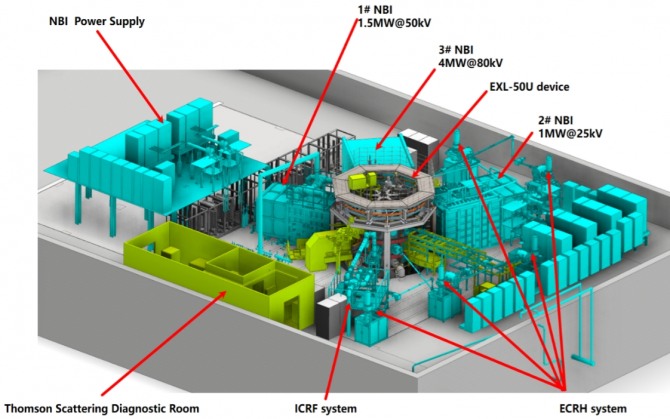
ENN Group, a private energy company headquartered in Langfang, Hebei province, announced on September 29 that its EXL-50U spherical torus device achieved controlled p-11B fusion with over 100 million reactions per second. The company says it reached this by combining high-energy neutral beam injection with precisely tuned high-frequency radio waves, targeting the plasma at what physicists call the first resonance peak—the narrow energy band where proton-boron collisions are most likely to fuse. By heating only that sweet spot instead of the entire plasma volume, ENN claims it avoided the wasteful blanket-heating approach that has stalled earlier attempts.
An international review panel of roughly ten researchers from universities and research institutions convened after the experiment and unanimously confirmed that alpha particles— the signature helium nuclei produced by p-11B fusion—were detected reliably and repeatably. The panel called the result a significant contribution to magnetic-confinement aneutronic fusion research.
Those are real milestones. They are also narrow ones.
The gap between detection and demonstration
Detecting alpha particles in a controlled lab shot is fundamentally different from sustaining a power-positive fusion reaction, and it is fundamentally different again from building a device that can generate net electricity at grid scale.
The plasma temperatures required for p-11B fusion are estimated at 300 million to 1 billion degrees Celsius—two to three times hotter than what deuterium-tritium reactors need. Even at those extremes, the fusion cross-section for proton-boron is dramatically smaller than for deuterium-tritium, meaning far fewer reactions per collision. That is why this reaction has remained theoretical for so long and why only a handful of companies worldwide—TAE Technologies in California,Marvel Fusion in Germany—have seriously attempted it.
Reaching 100 million reactions per second in a small spherical torus is an engineering achievement. Converting that reaction rate into net electrical power requires the device to produce more energy than it consumes to sustain the plasma—a threshold known as Q greater than one. ENN has not published a Q value. It has not published the input power required to achieve the reaction, the confinement time, or the energy balance. Without those numbers, the result sits firmly in the proof-of-concept category.
Why the timing matters
ENN is not a university lab working on a grant. It is a privately funded company with a commercial roadmap and a construction permit in hand. The company broke ground in mid-September on Helong-2, a third-generation spherical torus facility spanning 120 acres in Langfang, with a target completion date of 2027 and first hydrogen-boron power production claimed for sometime in the 2030s. A demonstration plant is slated before 2035.
That timeline is aggressive for any fusion project, aneutronic or otherwise. The most optimistic publicly tracked fusion programs—ITER, the Joint European Torus, the U.S. Department of Energy’s National Ignition Facility—have been iterating for decades on deuterium-tritium physics, which is comparatively easier. An aneutronic program moving from first plasma to a power plant in under a decade would represent a quantum leap in fusion engineering.
It is not impossible. But it is far from demonstrated.
Who wins if ENN is right—and who loses
If ENN’s claims hold up under independent scrutiny and repeated testing, the implications are seismic. The tritium supply chain—currently a bottleneck for every D-T fusion program on Earth—becomes irrelevant. Boron is abundant and inexpensive. Radiation shielding requirements vanish, dramatically reducing the cost and complexity of a fusion plant. Direct electrical conversion could push thermal efficiency well above the 40 percent ceiling that limits conventional steam-cycle plants. The economics of baseload clean energy shift overnight.
Several U.S. and European startups that have been raising billions on D-T physics would face an existential repositioning. TAE Technologies, which has raised over a billion dollars pursuing hydrogen-boron fusion using a beam-driven approach rather than magnetic confinement, would find itself in competition with a Chinese company that claims to have already achieved controlled reactions in a magnetic device. The IP landscape would fracture. Patents filed by Western firms on D-T first-wall materials, tritium breeding blankets, and neutron-moderation systems would become largely obsolete.
China’s state-run fusion programs—the EAST tokamak in Hefei and the planned CFETR prototype—are pursuing the D-T path on a national scale. ENN’s aneutronic bet represents a parallel track that could eventually outflank the state program, much as Chinese private space firms have challenged CNSA’s traditional dominance. If the technology works, Beijing gains not just an energy advantage but a strategic one: a fusion pathway that sidesteps the very materials and waste problems that constrain its rivals.
What to watch next
Three things will determine whether this is a genuine inflection point or an overreach dressed in peer review.
First, independent replication. ENN’s validation panel was assembled by the company and its findings have not yet appeared in a refereed journal with full experimental data. Other laboratories with spherical torus or stellarator capability—particularly teams at the Chinese Academy of Sciences, MIT, or the Max Planck Institute—need to reproduce the reaction under their own instrumentation. Science moves on reproducible data, not press releases.
Second, the Q value. Any fusion claim must answer the question: did the device produce more energy than it consumed? Without that number, the result is an interesting physics demonstration, not an energy breakthrough. ENN should publish the energy input, the fusion yield, and the confinement time alongside the alpha-particle measurements. Transparency is the minimum bar for a claim this large.
Third, the Helong-2 timeline. If the facility reaches first plasma on schedule in 2027 and begins reporting sustained p-11B reactions with improving energy gain, the market will have to take ENN seriously. If the dates slip—as they routinely do in fusion projects—the skepticism returns.
The bigger picture
The world needs fusion. The climate math is unforgiving, and no clean energy portfolio is complete without a reliable baseload source that produces no carbon and no long-lived waste. Hydrogen-boron fusion, if it ever materializes, would be the cleanest possible answer to that need.
But the history of fusion is a graveyard of premature announcements. Every major program has claimed commercial viability within a decade, and every major program has been wrong. The difference with ENN is that it is betting private capital on a harder reaction than the one ITER is pursuing. That is bold. It is also risky.
The scientific community should welcome the attempt. The energy markets should wait for the proof.