China Just Beat Usain Bolt With a Robot
A Chinese humanoid robot clocked 9.39 seconds in the 100m at the World Humanoid Robot Games, breaking Usain Bolt's world record. The milestone signals Beijing's accelerating push to dominate physical AI — and it matters far beyond sports.
The Clock Doesn’t Care About Geopolitics
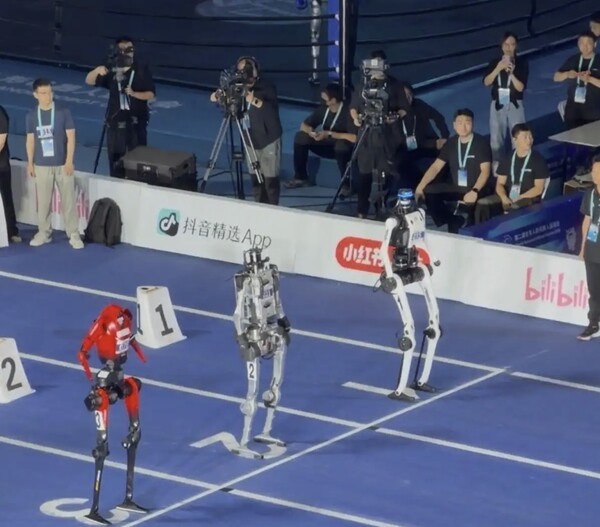
Nine point three nine seconds. That is the time a humanoid robot named Tiangong Ultra used to run 100 meters at the Second World Humanoid Robot Games in China on August 23rd. Usain Bolt’s record — the one that stood for over a decade as perhaps the most iconic number in all of athletics — was 9.58. The margin is slim by human standards. By robotic ones, it is enormous.
What happened in Beijing matters less as a sports story than as a signal flare from China’s robotics establishment. The event itself is not a sideshow. It is a coordinated demonstration of capability, and the choice of metric — the sprint — is deliberate. The 100-meter dash is the simplest, most universally understood measure of speed. Beating Bolt’s time in front of a global audience tells a story that no technical white paper ever could.
The Robot Behind the Clock
Tiangong Ultra is developed by the Beijing Humanoid Robot Innovation Center. It stands 180 centimeters tall and weighs 52 kilograms — not dramatically different from a human frame, which makes the performance all the more striking. In April 2025, it won the Beijing Yizhuang Half Marathon with a time of 2 hours, 40 minutes, and 42 seconds. The 100-meter run is a different beast entirely, demanding something the marathon did not: raw, burst power managed by software.
Guo Yizhi, the lead developer on Tiangong Ultra, told Beijing LvBao that the robot did not win by exploding out of the blocks. Its start was slow. It pulled ahead late, using a higher top speed to close the gap. The key detail he emphasized was autonomy — the robot ran entirely on its own, without remote control or pre-programmed trajectory tracing. That distinction separates a novelty from a product.
The improvements that enabled this run were systemic. Joint torque output increased. Rotation speed at the actuators went up. The battery capacity was enhanced. Underpinning the hardware was a reinforcement-learning algorithm trained to optimize gait patterns for speed. All of those changes together represent the kind of integrated engineering cycle that takes years in traditional robotics and months in the current Chinese environment, where development pipelines move with unusual urgency.
Why This Story Is Bigger Than a Race
Western coverage of Chinese robotics tends to orbit two narratives: that Beijing is copying Western designs, or that the technology remains far from commercial viability. Both frames are outdated. The Tiangong Ultra run does not prove China has conquered humanoid robotics. It proves the gap between rhetoric and reality is wider than most English-language outlets acknowledge.
The World Humanoid Robot Games itself is noteworthy. This was only the second edition, organized in China, featuring a multi-event format that includes the 400 meters, 1500 meters, and a 4×100-meter relay — all disciplines where sustained speed, stamina, and coordination matter. A robot that can sprint fast but cannot sustain pace or handle relay handoffs has limited utility. Beijing is building a competition that rewards the full spectrum of humanoid capability, not just a single sprint moment.
China has been investing heavily in humanoid robotics as part of its broader push into artificial intelligence and advanced manufacturing. The logic is straightforward: if a robot can move like a human through a human-built environment, it can work in factories, warehouses, construction sites, and potentially beyond. Speed is not the end goal — it is proof that the underlying control systems, power delivery, and balance algorithms are advancing rapidly enough to make those applications feasible.
Who Wins, Who Loses
The winners from this moment are clear: the Chinese robotics ecosystem, the Beijing Humanoid Robot Innovation Center, and the companies and research institutes feeding data and engineering talent into it. The Tiangong line now has a public benchmark — a number attached to its name that circulates globally and will be cited in future pitches, funding rounds, and procurement conversations.
The losers are less visible but equally real. Investors and partners who priced Chinese humanoid robots as years away from competitive performance now face a recalibration. Supply chains that assumed Western-designed or Japanese-designed humanoids would set the standard face uncertainty. The assumption that the hardest problems in robotics remain unsolved by Chinese teams is weakening with each public demonstration.
Manufacturing clients evaluating humanoid robots for their factories will also need to adjust their timelines. Speed records do not equal operational readiness, but they do compress the window during which skeptics can dismiss the entire category. Every second shaved off a race makes the next conversation about deployment timelines shorter and more urgent.
What Comes Next
Tiangong Ultra is scheduled to compete in the 400 meters, 1500 meters, and the 4×100-meter relay at the same event. Each of those races tests a different dimension of capability. The 400 meters demands speed endurance. The 1500 meters tests stamina and pacing. The relay introduces coordination under time pressure — arguably the closest a robotics event comes to simulating real-world teamwork.
If Tiangong Ultra performs across all three, the narrative shifts from one impressive sprint to a broader claim of versatility. If it falters in the longer distances, the 100-meter record becomes exactly what it is — a single-data-point highlight, impressive but incomplete.
The more consequential trajectory lies beyond the games. Beijing’s approach to humanoid robotics has always emphasized rapid iteration and public demonstration as much as laboratory research. The next six to twelve months will likely bring more competitions, more product announcements, and more international attention focused on Chinese-developed platforms.
The 9.39-second run will not be the last time a Chinese robot breaks a human benchmark. It may not even be the most important one. But it is a clean, undeniable number — and in the race for dominance in physical AI, numbers like that change the conversation.