Chinas Transformer Robot Signals a New Phase in the Humanoid Arms Race
China's HFUN-TECH unveiled a quadriform humanoid robot at WRC 2026 that morphs between bipedal, wheeled, mobile chair, and carrier modes. The product signals a shift from human-like aesthetics toward practical, cost-conscious engineering — and a new competitive dynamic in the global robotics race.
Beyond the Human Face
China’s humanoid robot strategy has been easy to misread. For years, the narrative centered on imitation — make robots look like people, move like people, and they will fit into human spaces. The market responded with an army of bipedal machines that looked impressive at trade shows and struggled in warehouses.
At the World Robot Conference in Beijing on August 21, that script changed.
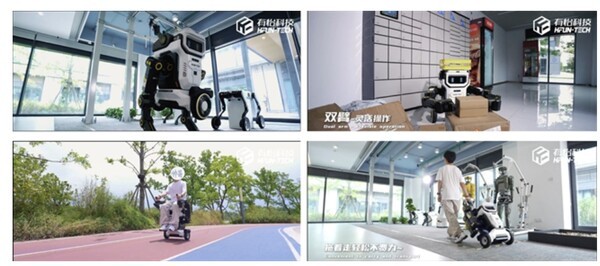
HFUN-TECH (有怡科技) launched its T01, a robot that refuses to stay in one form. It transforms between two-legged walking, wheeled transport, a mobile chair, and a rolling carrier — four modes in a single chassis. The company calls it the world’s first “transformer humanoid architecture.” Whether that claim holds up against competitors who have toyed with similar concepts remains to be seen. What is clear is the direction: Chinese robot makers are moving away from pure anthropomorphism toward utility-first design.
The Four Modes
The T01 is not trying to fool anyone into thinking it is human. That is the point.
In bipedal mode, it uses an integrated limb design that allows both legs and arms to operate from a single body structure — a simplification that cuts hardware complexity and parts cost. In wheeled mode, it reconfigures for speed and energy efficiency on flat surfaces, something bipedal robots inherently struggle with. The mobile chair and carrier modes address gaps that most humanoid robots ignore entirely: people need places to sit, and factories need things to move.
The robot switches between modes autonomously, using environmental sensors and task conditions to decide which form makes sense at any given moment. Long-distance transport? Roll. Complex terrain? Walk. The system schedules these transitions rather than waiting for operator input.
This is pragmatic engineering. It also undercuts the premium pricing that comes with complex bipedal locomotion — a critical factor when the goal is commercial deployment at scale.
Why This Matters Beyond China
WRC 2026 drew more than 300 companies from China and abroad, showcasing over 2,000 products and 150 new launches. The sheer volume of exhibits signals that China has moved past the prototype phase into what can only be described as a mass production mindset for humanoid robots.
For international observers, the T01 represents something more specific than Chinese ambition. It represents a design philosophy that Western and Japanese competitors are slow to adopt. Boston Dynamics, Figure AI, and Tesla’s Optimus have all bet heavily on the two-legged form factor as the default. They are betting that the future of robotics looks human. HFUN-TECH and a growing cohort of Chinese firms are betting that the future of robotics simply works.
That bet has economic logic. A robot that can walk and roll uses less energy than one that walks everywhere. A robot that folds into a carrier solves a logistics problem a pure humanoid cannot. Component simplification drives down cost, which drives down the price threshold for commercial adoption. In an industry where per-unit costs remain the single biggest barrier to deployment, this approach is not just different — it may be decisive.
The Supply Chain Angle
The source material notes HFUN-TECH’s explicit plan to accelerate commercialization through hardware simplification and parts cost reduction. That strategy implicitly depends on access to China’s mature robotics supply chain — actuators, sensors, reducers, and battery systems — all of which have seen massive domestic investment over the past five years.
What English-language coverage has largely missed is the cross-border dimension. Korean robotics firms have been quietly integrating Chinese supply chain components into their own humanoid platforms, drawn by cost advantages that domestic Korean suppliers cannot match. The T01’s existence, and its design choices, reflect a broader ecosystem shift: Chinese robot makers are no longer just competing on price, they are setting the design agenda. Firms in Korea, Japan, and elsewhere that fail to adapt to this new coordinate system risk being pushed into a supporting role in their own market.
Who Wins and Who Loses
Winners are the operators — logistics companies, hospital networks, service providers — who can deploy robots that do more than one thing without buying more than one platform. The T01’s multimodal design reduces the capital outlay required to cover diverse use cases.
Winners are also Chinese component suppliers, who benefit from a domestic market demanding simplified, cost-optimized designs at volume.
Losers are the pure-humanoid purists whose product differentiation rests on anthropomorphic appearance or performance milestones rather than total cost of ownership. The market is beginning to reward function over form, and that is a dangerous place to be if your entire brand is built on looking human.
What Happens Next
HFUN-TECH will need to prove the T01 can actually transition between modes reliably in real-world conditions. Concept demos at conferences are routine. Deployment in a functioning warehouse or hospital corridor is where the architecture will be tested. The company’s cost-reduction roadmap suggests it is aiming for commercial shipments within the next funding cycle, but no timeline was disclosed at the launch.
Competitors will respond. Figure, Tesla, and Chinese rivals including Fourier Intelligence and Unitree are all racing toward commercial deployment. The T01 forces them to justify the bipedal-only approach on grounds other than familiarity. If the transformer architecture proves robust, it could become a reference design for the next generation of utility-first humanoid robots — not just in China, but globally.
The WRC 2026 floor made one thing clear: the humanoid robot industry is no longer asking whether these machines will be commercially viable. It is arguing about what shape viability should take.