China's Moon Ice Hunt Reshapes Commercial Space Economy
China's upcoming Chang'e-7 mission aims to harvest lunar water ice, a move that could unlock a profitable commercial economy for fuel and life support while accelerating Beijing's timeline for a crewed moon base. The US, still focused on its own Artemis program, risks falling behind in the race to secure resources and set standards.
The Cold Trap That Changes Everything
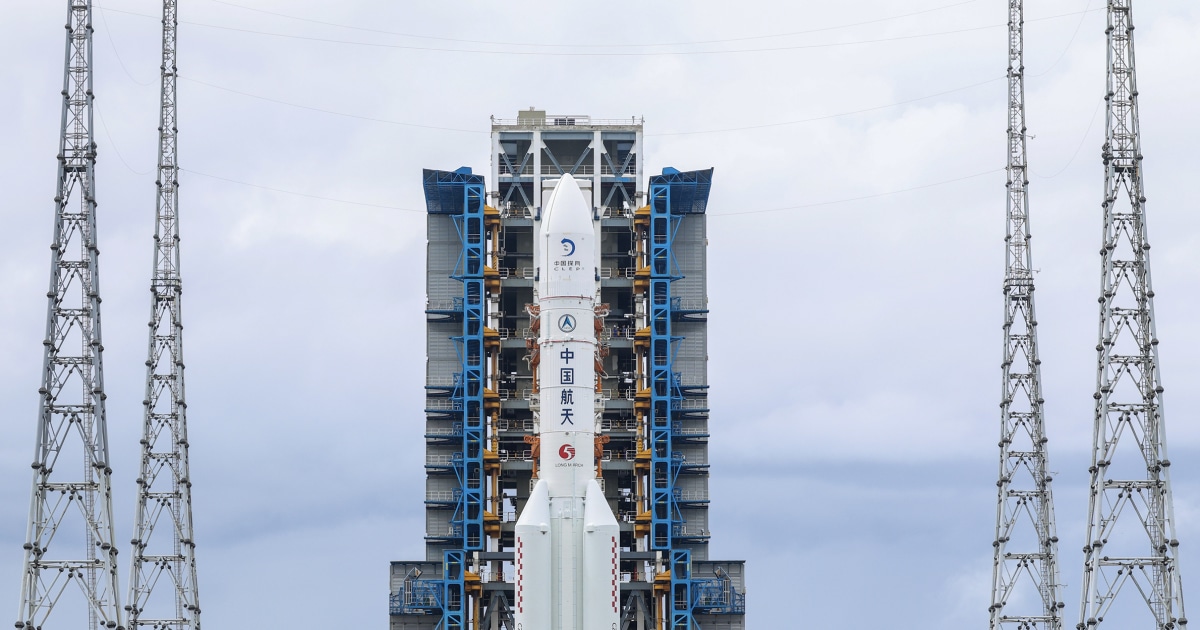
China is about to send its most ambitious robotic mission to the moon yet. Chang’e-7 will lift off next week from Hainan on a Long March 5 rocket, carrying a lander, a rover, and a hopping probe toward one of the solar system’s coldest places: the south pole.
The target is not the bright, dusty highlands that have drawn human footprints before. It’s the shadowed craters where temperatures plunge to minus 203 degrees Celsius. There, ancient water ice may be preserved in eternal darkness. Finding it would be more than a scientific triumph. It would be a resource strike.
Water on the moon is not just a novelty. It’s a potential fuel source. Split into hydrogen and oxygen, it can power rockets. It can sustain astronauts. Every kilogram lifted from Earth is extraordinarily expensive. If water exists near the surface at the lunar south pole, it could dramatically cut the cost of building a permanent human presence there.
China’s timing is deliberate. The mission is expected to land around November. That schedule aligns with Beijing’s public goal of a crewed lunar landing before 2030 and a joint research station with Russia by 2035. Success here would prove China can operate in the most challenging terrain on the moon and access critical resources. Failure would set that timetable back.
China’s Hopping Probe: A Novel Approach
Traditional wheeled rovers struggle on steep crater rims. They can climb up, but descending into pitch-black depths is risky. Chang’e-7 takes a different path. The hopping probe uses small thrusters to fly into shadowed craters, land on six articulated legs, then hop back to sunlit areas to recharge its batteries.
This is unproven technology. No spacecraft has performed controlled hops on the moon before. China has not released weight, engine performance, or flight-range figures. State media say the probe will attempt at least three hops. But the design itself signals a willingness to tackle problems that stump conventional engineering.
Why take that risk? Because the payoff could be enormous. If the hopper can safely sample ice from crater floors, it would demonstrate that China can access water deposits that are otherwise unreachable. That capability would give Beijing an edge in any future commercial or scientific operation at the south pole.
Who Wins, Who Loses
The immediate winner is China’s space program. A successful Chang’e-7 landing would place Chinese technology in the most scientifically valuable region of the moon. It would also project an image of precision and ambition at a time when China’s economy faces headwinds.
The losers are less obvious. India has already landed near the south pole with Chandrayaan-3 in 2023. Its next missions will likely focus on similar targets. Japan and Europe are developing their own probes. Russia is partnering with China on the planned research station. No single nation dominates the region yet, but whoever establishes a foothold first may set informal norms about usage, safety zones, and data sharing.
Commercial companies stand to gain most. Water ice could become the moon’s first export commodity. A fuel depot in lunar orbit or on the surface would change the economics of deep-space missions. If China secures claims or operational rights to ice-bearing craters, private firms may need to negotiate with Beijing rather than with Washington. That shifts leverage in the emerging space economy.
The US Lagging Behind?
The United States is not ignoring the south pole. NASA’s Artemis program aims to return astronauts to the moon by 2028 and establish a sustained presence. The agency’s VIPER rover, the European Space Agency’s PROSPECT drill, and the Japan-India LUPEX mission are all headed there. But none are scheduled for immediate launch.
Artemis itself has faced delays. The crewed flyby in April, which carried four astronauts farther from Earth than any humans before, was a milestone. But landing astronauts on the surface still requires new hardware, including the Starship lander and the Space Launch System rocket, both of which have encountered technical hurdles. Funding and political support for Artemis have been uneven.
China, by contrast, has been executing its lunar program with steady cadence. Chang’e-4 landed on the far side in 2019. Chang’e-5 returned lunar samples in 2020. Each mission built on the last, refining techniques for landing, sampling, and returning. Chang’e-7 is the next logical step. The Chinese approach is incremental but relentless.
The US response may lag because its priorities are split. Artemis is human-centric, focused on getting astronauts there. Commercial space companies like Blue Origin and SpaceX are also competing for contracts, but their lunar landers are still in development. Meanwhile, China is building a state-led constellation of robotic missions that map, characterize, and potentially exploit lunar resources.
What Comes Next
If Chang’e-7 finds water, the race will intensify. Other nations and private companies will accelerate their own missions. The lunar south pole could become a hotspot of activity within a decade, with multiple landers and rovers operating in close proximity.
That raises questions about coordination. Who decides where rovers can drive? How are water rights handled? There is no international treaty governing resource extraction on the moon. The 1967 Outer Space Treaty prohibits national appropriation, but says nothing about private ownership of extracted materials. The US and Luxembourg have passed laws allowing private companies to sell lunar resources. China has not. Expect debates over these rules to grow louder as more actors arrive.
For the commercial economy, the implications are profound. A single successful demonstration of in-situ resource utilization could unlock billions in investment. Companies could sell rocket propellant to other missions, offer life-support supplies, or build infrastructure for future tourists. China’s early move could give its domestic industry a first-mover advantage.
But there is also room for cooperation. The scientific community benefits from shared data. Multiple missions studying the same craters can produce a richer picture of lunar geology. If China and the US, or China and the ESA, coordinate their missions, they could avoid conflicts and maximize returns.
The Bigger Picture
China’s moon mission is not just about science or prestige. It is about positioning for an economy that does not yet exist. Water on the moon could become the most valuable commodity in cislunar space. Whoever controls the taps influences the flow of commerce, exploration, and perhaps even conflict.
The US remains the leader in lunar exploration, but its lead is narrowing. Artemis has a lofty timeline and a complex portfolio of new vehicles. China has a proven track record and a clear roadmap. The next few years will show which approach delivers.
For now, the world watches Chang’e-7. If the hopping probe touches down in a shadowed crater and returns data on water ice, it will mark a turning point. The lunar race will shift from who can visit first to who can stay longest and profit most. China is betting that it can be both.