How Citizen Scientists Proved That Spacecraft Can Outlive Their Handlers
When NASA abandoned ISEE-3 in 1997, the probe kept flying — and its ground systems were gone. A crowdfunding team of amateurs rebuilt command capability and fired thrusters after 27 years. The larger burn failed, but the achievement exposed a new kind of space mortality and a new model for who gets to operate big science.
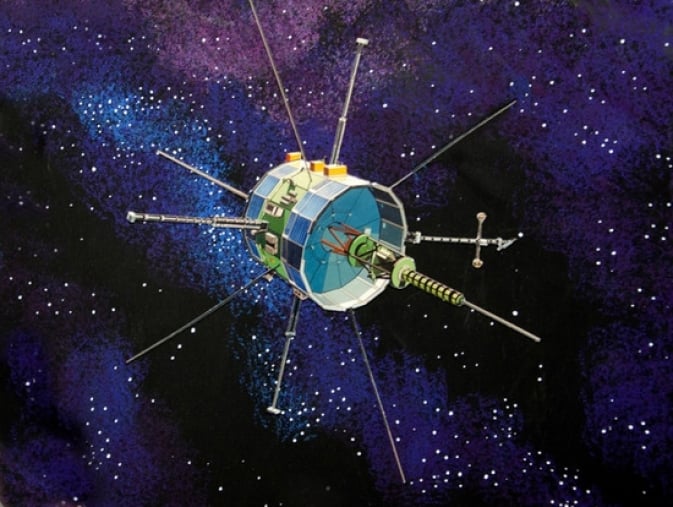
The probe that nobody owned was still listening
When NASA formally terminated ISEE-3 on May 5, 1997, the agency did something quietly radical: it left the transmitter on. The spacecraft had completed two milestone missions — first as the pioneer of halo orbits at the Earth-Sun L1 point, then as the International Cometary Explorer that flew through Comet Giacobini-Zinner in 1985. Its hydrazine thrusters went silent after 1987. Its ground equipment was dismantled. Its budget line disappeared.
But the spacecraft kept orbiting the Sun. It kept transmitting a carrier signal that no one on Earth was configured to decode.
This is the story most people miss about dormant space assets: they rarely die a single death. There is the mechanical death — consumables running out, components degrading. And there is the institutional death — the moment when the budgets dissolve, the procedures vanish, the specialists move on, and the hardware becomes an orphan despite still functioning. ISEE-3 survived the first kind long enough for a second kind to catch up. Then something unexpected happened.
A team with no mandate rebuilt a control room from scratch
In 2014, ISEE-3 made its closest approach to Earth in decades. A group of independent engineers, scientists, programmers and radio operators saw a narrow window and decided to use it. They called themselves the ISEE-3 Reboot Project, led by Keith Cowing and Dennis Wingo through Skycorp and the Space College Foundation. They had no NASA funding. They raised money publicly.
What they did next was technically audacious. The Deep Space Network hardware that could talk to ISEE-3 had been removed after the mission ended. There was no archived facility waiting to take up the slack. Instead, the team built a modern command system around software-defined radio — recreating 1970s signal formats in code rather than restoring obsolete hardware component by component. They pointed the 300-metre Arecibo telescope at the probe. They coordinated with a 20-metre dish in Bochum, Germany, and NASA antennas for tracking and reception.
By late May, two-way communication was re-established. ISEE-3 entered engineering mode. Telemetry began flowing back — power levels, temperatures, instrument status. Five scientific payloads appeared to be functional. The spacecraft was not just detectable; it was conversational.
NASA’s role was equally unconventional. The agency granted a non-reimbursable Space Act Agreement — the first of its kind for a spacecraft NASA neither owned in any operational sense nor planned to reuse. It authorized a private team to command a government asset under defined legal and safety terms. NASA supplied permission and coordination, not money, not engineering staff, not mission authority beyond the agreement’s boundaries.
This arrangement matters because it established a precedent that could reshape how agencies interact with non-government actors in deep space. There is no rule that says a retired spacecraft must go completely dark once its institutional backing ends. There is no requirement that ground control capability be permanently lost when a mission concludes.
Eleven pulses answered a question no one had asked before
On July 2, 2014, the team commanded eleven short bursts from ISEE-3’s spin thrusters. The spacecraft had been rotating at 19.16 revolutions per minute — close, but outside the 19.75-plus-or-minus-0.2 tolerance required for the planned trajectory maneuver. The pulses brought it to 19.75 rpm. It was the first thruster firing since 1987.
The achievement itself was modest in delta-v terms but enormous in what it proved. Hydrazine reached the catalyst beds. Valves opened. Heaters brought the propulsion system into operable state. Commands built by people who had never sat in the original control room were received correctly across millions of kilometers.
Then came the burn that would have changed everything.
A larger maneuver revealed the limits of resurrection
On July 8, the team initiated a trajectory correction targeting about 7.3 meters per second of velocity change. The plan called for over 500 pulses from the radial jets — enough to retarget the August 10 lunar flyby and set up a path back toward the L1 or L2 regions. Instead, thrust lasted only long enough to deliver roughly 0.15 meters per second before fading away.
The diagnosis, published in Acta Astronautica and corroborated by NASA’s HEASARC mission records, points to depleted nitrogen pressurant. ISEE-3 used compressed nitrogen to push hydrazine from its tank through the propulsion plumbing. Without that pressure, fuel remained aboard but could not reach the thrusters. A small residual supply sustained the eleven spin-up pulses, then collapsed under the demand of hundreds more.
On August 10, ISEE-3 passed within 15,600 kilometers of the Moon and continued into heliocentric orbit. The capture opportunity was gone. Contact deteriorated through September and was ultimately lost. The probe keeps circling the Sun.
The failure was real. But it was a different kind of failure than the one the project was designed to confront.
Two deaths, one survival
The reboot project exposed something important about how we think about spacecraft mortality. ISEE-3 outlived its institutional context for seventeen years. The hardware survived radiation, thermal cycling and vacuum. The ground system — the people, the procedures, the specialized equipment — did not.
This inversion is worth taking seriously as we plan for the future of orbital infrastructure. Satellites and probes are increasingly expensive, increasingly complex and increasingly difficult to replace. We build them to last. We do not always plan for what happens after the mission ends — especially when end-of-life means something as abrupt as institutional dissolution rather than gradual hardware failure.
The AO-7 amateur radio satellite resumed transmitting in 2013 after twenty-one years of silence, triggered by an electrical fault changing state. ISEE-3’s revival was deliberate: a team on Earth reconstructed the ability to speak its obsolete language. But both cases share a common implication — the boundary between active and dormant space assets is thinner than we assume, and the gap between them is maintained by institutional decisions rather than physical inevitability.
What changes if this becomes routine
The non-reimbursable Space Act Agreement was described by NASA as unique at the time. If similar arrangements become standard for orphaned spacecraft, several things follow.
Ground control capability could become a shared resource rather than a sunk cost tied to active missions. Software-defined radio makes the technical barrier lower than it was in 1997 — the Arecibo approach demonstrated that obsolete command protocols can be recreated in code rather than reconstructed in hardware.
Crowdfunded operations could operate alongside institutional ones without requiring ownership transfer. The ISEE-3 agreement did not give the project team any claim to the spacecraft. It granted permission to use existing transmission capability under defined conditions. That distinction — operating without owning — may be the more durable model for future citizen-spacecraft interactions.
The scientific payoff was immediate even after the maneuver failed. The team activated working instruments and made the data publicly available through a portal described by the Planetary Society in August 2014. The five functional instruments on a 1978-era probe could still return data from heliocentric space — data that would have been impossible to collect if the spacecraft had gone entirely dark.
The point is not the probe
Eleven pulses proved that a retired interplanetary spacecraft could answer a new control room assembled by people who never built it. The next several hundred pulses proved that even an extraordinary recovery still answers to one depleted tank.
The ISEE-3 Reboot Project did not rescue the probe. It did something more useful: it demonstrated that the death of a mission is not the death of a spacecraft, and that the knowledge to operate one can be rebuilt from outside the institution that designed it. The nitrogen pressurant ran out. The trajectory was not recovered. But the principle survived — and it is the principle that will matter for whatever comes next.