How a Call of Duty Game Became Korea's Security Flashpoint
Call of Duty: Modern Warfare 4 depicts a North Korean coup backed by Russia and a full-scale invasion of South Korea — and a top opposition figure just urged the president to play it. The game has turned into an unlikely weapon in Korea's security debate.
The Game That Reopened an Old Wound
Call of Duty: Modern Warfare 4 is not a documentary. It is a work of entertainment built by a US developer at Infinity Ward, drawing on the global popularity of K-pop and K-dramas as a marketing point for why Korea deserves a place in its narrative. Yet it is being treated in Seoul like a strategic briefing.
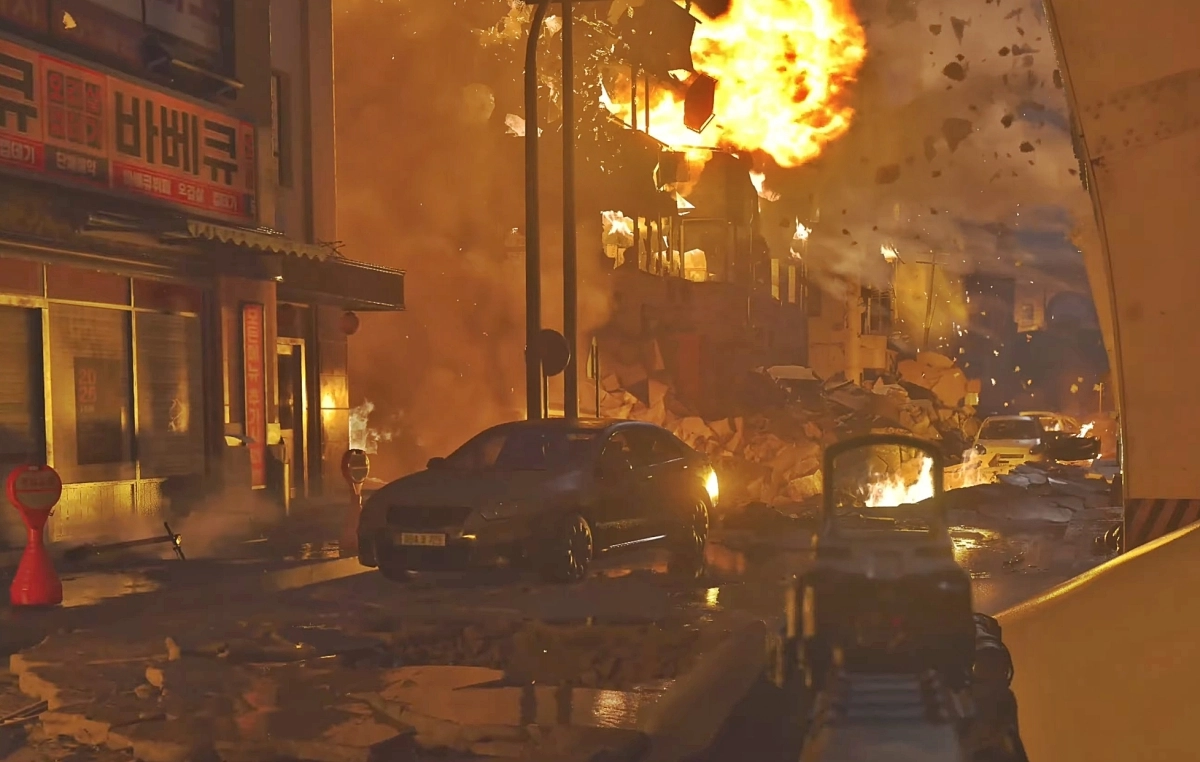
The game’s story unfolds on Oct. 23 release day, with early access already in the hands of digital pre-order buyers since Oct. 16. Its scenario is specific and deliberately provocative: a Russian defense minister voiced by Mads Mikkelsen offers electromagnetic pulse weapons and political backing to hardline North Korean officers. They stage a coup, execute the ruling family’s younger successor, and launch a full-scale invasion of South Korea. Familiar Seoul locations — convenience stores, food alleys, baseball stadiums, construction sites — become kill zones. The Korean marines and US soldiers who oppose them are not abstract forces; they are characters with names and ranks, including a young marine named Park Hyun-joon who barely survives his first ambush.
What makes this particular Call of Duty entry remarkable is not its premise — the franchise has flirted with Korean settings before — but what happened the moment it leaked.
A Politician’s Weaponized Controller
Ahn Cheol-soo, a lawmaker in the opposition People Power Party, used the game as a proxy battleground against President Lee Jae-myung on Oct. 20. He posted a YouTube link to game footage alongside a post accusing the president of harboring a fantasy about North Korea detached from reality.
The spark was Lee’s remarks the day before on the transfer of wartime operational control — a longstanding point of contention in South Korea-US alliance management. Lee argued that South Korea’s conventional military ranks among the world’s top five and that its defense budget already exceeds North Korea’s annual GDP. He also characterized nuclear weapons as a last-resort defensive tool, implying that the risk of actual nuclear combat remains remote.
Ahn’s response was unusual for a Korean politician: he did not cite an intelligence report, a white paper, or a think tank analysis. He told the president to play a video game. “If you don’t understand the risk of North Korean provocation, at least play Call of Duty: Modern Warfare 4,” Ahn wrote.
The subtext was clear. Ahn was arguing that Lee’s confidence in South Korea’s conventional deterrence overlooks the possibility of a catastrophic escalation scenario — one that does not require a nuclear exchange to devastate Seoul. The game, for all its fictional scaffolding, models a pathway: Russian backing, a North Korean internal power struggle, an EMP strike that blinds Seoul’s power and communications grids, followed by ground assault. Whether Ahn believes that pathway is likely or merely possible, he is using it to frame Lee as dangerously complacent.
Who Wins and Loses From This Framing
Ahn gains a rhetorical shortcut. Instead of entering a dry debate about operational control timelines or force posture, he offers a visceral, sensory experience that players can absorb in hours rather than weeks. The game compresses months of strategic analysis into a sequence of firefights and narrative choices.
Lee loses credibility on his own turf. His argument rests on quantifiable metrics — rank, budget comparisons, capability assessments. Ahn sidesteps those numbers entirely and reframes the question around worst-case plausibility. If the president cannot engage with the scenario the game presents, his position begins to look like denial rather than analysis.
The North Korean regime loses nothing directly, but the game reinforces a Western-American media stereotype that Seoul already wrestles with: the portrayal of the DPRK as an unpredictable actor capable of internal implosion and external aggression simultaneously. That framing can harden public opinion in ways that make diplomatic flexibility more difficult for any South Korean administration.
The Controversy Was Inevitable
Critics began raising concerns as early as May 2026, when the game was first revealed. Sarah Son, a Korean studies researcher at the University of Sheffield, told the BBC that representing an unfinished war as entertainment could trigger painful memories for a population that has lived under the armistice for more than seven decades. Domestic commentators echoed the concern, warning that the game could deepen hostility toward North Koreans and normalize the idea of conflict as leisure.
Infinity Ward’s narrative director Jeffrey Negus pushed back, telling Yonhap News that the studio chose Korea because of the country’s growing cultural footprint worldwide and insisted the game focuses on individual choices under duress rather than political messaging. He said the team consulted Korean employees and military specialists to get equipment and cityscapes right. That defense is standard for the franchise but rings thin here. The game is set in living memory territory — places where real people live, shop, and commute — and depicts mass executions of civilians ordered by a fictional North Korean commander. Whether the intent was political or commercial, the effect is indistinguishable from propaganda to anyone who has experienced the Korean War’s aftermath.
What Comes Next
The game’s release will dominate Korean gaming conversations for weeks. Ahn’s intervention ensures it will also dominate political ones. Watch for three developments:
First, a potential escalation in rhetorical warfare. If Lee does not directly address Ahn’s challenge, his camp risks appearing evasive on a security issue. If he does engage with the game, he risks legitimizing a fictional scenario as a serious policy reference point.
Second, a renewed debate over wartime operational control. Lee’s position on early transfer has been controversial among alliance hawks; Ahn’s use of the game gives that debate a new cultural wrapper that could attract younger voters more familiar with interactive media than with alliance treaties.
Third, a broader reckoning in Korean entertainment about how far creators can go with conflict scenarios set in living memory. Other publishers will notice that Call of Duty faced minimal backlash in Western markets for its Korean setting while generating significant domestic controversy in Seoul. That asymmetry will shape future decisions about where and how the franchise — and similar titles — choose to set their stories.
The most important implication, however, is cultural. An American video game is now a primary tool in a South Korean legislative dispute about national security. That reversal of direction — from Washington to Seoul via a controller — is a signal of how deeply geopolitical imagination has migrated into entertainment spaces. The audience that plays this game will not necessarily agree with Ahn’s politics, but they will carry its imagery into every subsequent conversation about North Korea.
The Bottom Line
Modern Warfare 4 is not a strategy guide. It is a product designed to sell copies, and its Korean setting was chosen partly because Korean culture has global appeal. But products do not exist in a vacuum. When a politician treats a shooter game as evidence, the distinction between entertainment and intelligence evaporates — and the president bears the cost.