COP31s Fossil Fuel Silence Is a Market Signal, Not Just Diplomacy
The draft COP31 agreement omits fossil fuels entirely — a diplomatic failure that sends a colder signal to investors than any headline might suggest. Here is who wins, who loses, and what changes next.
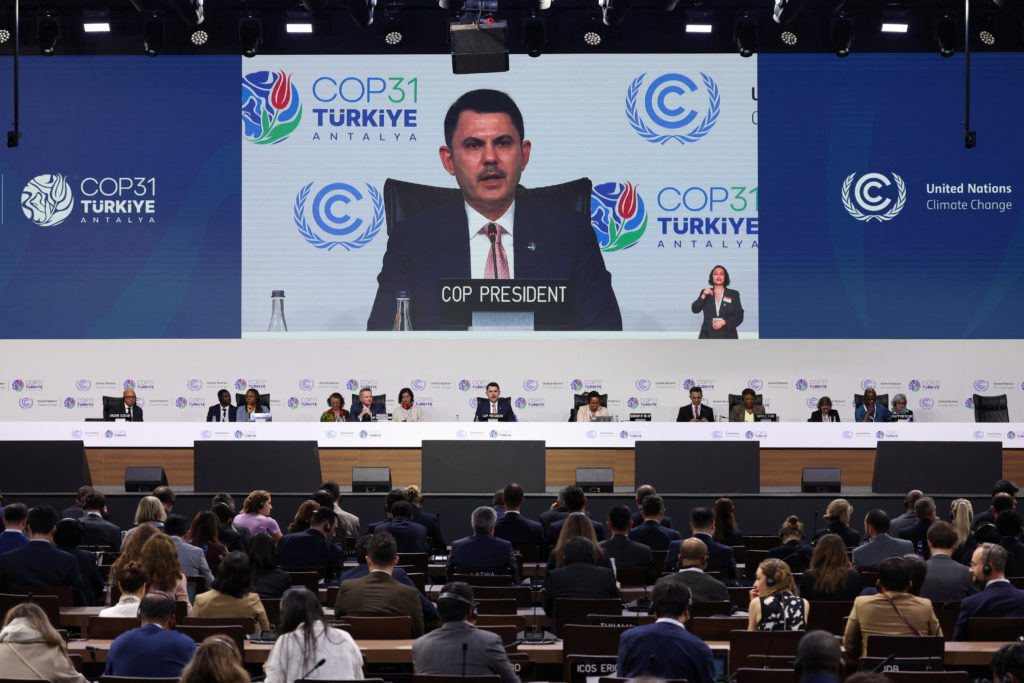
The Empty Hallways Tell the Story
Workers were packing up electronics inside the pavilion area of the COP31 venue in Antalya by Saturday evening. Tens of thousands of participants who had filled the corridors two weeks earlier had thinned to a handful of security guards snapping photos beside deserted exhibition halls. Negotiators were still inside, running on overtime, but the visual alone was damning: a global summit structurally collapsing before its final text was even finished.
The reason is blunt. The draft final agreement contains no mention of fossil fuels whatsoever. A document meant to chart humanity’’s response to a warming planet that is already pushing past the 1.5 degrees Celsius threshold established in the Paris Agreement has simply erased the central problem.
One hundred civil society groups wrote to co-hosts Turkey and Australia on Saturday warning they were “on course to preside over one of the most disappointing COPs” the United Nations has ever held. There were hours left on the clock. Whether those hours produced anything different remained unknown.
What made the scene particularly stark was the contrast with the packed trade floors visible through glass walls — solar panel vendors, green hydrogen startups, and battery storage firms still staffing their exhibits, suddenly rendered invisible by a negotiating process that had excised the very emissions sources those technologies exist to replace. The symbolism cut both ways: market innovation thrives even when diplomacy retreats, but the feedback loop between policy signal and capital deployment has been severed at its most critical junction.
What Gets Lost When Fossil Fuels Disappear From the Text
The omission is not merely symbolic. Language in UN climate agreements functions as a coordinating signal for governments, banks, insurers, and sovereign wealth funds worldwide. When a major multilateral deal references a sector — even critically — it shifts risk assessments. Capital flows adjust. Boards of oil majors recalibrate expansion plans. Renewable developers cite the text to pressure home governments for subsidies and permits.
Remove the reference entirely, and the market reads silence as permission. That is the non-obvious consequence of this diplomatic failure: the deal’’s absence of fossil fuel language does more damage than an explicitly weak clause would. It removes the constraint itself. A poorly worded phase-out commitment still anchors legal challenges, shapes litigation strategy, and gives activists a benchmark against which to measure national progress. No text at all provides no handle for anyone seeking accountability.
The United Nations previously announced that the world is likely to blow past the 1.5 degree Celsius guardrail. The Climate Action Tracker noted that progress on slowing global warming has stalled for five consecutive years, even as heat waves in Europe and flooding in Nepal grow deadlier. The physics are moving faster than the politics, and now the politics are refusing to name the driver.
This pattern repeats across subsidiary texts. References to methane, to coal-specific phase-downs, to stranded asset risks — all absent. For institutional investors managing trillions in portfolios, these omissions compound. Each missing qualifier erodes the evidentiary basis for fiduciary arguments that had been building since the Task Force on Climate-related Financial Disclosures reframed climate risk as material risk. Pension funds in Europe that had quietly begun excluding unabated thermal coal from mandates now face renewed pressure from beneficiary inquiries about whether climate considerations remain operational priorities or have become rhetorical exercises.
Who Wins and Who Loses
The winners from this outcome are narrow and well-defined. Oil and gas producers who have faced mounting regulatory and reputational pressure at every summit since Paris gain breathing room. Companies that built strategic scenarios around a credible fossil fuel phase-out must now revise those models upward. The cost of capital for new extraction projects, which had been creeping higher as lenders priced in transition risk, may stabilize or even improve. Major producers operating in jurisdictions like Guyana, where offshore discoveries continue to attract financing with little sovereign climate conditionality attached, will read this text as validation that demand-side policies remain aspirational rather than enforceable.
National oil companies face a different calculus. State-owned enterprises in countries like Saudi Arabia and the UAE have long treated multilateral climate processes as legitimacy theater — attending to project influence, shaping narrative, extracting concessions without binding themselves. For them, the silence is not a reversal but an affirmation of strategy. The question now is how aggressively they expand capacity while the window of diplomatic scrutiny narrows.
The losers are far broader. Small island nations — Tuvalu’’s Environment Minister Maina Talia spoke plainly about holding the line while watching the room around him stall — face rising seas with fewer political guarantees behind them. Developing countries in the Global South, which have long argued that wealthy nations owe them climate finance for adaptation and disaster recovery, walk away with nothing newly committed and an explicit acknowledgment absent from the text.
The United States, the world’’s largest economy and a top emitter, did not participate directly in these talks. Its absence removes a major carbon emitter from the negotiating table entirely, which amplifies the impact of whatever text emerges. When the biggest polluter is not in the room, the remaining players are both fewer and less capable of delivering globally significant emissions cuts. American climate policy now operates through executive action and domestic legislation rather than diplomatic architecture — a shift that insulates it from collective negotiation but also detaches it from the multilateral feedback mechanisms that once compelled incremental ambition upgrades.
European Union institutions face an internal contradiction. The bloc has positioned itself as the climate agenda’’s standard-bearer while quietly acquiescing to softer language that avoids antagonizing key member states and energy-importing neighbors. The fossil fuel omission resolves that tension externally while deepening it internally — the European Green Deal’’s credibility depends on diplomatic leadership, and that leadership has gone unperformed.
The Finance Gap That Will Define the Next Cycle
Vulnerable nations have been clear: wealthy countries that caused the climate crisis must contribute more to U.N. funds. That demand has circulated through every COP for nearly a decade without meaningfully expanding. The funding shortfall for adaptation alone runs into the hundreds of billions annually. This summit produced no new commitment, no framework, no mechanism — and no mention of the sectors that generate the emissions those funds were supposed to counteract.
The New Collective Quantified Goal on climate finance, negotiated since COP28, remains unrealized. Estimates from the OECD suggest developed countries fell short of the $100 billion annual pledge by several years running, and the replacement figure floated for post-2025 commitments has never breached the low hundreds in actual proposals. With no fossil fuel language anchoring the discussion, there is no textual lever to tie finance flows to emissions trajectories — the two problems decouple entirely.
Teresa Anderson of ActionAid International put it directly: no one knows what is happening behind closed doors, or what the outcome will be. That uncertainty itself is a policy outcome. Markets hate uncertainty more than they hate bad news. A vague, fossil-fuel-free agreement leaves every investor — in renewables, in infrastructure, in insurance — operating without a clear regulatory horizon.
Insurance markets are the canary here. Lloyd’’s and Munich Re have already begun repricing catastrophe exposure in South Asia and the Caribbean on the back of increasingly frequent compound events. But underwriting models require policy signals to justify long-horizon capital allocation. Without them, insurers retreat toward shorter contracts, higher deductibles, and geographic exclusions that disproportionately affect the same developing nations demanding greater finance. The feedback loop closes: no political signal, higher risk premiums, reduced access to capital, slower adaptation, more losses, escalating demands that go unmet.
Private climate finance has partially filled the gap but with distortions. The bulk flows toward mitigation projects in middle-income countries where revenue streams are trackable. Least-developed nations and small island states receive a fraction. The COP31 silence entrenches that distortion by removing the multilateral authority that could credibly redirect priority toward adaptation-heavy jurisdictions.
Market Mechanics Beneath the Diplomatic Surface
What deserves deeper attention is how financial markets are already pricing this outcome independent of the final text. Credit default swaps on diversified energy portfolios have not moved dramatically, suggesting the market sees continuity rather than rupture. But equity analysts covering renewable developers are adjusting discount rates upward, reflecting longer uncertain policy horizons. Tax credit utilization timelines in the United States — driven by the Inflation Reduction Act — provide a partial buffer, but those provisions sunset on fixed dates regardless of international diplomacy.
Sovereign wealth funds with explicit climate mandates, notably Norway’’s GPFG and Qatar Investment Authority, confront a reputational choice. Their governing statutes reference environmental responsibility, yet portfolio companies benefiting from expanded fossil fuel viability are concentrated in neighboring fund holdings. The contradiction between fiduciary duty and stated ESG principles will intensify as boards field shareholder resolutions that previously might have found rhetorical support in strong UN text.
Carbon market mechanisms offer another secondary effect. The Article 6 framework under the Paris Agreement, designed to enable tradable emission reductions, stalled in previous rounds precisely because of disputes over transparency and corresponding adjustments — disputes that fossil fuel language was meant to resolve by establishing baseline expectations. Without that anchor, voluntary carbon markets continue operating in a gray zone where integrity debates persist and corporate net-zero claims grow increasingly vulnerable to scrutiny.
What Comes Next
The next climate summit lands in Addis Ababa, Ethiopia, in November 2027. The trajectory so far suggests the pressure will not ease. Activists already escalated dramatically inside the Antalya venue — one protester wore a red noose and a vest reading “you are killing the future” before climbing onto a table and shouting that the Global South cannot wait. Security removed him, but the image captured the mood: frustration spilling past diplomatic decorum.
Harjeet Singh, a strategic adviser to the Fossil Fuel Treaty Initiative who has attended eighteen summits, said the disagreements remain numerous and unresolved. Five years of stalled progress on emissions reduction have coincided with increasingly deadly disasters. The pattern is now unmistakable.
But the deeper shift may not be in what emerges from Addis but in what bypasses the process entirely. Subnational actors — cities, regions, state-level regulators — are accelerating climate mandates through purchasing power, zoning rules, and procurement standards that do not depend on multilateral consensus. California’’s vehicle emissions rules, the EU’’s CBAM mechanism, and China’’s provincial carbon trading expansions operate at scales that dwarf diplomatic rhetoric. The fossil fuel omission at COP31 accelerates the centrifugal drift of climate governance away from the UN framework and toward these parallel architectures.
The immediate question remains whether the overtime session produces a last-minute insertion of fossil fuel language. If it does not — and the momentum inside the emptying venue suggests it will not — then COP31 will go down as a summit that formally acknowledged the 1.5 degree limit was being breached while refusing to name the emissions sources responsible. That contradiction will echo through boardrooms and budget ministries for years, not as a scandal but as a structural revelation: the multilateral system has outlasted its own relevance, and the markets are already factoring that in.