A Dark Matter Anomaly From the Sanford Labs That Could Reshape Particle Physics
The LZ dark matter experiment at Sanford Underground in South Dakota has reported a single anomalous event that defies known backgrounds. If real, it points to a dark matter particle far heavier than WIMPs — and a crack in the standard model no one expected.
What LZ Found That No One Expected
An international team running the LUX-ZEPLIN (LZ) dark matter detector at the Sanford Underground Research Facility in South Dakota has published results that sit in a strange middle ground — somewhere between anomaly and possibility.
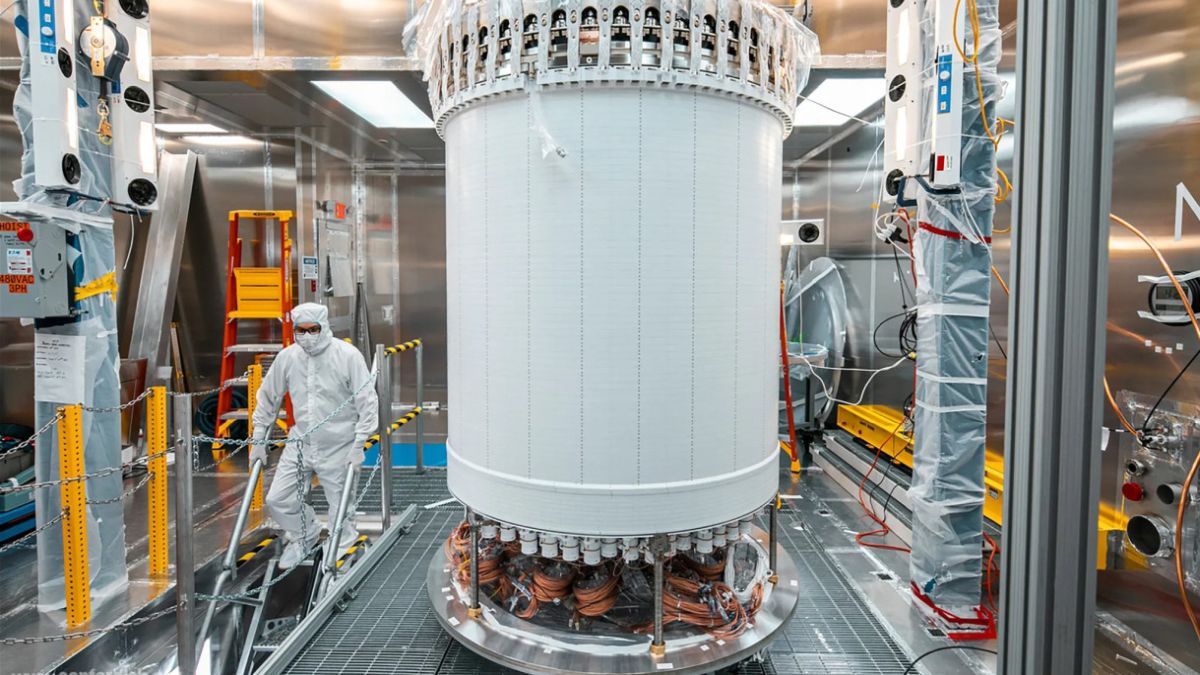
The detector, buried 1.6 kilometers beneath the surface in a former gold mine, sits inside a 10-ton tank of ultra-pure liquid xenon. Its job is to catch the faint flash of light and the stray electrons produced when a dark matter particle bumps into a xenon nucleus. For years, the collaboration has been scanning for exactly that kind of event — the signature of a Weakly Interacting Massive Particle, or WIMP, the leading dark matter candidate.
On September 3, 2026, the LZ team announced a different kind of finding. In 220 days of data collected between March 2023 and April 2024, the collaboration identified a single particle interaction that did not fit any known background source. The team, which includes researchers from institutions across three continents, chose to present the result at the 2026 TeV Particle Astrophysics Conference in Japan rather than bury it in a supplemental table.
The stakes of that choice matter.
A Signal That Does Not Fit the Box
Standard WIMP searches look for interactions in a narrow mass window — roughly 100 times the proton mass. That is the region where most theoretical models predict WIMPs should leave a detectable trace in a liquid xenon detector. LZ has been ruling out parameter space in that region with growing precision, narrowing the possibilities without finding a single confirmed signal.
The new result points elsewhere. The anomalous event, if it is dark matter, corresponds to a particle at least 200 times the proton mass — and possibly heavier. That pushes the signal into territory where the standard WIMP paradigm becomes strained. A particle of that mass would interact so weakly that conventional detection strategies struggle to distinguish it from background. It would also change the timeline for how dark matter decoupled from the early universe, which has implications for cosmological models that go well beyond the detector itself.
Rick Gateske, a physics professor at Brown University and the LZ spokesperson, put it plainly at the conference: the event appeared in the exact region where dark matter signals are expected, in an environment with some of the lowest background noise of any experiment on Earth. But he also said exactly one thing was observed. “We do not want to jump to conclusions,” Gateske said. “We cannot claim we have found dark matter.”
The 0.5 Percent Problem
The collaboration estimates a 0.5 percent probability that the signal is explainable by known background processes. In particle physics, that is not close enough to declare a discovery. The standard threshold for claiming a detection is five sigma — roughly one in 3.5 million. LZ is nowhere near that bar.
But 0.5 percent is also not noise. It is the kind of number that keeps an experimentalist awake at night. It is the kind of result that either gets buried in a supplementary file or reshapes a field, depending on whether another experiment sees it again.
The risk for the LZ team is real. If this were a fluctuation, the collaboration risks being remembered for the one time they mistook a whisper for a shout. If it is real, they risk being remembered for hesitating when the field was ready to move.
Why This Matters Beyond the Sandbox
The broader context is what makes this story travel. For over a decade, the WIMP hypothesis has dominated dark matter research. Detectors in the United States, Europe, and China have all been built to the same basic design — a large volume of noble liquid shielded deep underground, waiting for a nucleus to recoil. None has found a signal. The null results have been precise, powerful, and increasingly frustrating for theorists who built entire programs around particles in a specific mass range.
If LZ’s anomalous event holds up, it does not just add a new data point. It suggests that the dark matter particle may be heavier, slower to interact, and harder to catch than the standard model assumed. That would mean the next generation of experiments needs to redesign their search strategies — not just build bigger tanks, but look in different places.
It would also open a window for alternative theories. Axions, sterile neutrinos, and other non-WIMP candidates already fill that heavier-mass territory. A confirmed signal from LZ would not pick a winner among them. But it would force the field to take them seriously in a way that decades of WIMP-focused null results have not.
Who Wins and Who Loses
The winners, provisionally, are theorists who have argued that the WIMP window is closing. They can point to LZ’s own result — the very experiment designed to find WIMPs reporting an event that looks like something else entirely.
The losers are the experimental programs that built their funding cases on the assumption that WIMPs are just below the current sensitivity threshold. That does not mean their work is wasted. Better constraints are still results. But the narrative that dark matter is “just around the corner” in the classic WIMP mass range is harder to sustain.
Japan’s participation in this result deserves attention beyond geography. Japanese researchers have long been central to rare-event experiments — Super-Kamiokande for neutrinos, XMASS for direct dark matter searches, and now LZ. The decision to present at a conference in Japan signals a subtle shift in where the field’s center of gravity sits. The deepest, quietest experiments are often in places with long histories of handling radiation, precision instrumentation, and underground infrastructure. That includes Japan as much as it includes the United States and Europe.
What Comes Next
LZ will continue running. The collaboration has committed to releasing more data as it accumulates. Whether a second event appears in the next dataset is the question that will determine if this story ends as an interesting anomaly or grows into a rearrangement of particle physics.
Other experiments are watching closely. The XENONnT detector at Gran Sasso in Italy, the PandaX experiment in China, and the upcoming DarkSide-20k in the Laboratori Nazionali del Gran Sasso all operate on similar principles. If LZ’s result is real, one of them should see it too — provided they are looking in the right mass range. If they do not, the burden of explanation shifts back to LZ.
Until then, the scientific community sits in the uncomfortable space between excitement and caution. A single event at 0.5 percent background probability is not a discovery. It is a signal worth chasing. And in the search for dark matter, that is about as much as anyone can ask for.