DeepMind's New Boss Admits the Gap — Then Maps the Path Back
Korey Carmichael Kabkuchoglu takes real command at DeepMind after Hassabis steps to chairman. His first interview is an unvarnished acknowledgment that Google's models lag the frontier — and a bet that agentic workflows and a unified research-product org can close it.
The Honest Opening Move
Korey Carmichael Kabkuchoglu did not flinch.
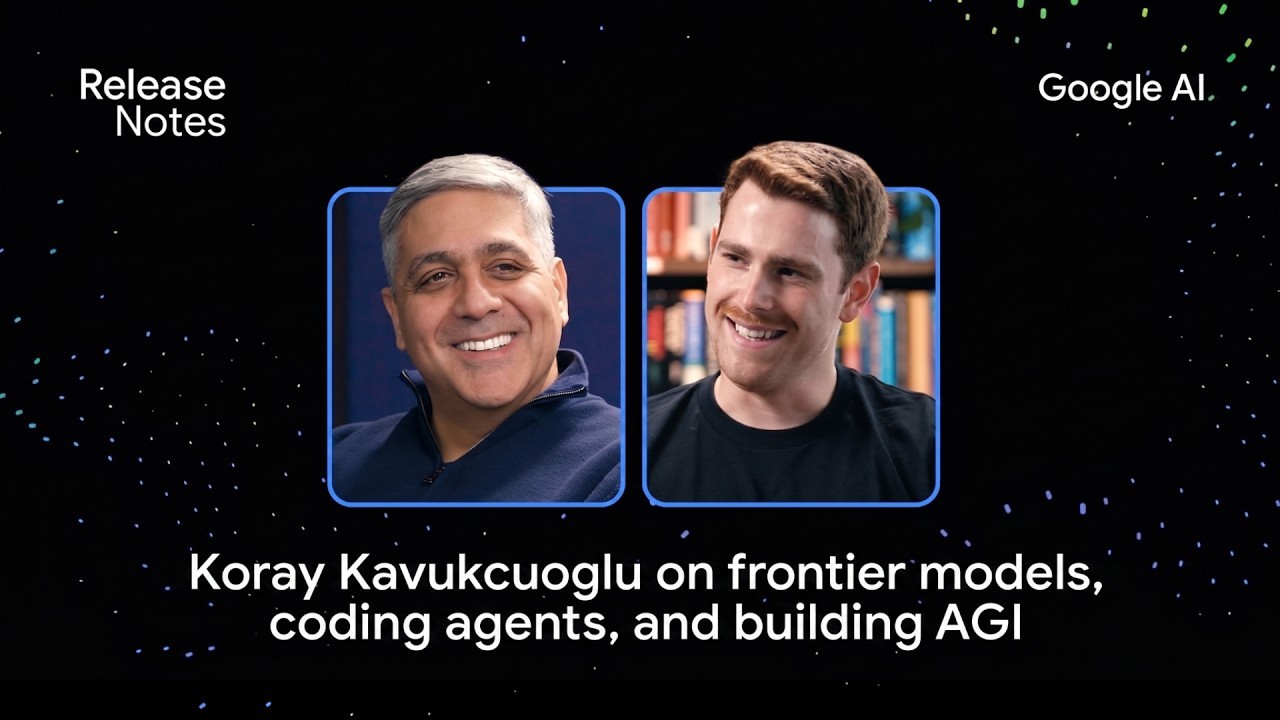
In his first interview since assuming day-to-day command of Google DeepMind — after Demis Hassabis moved to the chairman role — the newly empowered senior vice president looked directly at the uncomfortable reality and named it. “The market’s assessment that our current model quality falls somewhat short of the cutting-edge frontier is a fair critique,” he said on Google’s Release Notes YouTube channel.
That sentence alone is worth tracking. In the usual tech-ceo playbook, a leader emerging from a transition either deflects or doubles down on vague confidence. Kabkuchoglu did neither. He accepted the premise, then built an entire strategic statement on top of it.
“Beyond reaching the frontier summit, we have no other important goal,” he said. “Every decision, every research priority, every resource allocation is aimed solely at achieving that.”
The bluntness signals something unusual at a company that has spent the past two years navigating a widening perception gap against OpenAI and, increasingly, Anthropic. It also suggests Kabkuchoglu — who helped shepherd Google’s TPU development and long-horizon AI investments from the inside — understands that the only credible path forward begins with telling the truth about where they stand.
What Changed in the Org Chart
The leadership shuffle matters more than the titles. Hassabis’s move to chairman is not a retirement; he remains the public face and strategic compass of DeepMind. But Kabkuchoglu now sits at the center of the operating machine — the person who decides which research gets built into products and which products feed back into research.
That structural change is precisely why Kabkuchoglu spends considerable time in this interview describing the post-Gemini 3.0 reorganization as a completed pivot, not a work in progress. Research and product have been consolidated under a single DeepMind roof. The old separation between labs that publish papers and teams that ship features has been largely dismantled.
The claimed result is a feedback loop that did not exist before: user interactions with Gemini now feed directly into AGI research priorities, and research breakthroughs move faster into production because there is no organizational wall between the two functions. Kabkuchoglu calls this a “data flywheel” built on Google’s ecosystem — a phrase that may sound like corporate language but actually describes something concrete: billions of daily interactions across Search, YouTube, Gmail, Workspace, and Android generating training signals that OpenAI and Anthropic simply cannot replicate at the same scale.
The Agentic Bet
Perhaps the most significant strategic signal in the interview is Kabkuchoglu’s framing of where DeepMind’s next breakthrough will come from.
He describes a paradigm shift triggered by Gemini 3.0: the realization that pushing benchmark scores higher on a single model is no longer the winning move. The frontier is moving toward what he calls “agentic workflows” — systems that do not just answer questions but execute multi-step software engineering tasks and high-level work alongside users.
“As research results and technical infrastructure accumulated during AI agent development begin to converge, momentum is accelerating,” he said.
This is a direct response to the competitive landscape. OpenAI has spent 2024 and 2025 building toward GPT-5 and increasingly agentic capabilities. Anthropic is pursuing a more cautious trajectory with Claude. Google’s response is to bet that the next meaningful leap in capability comes not from scaling a single monolithic model but from building systems that compose multiple capabilities into autonomous, iterative workflows.
It is also a more defensible position than pure scale. Every competitor can buy GPUs. Fewer companies have the integrated stack — chips, cloud, models, distribution channels, and user behavior data — that turns agentic research into a compounding advantage.
Gemini 4: Google’s Most Ambitious Project
On the product side, Kabkuchoglu confirmed that pre-training for Gemini 4 is proceeding on schedule and described it as “the most ambitious project in Google’s history.” Internal test results, he says, are “encouraging.”
That word — encouraging, not revolutionary, not groundbreaking — deserves attention. It is deliberately calibrated language. Google is signaling confidence without overpromising, which is a different rhetorical posture than the breathless reveals common in this industry.
The interview also reveals that Google is running a dual track: Gemini 4 as the flagship research push, paired with a simultaneous refinement of the Flash model lineup for high-efficiency, low-latency deployment. The strategy is clear — capture the frontier with Gemini 4 while expanding the addressable market with Flash-tier models that compete directly on cost and speed.
This mirrors Google’s historical pattern: dominate the research peak, then monetize through infrastructure and consumer reach. The question is whether the gap has widened too far for that playbook to work as reliably as it has in the past.
Redefining AGI
Kabkuchoglu’s most philosophically interesting remarks concern AGI itself. He rejects the idea that a single benchmark or test will declare the moment of arrival.
“There is no single definitive test or benchmark that determines whether AGI has been reached,” he said. “AGI is not a threshold you cross at a certain point in time. It is a process — the continuous elevation of collaborative intelligence that users can rely on to tackle high-level research and everyday problems.”
This is a strategic framing choice, not just philosophy. If AGI is a moving target defined by user trust and task completion rather than a leaderboard score, then Google’s distributed ecosystem becomes an advantage rather than a liability. OpenAI can win a benchmark. Google can win the accumulation of real-world task completion across billions of users — if the product quality keeps pace with the claim.
Who Wins, Who Loses, What Happens Next
The immediate winner of this positioning is Google’s investors, who have watched DeepMind’s relative standing erode while OpenAI closed the gap and Anthropic carved out a credible middle ground. Kabkuchoglu’s honesty removes the fiction that Google was ahead on quality and replaces it with a race narrative that at least puts them back in contention.
The loser is any observer who assumed the leadership transition was merely ceremonial. Kabkuchoglu now owns the P&L of frontier capability, and his interview makes clear he is treating that responsibility with urgency rather than institutional caution.
What happens next comes down to three things: whether Gemini 4’s “encouraging” internal results translate into externally verifiable performance, whether the agentic workflow bet produces a demonstrable step-change in capability rather than incremental improvement, and whether the research-product flywheel actually generates data advantages fast enough to close a gap that may already be significant.
The interview itself is a tactical masterstroke — acknowledging the deficit builds credibility, outlining a concrete path forward maintains momentum, and reframing AGI as a process rather than a destination buys Google time and space to execute. Whether the execution delivers is the question no press interview can answer.