Earth's New Mini-Moon Already Leaving — Why It Matters Anyway
A 2-meter asteroid briefly captured as Earth's second moon has already been spotted heading back into solar orbit. The find reveals something bigger about how often these objects visit us — and what that means for planetary defense and the law.
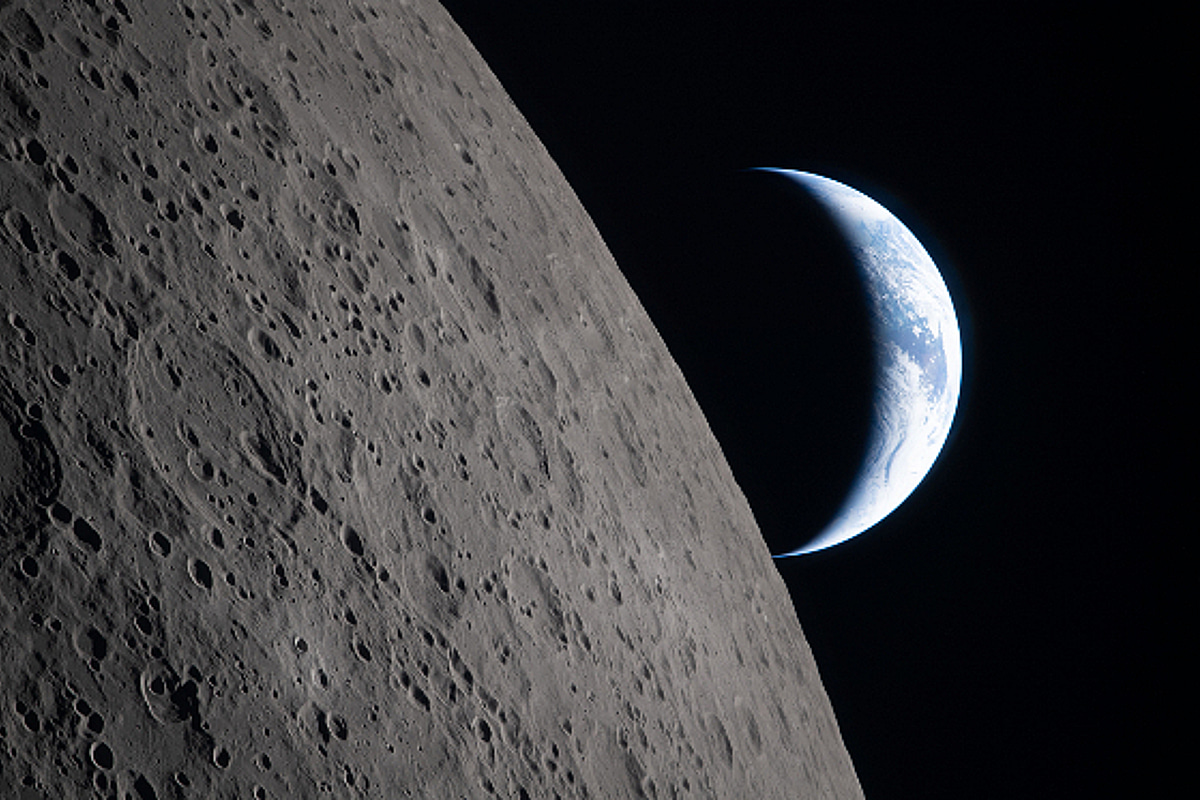
A Moon That Won’t Stay
Earth gained a second moon last spring, lost it this winter, and most people never noticed. The object in question, asteroid 2026 QQ8, was captured by Earth’s gravity in April and formally announced by the International Astronomical Union’s Minor Planet Center on November 29. By early December it will have slipped free and resumed its independent orbit around the Sun. At roughly two meters across, it is also far too small to see without a telescope — which means no one looked up and saw a second moon rising over their city.
That invisibility is precisely why the finding matters more than the headline suggests. A natural object the size of a car spent seven months circling our planet and was detected only because a professional astronomer happened to point a survey camera in the right direction at the right moment. If we are routinely missing mini-moons of this size, we are almost certainly missing smaller ones that linger longer, or larger ones that pass through without triggering an alert.
Frequency Hiding in Plain Sight
Matthew Payne, director of the Minor Planet Center, stated that on average Earth likely hosts one mini-moon at any given time. These objects stay bound for weeks or months before slipping back into solar orbit. Two previous captures are documented: 2006 RH120 orbited Earth for roughly a year, and 2020 CD3 lasted about three years before departing. Both were discovered after they had already been captured.
That pattern — discovery coming after capture, not before — is the defining problem for anyone concerned with planetary defense. Detection of a transient mini-moon requires a survey system sensitive enough to catch a two-meter rock against the diffuse sky background while it is still inside Earth’s Hill sphere. Current all-sky monitoring networks, including NASA’s Planetary Defense Coordination Office assets and private systems like those operated by Applied Space & Astrophysics, are optimized for hazard detection: near-Earth asteroids on intersecting orbits. They are less well tuned to objects that arrive slowly from behind, enter bound orbits, and then leave.
Hungarian astronomer Krisztián Sárneczky, who first spotted 2026 QQ8 in August, initially thought it might be debris from a defunct satellite. The confirmation that it was natural required tracking its orbit over several weeks and analyzing how sunlight affected its motion. This uncertainty between artificial and natural origin is common for small, dim objects in Earth orbit. Every similar detection creates follow-up work that diverts limited observing time away from other priorities.
No Collision Risk, but Not No Risk
The closest approach of 2026 QQ8 during its capture is estimated at roughly 570,000 kilometers — significantly farther than the Moon’s average distance of 384,400 kilometers. There is zero collision risk from this particular encounter. But the same cannot be said for every mini-moon candidate.
Objects captured into Earth orbit must originate from nearby space, typically from the Amor or Apollo groups of near-Earth asteroids. Some fraction of those populations inevitably cross paths with our gravitational domain at velocities low enough for temporary capture rather than a direct flyby. Each capture event represents a small body entering the Earth–Moon system under conditions where orbital perturbations from both bodies make long-term prediction difficult.
For planetary defense, the lesson is straightforward: the Earth–Moon environment is not static. It accumulates and releases small natural objects continuously, and our observation systems are not yet calibrated to measure that flux reliably. A sensor network capable of detecting a two-meter mini-moon at 570,000 kilometers would presumably also detect comparable hazardous asteroids on pre-impact trajectories — but only if those sensors are pointed at the right patches of sky at the right times.
Who Owns a Moon You Don’t Keep
The legal dimension of temporary satellite capture is even more unsettled than the observational one. The Outer Space Treaty of 1967 governs celestial bodies but was written with permanent moons and planets in mind. An asteroid that circles Earth for three months, exits, returns two decades later, and then leaves permanently does not fit neatly into existing frameworks for sovereignty, resource rights, or liability.
If a mini-moon were to contain accessible concentrations of platinum-group metals or water ice — plausible for a two-meter primitive body — who has the right to retrieve it? The capturing state? The state of origin of the asteroid? No one, because asteroids are not subject to national appropriation under Article II of the treaty? The law simply does not say. National space laws in the United States, Luxembourg, the UAE, and Japan address mining of celestial resources, but none explicitly covers objects that are simultaneously in orbit around Earth and in independent solar orbit at different points in time.
This gap is unlikely to close soon. The political friction over lunar resource claims under the Artemis Accords has already stalled broader agreement on how to treat extraterrestrial materials. A mini-moon changes hands between地球 gravity and solar orbit within months; legislating ownership over such an object would require a speed of international diplomacy that currently does not exist.
Public Fatigue Before the Problem Exists
Perhaps the least discussed consequence of this discovery is what it does to the public vocabulary around moons. Headlines declaring a new second moon generate genuine excitement, but the qualifier — temporary, tiny, leaving soon — arrives only after the click. If this pattern repeats, as Payne’s frequency estimate implies it will, the public will learn to dismiss such announcements as temporary curiosities rather than serious scientific findings.
That fatigue is dangerous. The real concern with mini-moons is not the spectacle of a second moon but what their presence tells us about the population of small near-Earth objects we are failing to track. Every undetected two-meter body that enters Earth orbit silently is one we could not study, one we could not deflect if it were on a hazardous trajectory, and one we cannot account for in impact probability models. The fact that 2026 QQ8 was found at all is evidence that our survey sensitivity is adequate for large-scale detection. The fact that it took a professional astronomer rather than an automated system to identify it as natural is evidence that our situational awareness is not.
What Comes Next
The Minor Planet Center will continue to catalog transients like 2026 QQ8, and the next capture will almost certainly arrive before this one fades from memory entirely. What should change is how astronomers and space agencies respond to them.
Routine classification of Earth-captured transients as scientific targets rather than noise would improve our understanding of the size-frequency distribution of near-Earth objects below the threshold of current hazard lists. Coordinated follow-up using ground-based facilities like the Lowell Discovery Telescope and the University of Hawaii’s survey instruments could turn each capture into a short but dense dataset on composition, rotation, and orbital evolution. Funding mechanisms for planetary defense should explicitly account for the observation gap between hazard detection and transient capture tracking.
The next mini-moon will not wait for policy to catch up. It is already en route, probably, somewhere in the data streams from automated sky surveys, waiting for someone to notice that a two-meter object is moving the wrong way against the background stars.