Earth's Stolen Oxygen is Rusting the Moon, One Magnetic Tail at a Time
New research shows hematite forming on the Moon through a process that depends on Earth's magnetic tail delivering atmospheric oxygen to our neighbour every full moon. The finding reframes how planetary atmospheres can reach across space.
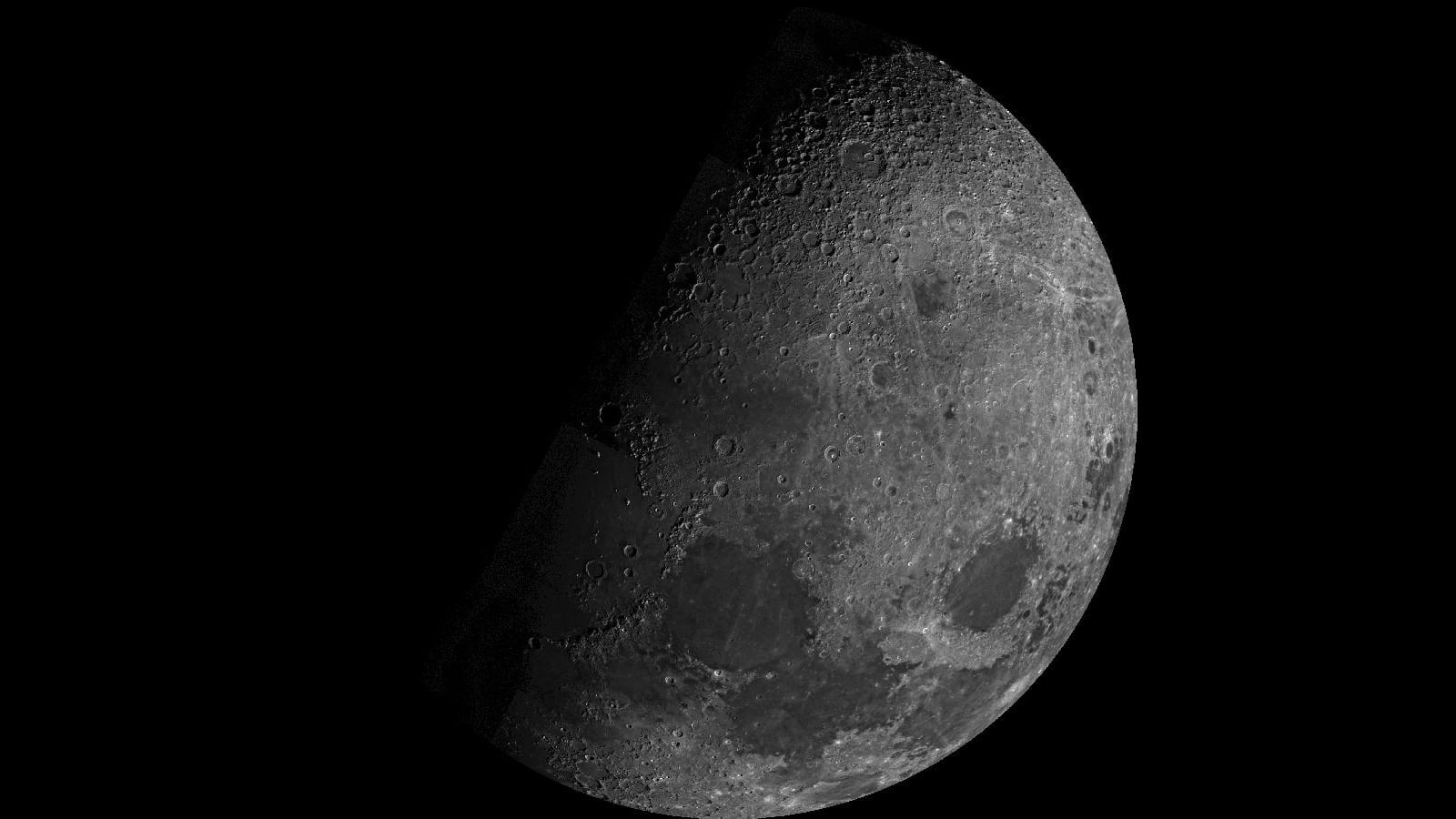
Rust on the Moon makes sense if you stop thinking of the Moon as alone
The standard picture of the lunar surface is one of brutal reduction. For most of every orbit, the Moon sits in the solar wind — a stream of hydrogen ions bombarding the regolith. Hydrogen is a reducing agent, the chemical opposite of what you need to turn iron into rust. The Moon has no substantial atmosphere. It has almost no liquid water. By all conventional chemistry, hematite (Fe₂O₃) should not exist there.
Yet it does. And the leading explanation now ties the rust directly back to Earth, our nearest neighbour, rather than some exotic local process.
The discovery: asymmetric hematite at high latitudes
The signal came from NASA’s Moon Mineralogy Mapper — known as M3 — aboard India’s Chandrayaan-1 orbiter. In a 2020 study published in Science Advances, Shuai Li and colleagues identified spectral absorptions consistent with hematite across both polar regions, concentrated between roughly 75 and 90 degrees latitude. The mineral was not evenly distributed.
It appeared more extensively on the near side — the hemisphere that permanently faces Earth — than on the far side. It also clustered preferentially on east- and equator-facing slopes of topographic highs. That asymmetry mattered. It pointed toward a supply arriving from a single direction rather than being deposited uniformly by micrometeorites or solar wind.
The instrument record that revealed the hematite was originally deployed to map water and hydroxyl across the Moon’s surface, including beyond the permanently shadowed poles. The Moon is extraordinarily dry by terrestrial standards, but dry does not mean chemically inert. Even trace hydration in the regolith opens pathways for oxidation that were long assumed impossible.
The delivery system: Earth’s magnetotail at full Moon
Earth’s magnetosphere is compressed on the dayside by the solar wind and drawn out on the nightside into a magnetotail that extends well beyond the Moon’s orbit. At full Moon, the Moon passes through that tail, shielded from the Sun for several days.
Japan’s Kaguya orbiter provided the critical missing piece: in a 2017 Nature Astronomy paper, researchers detected energetic oxygen ions of terrestrial origin at lunar distance. The oxygen had escaped Earth’s upper atmosphere and ridden Earth’s magnetic field lines more than 385,000 kilometres outward.
The geometry is elegant and specific. During the magnetotail passage, Earth’s magnetic field blocks more than 99 per cent of the hydrogen-rich solar wind. Simultaneously, the same field delivers oxygen ions produced in our own atmosphere. The Moon does not gain breathable air — individual energetic particles strike iron-bearing minerals in the soil — but the local chemistry flips from reduction to oxidation for the duration of the crossing.
That explains two observations at once: why rust can form in an environment dominated by hydrogen, and why the signal is stronger on the near side. The effect is cumulative, repeated over billions of full moons, not something visible as a periodic colour change.
The chemistry: oxygen without water
The 2020 orbital data needed laboratory confirmation. In 2025, Xiandi Zeng and colleagues published a study in Geophysical Research Letters that tested the reaction directly. They baked iron-bearing samples to remove adsorbed water, placed them under vacuum, and irradiated them with energetic oxygen ions. Hematite formed on metallic iron, iron sulphide, and ilmenite.
The experiment demonstrated a clean anhydrous route: oxygen implantation alone can oxidise suitable minerals. It also revealed the contest that governs whether rust survives. High-energy hydrogen ions reduced the newly formed hematite back toward metallic iron. Lower-energy hydrogen, representing ordinary solar wind conditions, was far less effective at erasing the oxide under the tested conditions.
A second laboratory study, published in Icarus in July 2026, added an important qualification. Using basaltic powder, the researchers found their strongest ferric-iron signatures when three factors acted together: low-flux oxygen irradiation, trace adsorbed water, and a brief laser pulse simulating micrometeoroid heating. Dry basalt alone produced no pronounced ferric feature.
The two experiments are complementary rather than contradictory. One shows that oxygen ions can make hematite on favourable iron-bearing phases without bulk water. The other indicates that in basaltic material — the dominant rock type across much of the lunar surface — hydration and short bursts of impact heating amplify the pathway.
Where the rust survives, and where it doesn’t
The lunar poles contain both permanently shadowed ice deposits and more dispersed molecular water or hydroxyl. These are not hidden lakes beneath the dust. Rust formation appears to need only trace hydration within individual grains, while micrometeoroid impacts provide transient heating and expose fresh iron. The combination — oxygen arriving from Earth, a splash of water bound to regolith grains, and the momentary flash of an impact — creates just the right conditions for oxidation.
The remaining hematite on the far side is a reminder that the case is not closed. Terrestrial oxygen should overwhelmingly favour the near side, but the far-side signal suggests that impacts, implanted solar-wind oxygen, or other local processes also contribute. Leading explanation is not the same as sole cause.
What a grain of rust could tell us about Earth’s past
The most compelling implication of this finding extends beyond lunar science. If lunar hematite records terrestrial oxygen, and if that oxygen carries isotopic signatures unique to its source, then a returned sample could preserve a record of Earth’s atmospheric evolution spanning billions of years.
Different surfaces on the Moon have different exposure ages. Grains associated with older terrains may lock in information about Earth’s atmosphere at times when direct geological evidence has long been destroyed by plate tectonics and erosion. The Moon, in this reading, is not just a neighbouring world — it is an archive.
Orbital spectroscopy has identified the mineral. Kaguya detected the oxygen transport mechanism. Laboratory experiments show the chemistry is plausible. What remains is the chain of evidence inside an uncontaminated sample: isotopic proof of terrestrial origin, a timeline for when oxidation occurred, and a precise accounting of which combination of ion implantation, hydration, and impact heating produced each grain.
The rust itself is sparse and microscopic. It will not turn the Moon red to the naked eye. But the connection it encodes is planetary in scale: material escaping Earth can cross 385,000 kilometres and alter the surface of another world, for a few days at a time, month after month, epoch after epoch. We have spent decades studying the Moon as an isolated body. The data now suggest that its surface chemistry has always been entangled with our own.