Europe's Blood Banks Hacked: Who's Behind the Escalation?
Hackers who wrecked supermarket freezers across eight European countries have now targeted blood bank refrigeration in France — a disturbing escalation that exposes how thin the line is between commercial nuisance and public health catastrophe.
The Midnight Shift Nobody Saw Coming
Blood banks do not typically make headlines. They exist in the background of the healthcare system — cold rooms humming in sterile buildings, staff monitoring temperatures, vials of plasma and red cells waiting for the next emergency. That is precisely why a cyberattack on this infrastructure reads so differently from one that takes down a retailer’s POS system or a hospital’s scheduling software. The implications are biological, not logistical.
Over the weekend of November 2, French authorities confirmed that three regional blood bank facilities fell victim to a coordinated cyber intrusion targeting their refrigeration monitoring and control systems. Remote access to the cooling equipment was blocked. Blood products were at risk of spoilage.
They were not. Staff on 24-hour duty caught the alarms immediately and transferred blood components to offline backup refrigerators before temperatures could climb to dangerous levels. The French health ministry stated there would be no disruption to blood supply. But the fact that someone felt emboldened enough to aim at medical cold storage — rather than, say, a shopping mall’s frozen food aisles — tells you everything about where this campaign is heading.
What makes this incident particularly chilling is the specificity of the target. Blood bank refrigeration systems are not generic industrial controllers. They are precision instruments calibrated to maintain narrow temperature bands — platelets at 20 to 24 degrees Celsius, red cells at 1 to 6, plasma frozen below minus 18. An attacker who understands that level of detail has done their homework. They know exactly what they are threatening.
The Supermarket Prequel
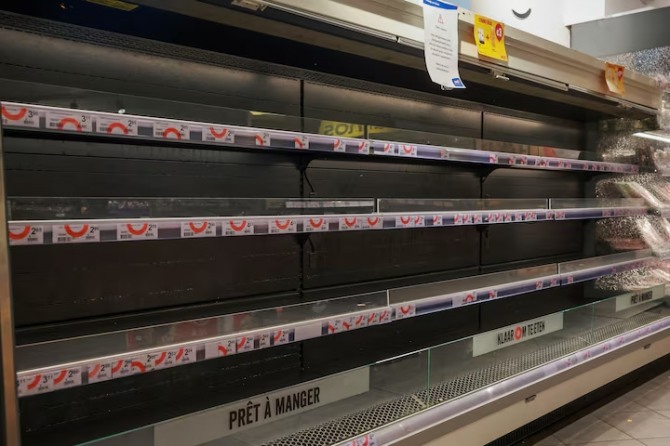
This is not an isolated incident. It is the second act of a campaign that began days earlier, when refrigeration units in supermarkets across eight European countries — including Sweden, Belgium, and Luxembourg — were remotely manipulated, causing temperatures to spike and entire inventories of perishable goods to spoil.
In Belgium, the Delhaize Shop & Go chain reported that multiple stores around Brussels were hit. Fresh produce, dairy, frozen foods — all dumped. Empty shelves became the overnight news. In Sweden, retailers described watching inventory turn to waste through dashboards that flickered from green to red as automated cooling systems were overridden. The attacks did not demand ransom through encrypted messages or threaten data leaks. They simply turned off the cold and walked away.
Both episodes share a signature: the attackers are not after money in the traditional sense, nor are they exfiltrating personal data. They are demonstrating the ability to reach into critical physical systems — temperature-controlled environments that hold things people need to survive — and break them.
Forensic analysts have noted that the same type of remote access exploit appears in both campaigns, though investigators have not yet confirmed whether a single group is behind all of it. The technical overlap is suggestive but not conclusive. What is clear is the speed of escalation: from retail to healthcare in under a week.
What Changed Between Act One and Act Two
The supermarket attacks were expensive inconveniences. Hundreds of thousands of euros in wasted inventory. Frustrated shoppers. A reminder that Europe’s retail supply chains run on networked industrial controllers that were never designed to withstand hostile remote access. The ripple effects were real but contained — grocery prices ticked up slightly in affected regions, and some stores operated at reduced capacity for days as restocking caught up.
The blood bank attacks are a different category of threat entirely. Blood components have shelf lives measured in days, not weeks. Platelets, in particular, degrade rapidly outside precise temperature bands. A single compromised unit in a high-volume transfusion center could mean delayed surgeries, cancelled treatments, or worse — patients sent home without the blood products they depend on.
France got lucky this time. Staff presence, backup refrigeration, and rapid response averted a crisis. But luck does not scale. Smaller blood centers — rural facilities, volunteer-run collection points, hospitals in less well-funded regions — may not have the same margin for error. Some operate with a single refrigerator unit and no offline contingency. A night shift staffed by one or two people might not detect an anomaly until it is too late.
The second-order effects are already visible. French hospitals have begun requesting blood transfers from neighboring regions, straining logistics that were already tight. Blood donation appointments have been postponed in some areas as anxiety spreads. Pharmaceutical companies that rely on temperature-controlled blood-derived products for clinical trials are quietly reviewing their supply chain safeguards. The attack on one facility is sending shockwaves through an ecosystem that depends on just-in-time delivery of fragile biological materials.
The Attribution Gap
No group has claimed responsibility. No nation has been formally accused. French investigative authorities are examining the attack vector, the scope of affected equipment, and the timeline for full system recovery. The Belgian and French probes into the supermarket incidents remain open as well.
This ambiguity is deliberate. Attribution in cyber operations is notoriously slow, and attackers benefit from the uncertainty. State actors can plausibly deny involvement. Criminal syndicates can hide behind proxy servers. Hacktivists can vanish into encrypted channels. For the victims, the lack of a named adversary does not reduce the immediate risk — but it does complicate the political response.
Europe’s post-Ukraine-security mindset has made the region more alert to infrastructure threats. The war in Ukraine exposed how interconnected critical systems have become and how vulnerable they are to disruption. But awareness is not the same as resilience. The supermarket attacks tested one layer of that resilience. The blood bank attacks tested another.
cybersecurity firms operating in the region have reported a spike in defensive inquiries from healthcare providers — clinics, laboratories, and independent pharmacies all seeking assessments of their own refrigeration controls. The message is plain: if these systems can be reached in France and Belgium, they can likely be reached anywhere. The question is whether those running the systems have the budget, the expertise, or the political will to harden them before the next attempt.
Who Wins, Who Loses, What Comes Next
The attackers win by making Europe feel fragile. Every successful intrusion — whether it wastes groceries or threatens blood supplies — reinforces a narrative that the continent’s digitally connected infrastructure is one clever exploit away from chaos. That narrative has value beyond the immediate damage. It erodes trust. It creates panic. It pressures governments into reactive spending rather than strategic hardening.
The victims bear the direct cost. Shoppers face empty shelves. Hospitals scramble for backup capacity. Workers spend their weekends chasing alerts instead of resting. And behind the scenes, clinicians are recalibrating triage protocols, wondering how many fewer procedures they might have to defer if the next attack catches a facility off guard.
What happens next depends on whether investigators can close the gap between the two campaigns. If the supermarket and blood bank attacks are linked by the same operator, the escalation from commercial to medical targets signals a deliberate expansion of scope — a testing of boundaries to see how far the response can be pushed before something breaks. If they are separate, it suggests the attack playbook is circulating among multiple groups, which is a far more dangerous scenario. A replicated method means no single fix can contain it.
The French health ministry has disabled remote access to compromised cooling units. That is a containment measure, not a solution. Until the underlying vulnerability is patched and the threat actor identified, the next midnight shift may not go so smoothly. Blood banks will continue to operate with one eye on the screens and the other on the backup generators, hoping the cold holds — and hoping whoever is on the other side of that exploit decides the game is not worth playing again.