Europe's €200M Bet on Greenland Is About Much More Than Countering Trump
Von der Leyen's visit to Nuuk masks a deeper contest: the EU is racing to secure critical minerals away from Chinese dominance while Greenland navigates between American pressure and European partnership. The real prize is not territory — it's supply chain sovereignty.
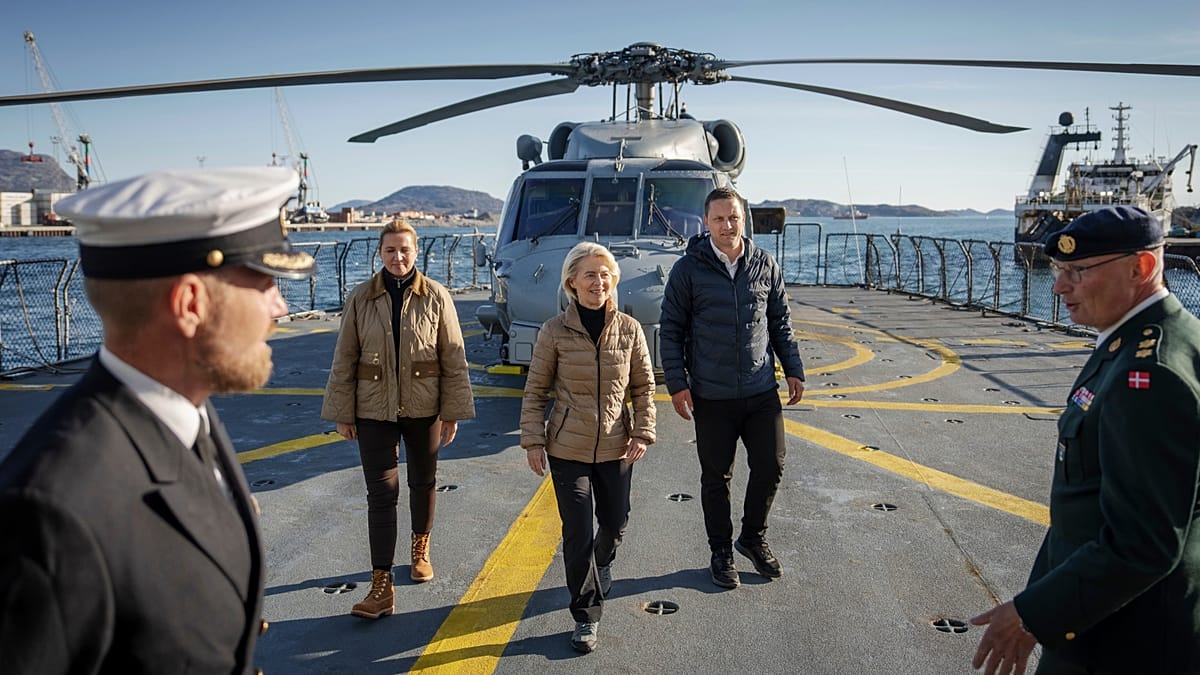
The Quiet Mineral War Behind Von der Leyen’s Visit
Ursula von der Leyen stood in Nuuk on a Monday in September 2026 and spoke about principles — territorial integrity, sovereignty, the inviolability of borders. She did not mention Donald Trump by name, but the former president’s shadow was everywhere. What she did not say out loud, though it animated every sentence of the day, was that the real stakes in Greenland are not about maps or pride. They are about who controls the materials that will power Europe’s next century.
The €200 million investment package announced alongside her trip sounds modest for a territory the size of France. Spread across digital infrastructure, hydropower, and mining, it amounts to roughly €100 million a year — a trickle compared with the scale of the challenge. But the gesture is calibrated. It is not about transforming Greenland overnight. It is about ensuring that when the world’s demand for rare earths and critical minerals surges, Brussels has a seat at the table rather than watching from the sidelines as Chinese companies lock down supply chains.
Why Greenland Matters More Than Anyone Admits
Greenland sits on 25 of the 34 minerals the European Commission has classified as critical. That list includes lithium, cobalt, graphite, and rare earth elements — the same inputs that sit inside electric vehicle batteries, wind turbine generators, and the semiconductors underpinning everything from AI chips to defense systems. Right now, China processes roughly 60 percent of the world’s rare earths and controls an even larger share of the refining capacity for many of these materials. The leverage is enormous. Beijing has already used export restrictions as a tool of economic coercion, most notably against Japan in 2010 and more recently against the Netherlands over chip equipment.
For Europe, this is an existential bottleneck. The bloc’s Green Deal and its broader industrial strategy cannot function without secure access to these minerals. Until recently, the EU’s approach was largely reactive — hoping suppliers would diversify, hoping diplomatic pressure would keep Chinese firms in check. Greenland changed the calculus. The island is not just a geological opportunity. It is within Europe’s geographic orbit, under the sovereignty of a NATO member state, and willing to engage on its own terms.
The Trump Factor (and Why It Complicates Everything)
Trump’s fixation on Greenland has been the least stable element in this calculation. He first floated the idea of purchasing the territory during his presidency, returned to it in January 2025 with threats of steep tariffs against Denmark if Copenhagen did not negotiate, and then, after backing down from public backlash, revived the topic again in July 2026. On Monday of this week, he posted a map showing Greenland under American control — a graphic provocation aimed squarely at domestic audiences and at European leaders alike.
His stated rationale has shifted between versions. At times he cited mineral wealth. At others he complained that allies had failed to invest enough in the region. When speaking to the New York Times, he called it ultimately a question of ownership. The inconsistency is the point. It keeps other capitals guessing.
Von der Leyen’s response was carefully worded. She declared solidarity with Denmark and Greenland without naming Trump. She repeated the language of international law. But her actions told a different story. The €200 million commitment, the upcoming NATO Arctic Shield exercise involving ten nations, and the Commission’s proposal to earmark €530 million for Greenland in the next EU budget — all of it signals that Europe is treating Greenland not as a diplomatic pawn but as a strategic partner worth investing in. The question is whether that investment is large enough to matter.
The Real Competition Is With China, Not Just Trump
Here is where the nuance most English-language coverage misses. The primary competitor for influence in Greenland is not Washington but Beijing. Chinese state-owned enterprises have been quietly acquiring mining concessions on the island for years. The conditions in Greenland — harsh glacial terrain, remote locations, expensive logistics — deter many Western investors who cannot absorb the risk. Chinese firms, backed by state financing and a longer time horizon for returns, have found the economics more acceptable. They have moved first. That head start is precisely what the EU’s new investment is designed to counter.
The three pillars of von der Leyen’s package reflect this understanding. Digital connectivity through subsea cables and satellite infrastructure is about reducing Greenland’s isolation — and giving European technology firms a foothold. Clean energy, especially hydropower, addresses the single biggest cost barrier to mining in the Arctic: electricity. Sustainable mining of critical raw materials is the endgame. Together, they form an infrastructure-first strategy rather than a grab-for-resources approach. That distinction matters. It signals to Greenland’s leaders that Europe is thinking about long-term partnership, not extraction.
Who Wins, Who Loses, What Comes Next
Greenland’s Prime Minister Jens-Frederik Nielsen put it plainly: the territory needs the EU, and the EU needs Greenland. That interdependence is the opportunity. But it is also the risk. Greenland will not accept European investment simply to replace American pressure with European conditionality. Its government has made clear that its future belongs to Danes and Greenlanders alone. Any European strategy that ignores that sovereignty will fail — not because of trumpets or tariffs, but because Copenhagen and Nuuk will simply walk away.
Denmark’s Prime Minister Mette Frederiksen signaled openness to working more closely with both the US and Europe on Arctic security. That balancing act is deliberate. Denmark wants American protection through NATO and European investment through the EU. It does not want to choose between them. The €200 million package gives Copenhagen a lever — a way to remind Washington that European engagement is active and sustained, even if the transatlantic relationship grows strained.
For Europe, the test is scale. €200 million over two years is a starting position, not a strategy. If the EU wants to meaningfully challenge Chinese dominance in Greenland’s mining sector, the numbers will need to grow. The proposed €530 million in the next budget is a step in the right direction, but mining infrastructure in the Arctic requires hundreds, often thousands, of millions per project. The Commission will need to convince member states that this spending is non-negotiable — not just for geopolitical posturing, but because Europe’s ability to build its own green industrial base depends on breaking the Chinese monopoly.
The Arctic Shield exercise next month will be the military complement to this economic play. Ten NATO nations conducting operations in the high north is a visible signal. But signals without investment are just noise. The world will be watching whether the EU follows through with capital, not just communiqué.
Trump may return to his annexation fantasy. He may escalate tariffs. He may post another map. Europe’s response should not be defined by him. The reason to invest in Greenland has nothing to do with whether the United States wants it and everything to do with whether Europe can afford not to have it.