How a Fake Cell Tower in Tokyo Exposed a City's Digital Vulnerability
A counterfeit base station parked in central Tokyo disrupted 10,000 phones and stole credentials through phishing — exposing a gap in urban telecom security that dense cities worldwide share.
A car sat on the edge of Ginza. Inside it, someone was lying.
Not in the dramatic sense of a hostage situation. But a digital lie — one broadcast across 500 meters of central Tokyo on a frequency smartphones trust by instinct. On a recent Saturday, police surrounded the vehicle and arrested a 31-year-old Chinese national for what amounts to one of the most publicly visible cellular deception attacks ever recorded in Japan’s capital.
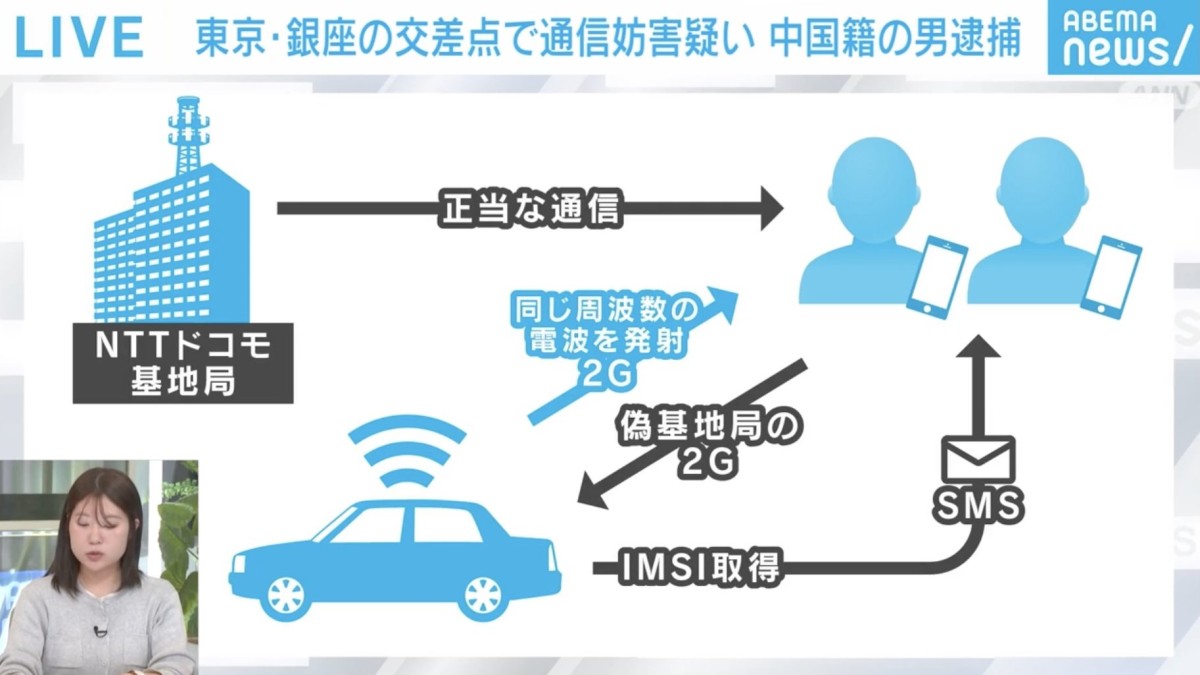
The suspect, identified as Yu Hai, allegedly parked his sedan near the Ginza Four-chome intersection and activated equipment hidden beneath the rear seat. A portable power supply sat in the trunk. The device transmitted high-power radio waves on the same frequencies legitimate cell towers use — except these waves came from a counterfeit base station designed to impersonate one.
About 10,000 mobile phones in the area lost signal temporarily. Those phones, programmed to seek the strongest available connection when forced offline, latched onto Yu’s 2G signal instead. And because 2G lacks the mutual authentication protocols built into 4G and 5G networks, the phones never checked whether the tower they connected to was real.
That single protocol gap did all the damage.
How the trap worked — and why it targets tourists
Once connected, the fake base station extracted each phone’s unique SIM identification number. Police believe Yu then used those numbers to send targeted SMS phishing messages in Chinese, warning recipients that their cards had been fraudulently used and directing them to fake websites designed to harvest login credentials.
Eighteen victims have been confirmed so far, all Chinese nationals. Fourteen were visitors to Japan — tourists or business travelers — making them disproportionately vulnerable. They were unfamiliar with local scam patterns, likely checking phones more frequently while navigating an unfamiliar city, and probably less suspicious of messages written in their native language.
Related credit card fraud losses total approximately 4 million yen. The worst-hit individual lost 650,000 yen.
The pattern repeats elsewhere. Similar attacks have been reported in Shibuya and Shinjuku — districts with even higher concentrations of foreign visitors. This is not an isolated incident in Ginza; it is a methodology finding its rhythm across Tokyo’s busiest streets.
The deeper problem: cities are wired for convenience, not defense
What makes this case significant beyond its victim count is what it exposes about urban telecom architecture. Major cities worldwide — London, New York, Seoul, Singapore — run on the same legacy infrastructure decisions made decades ago. 2G networks persist because they provide rural coverage at low cost, even as 4G and 5G dominate urban cores. That coexistence creates an opening: a counterfeit tower can force modern smartphones onto ancient, unauthenticated protocols simply by broadcasting louder than the real thing.
The technology to build such devices is commercially available. Not exactly easy to acquire, but accessible enough that one individual managed to construct a functional setup hiding under a car seat. Japanese authorities noted the equipment was not standard consumer gear and could not be easily removed from the vehicle — suggesting deliberate, purpose-built hardware rather than a bolted-on kit.
This is the uncomfortable reality for city planners and telecom regulators: the very density that makes a city valuable also makes it a target. Crowded streets mean crowded spectra. Dense populations mean more potential victims within range. A single rogue transmitter can disrupt thousands of connections simultaneously, and the disruption is often invisible until the financial damage appears days later.
How police caught him — and why that matters
The investigation began when NTT Docomo received multiple complaints from users reporting unexplained loss of service in the Ginza area. Japanese authorities took the matter seriously enough to bring in the Ministry of Internal Affairs and Communications for technical support. Police conducted repeated signal measurements from multiple angles around the suspected zone before executing a dawn-style takedown on a busy Saturday afternoon.
This was not a cold case solved by tracing financial records months later. It was a real-time detection operation — rare for this type of crime. The fact that Docomo’s network monitoring flagged anomalous interference patterns suggests that carrier-level intrusion detection can work when operators cooperate and agencies respond quickly.
But cooperation has limits. Yu denied the charges, claiming he did not know about any wireless equipment in his car. Police are now investigating whether he acted alone or followed instructions from someone else — possibly overseas. The arrest warrant was filed under charges of important wireless communication obstruction, escalating the case beyond a simple radio law violation.
What happens next — and what other cities should do
Yu’s demeanor during the field investigation drew attention. Witnesses reported he remained calm, offered no resistance, and at times smiled when asked to show the contents of his vehicle. Whether that indicates guilt, detachment, or something else entirely remains unclear without access to his full record.
Police continue examining the seized equipment and analyzing data from confiscated phones. The origin of the hardware and any organizational backing are still under investigation.
For the public, the message from investigators is straightforward but unsatisfying: you cannot prevent the signal jamming itself. The countermeasure lives entirely in behavior — do not open suspicious messages, do not click links from unknown numbers, treat unexpected calls from overseas with skepticism.
For cities, the lesson runs deeper. Tokyo’s experience should trigger a review of 2G exposure in dense urban areas. Operators and regulators should assess whether legacy network shutdowns can accelerate in tourist-heavy districts. Signal monitoring infrastructure should be upgraded to detect non-standard transmitters automatically. And cross-agency protocols for rapid response to cellular interference events need formalization — what worked ad hoc in Ginza should not remain accidental.
The next attack may not wait for a Saturday afternoon in February. It may arrive during Golden Week, when visitor numbers spike and defenses blur.