The Farage Polling Scheme That Exposes a Loophole Populists Everywhere Want
Undercover footage shows Reform UK senior figures arranging secret foreign-funded polls while deliberately bypassing UK donation rules. The scheme reveals how populist parties are testing the boundaries of electoral transparency — and why it matters beyond Britain.
The Polls That Whispered for Reform UK
Three polling results. Three front-page newspaper stories. Three carefully omitted credits. That is the tangible output of what Channel 4 News has uncovered: a covert operation inside Reform UK that used an American shell company to fund surveys the party then presented as independently motivated. The total cost was £32,500. The political return — headlines blaming Labour, momentum ahead of local elections — was immeasurable by comparison.
The more consequential finding is not the money itself but the architecture around it. James Orr, Reform UK’s Head of Policy, and Dan Jukes, a senior aide to Nigel Farage, discussed and deployed methods to keep these payments invisible to the Electoral Commission. They spoke of “clandestine projects” and joked about brown envelopes. They assessed the regulator as “completely useless” and “sso dumb and ineffective” that technical breaches would go unpunished. The attitude is the scandal as much as the act.
How the Money Moved
The mechanism was straightforward and, if executed as described, illegal. A UK-based “donor” — actually an undercover reporter posing as William Lockwood — would appear on paper as the source of funds. The money originated from his “father,” a US resident. Under UK electoral law, American individuals are impermissible donors. Donations from impermissible sources must be reported within 30 days and returned if not合法. The entire point of the arrangement was to disguise the true origin.
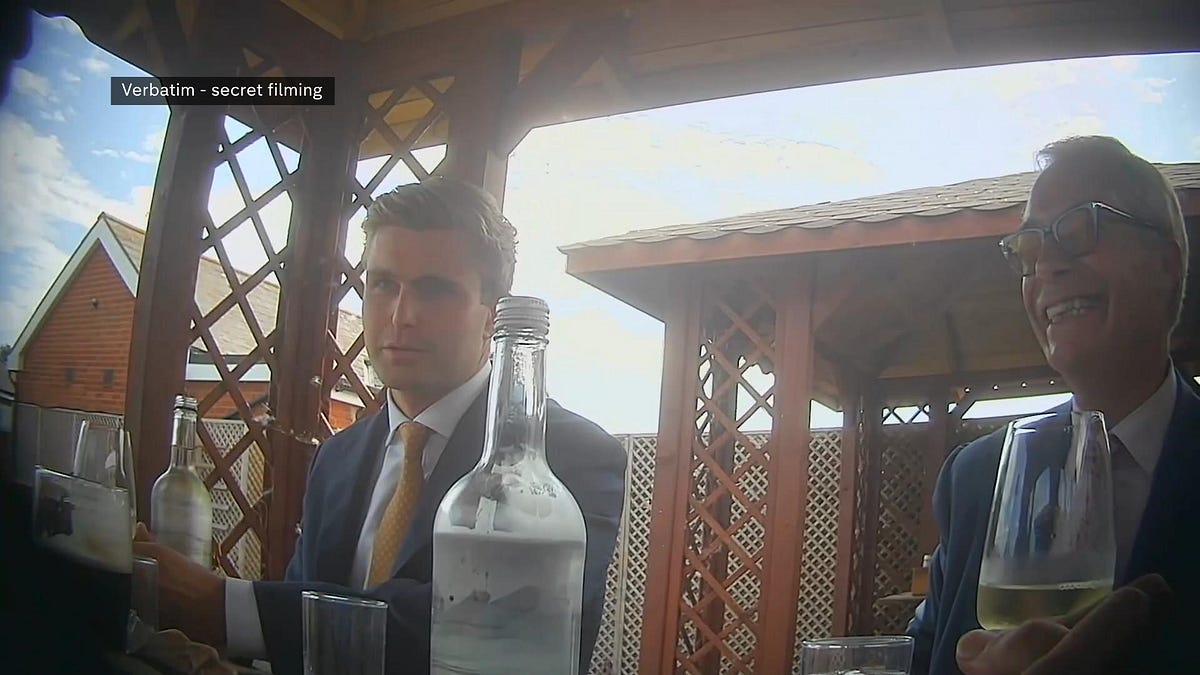
Farage met the undercover team in Clacton over oysters and wine after the polls had already been published. He called the results “amazing” and said “it worked. Boom.” When the question of a larger donation arose — reportedly £500,000 — Farage replied “thank you” and assured the team “it’s all above board.” He was told his aides had screened the donor and that he “knows you are a significant donor” but did not need to understand the mechanics.
That distinction — between knowing a donor exists and understanding how the money actually reaches the party — is where the legal and political vulnerability sits. Farage’s denial that he knew about the foreign funding before the payments were made is plausible deniability by design. Whether it holds legally depends on what the evidence proves about what he was told and when.
The Pattern Beyond Britain
What makes this story matter to readers outside the UK is that the technique on display is portable. The use of proxy donors, offshore or cross-border structures, and third-party organizations to mask the true source of political funding is not unique to Reform UK. It is a playbook that has appeared in variations across Europe and North America, typically wherever electoral finance laws create a bottleneck that well-resourced actors want to circumvent.
Populist movements are particularly prone to this pattern because they combine two features: a rhetorical commitment to anti-establishment transparency and a structural incentive to operate outside conventional funding channels. Established parties raise money through Membership fees, bundled donations, and regulated fundraising events. Populist parties that position themselves as outsiders often face tighter scrutiny, hostile media environments, and fewer ties to traditional donor networks. The pressure to find alternative funding creates temptation — and the ideological framing provides cover.
The Reform UK case shows the temptation winning. Orr and Jukes did not discover this method in a moment of crisis. They proposed it systematically, tested it with multiple polls, and discussed scaling it up. This was strategy, not improvisation.
Who Wins, Who Loses
Reform UK wins in the short term if the scheme goes undetected. The party received roughly £33,000 worth of polling it would otherwise have paid for, plus the media amplification that came with front-page placement. The Telegraph and the Times ran the results without disclosing Reform UK’s role. JL Partners, the polling firm, now says it is reviewing its procedures after discovering “weaknesses” it did not previously recognize. Bob Posner, former chief executive of the Electoral Commission, says the conduct amounts to serious criminal offences.
The public loses because the political conversation was subtly engineered without anyone’s knowledge. Voters saw headlines suggesting organic concern about Labour’s election plans. They did not see that a party with a vested interest in those narratives had paid for the data and arranged its publication. This is not conspiracy theory — it is the definition of influence opacity.
Democracy loses because the rule of law on party funding becomes advisory rather than binding. If senior party officials can treat the Electoral Commission as a joke and structure donations through proxy donors with confidence, the regulatory framework exists only for parties that choose to follow it. That creates an asymmetric advantage and erodes trust in the entire system.
What Happens Next
Several institutions are now responding. The Parliamentary Commissioner for Standards is separately examining whether Farage should have declared £5 million from crypto billionaire Christopher Harborne and whether benefits from convicted fraudster George Cottrell went unreported. The Electoral Commission has referred the matter to the police. The British Polling Council is seeking information from JL Partners. The Telegraph has suspended relevant articles and is reviewing its relationship with the polling firm. The Times says it was not informed of Reform UK’s involvement.
The criminal investigation Posner calls for is the critical next step. UK election finance law is not trivial — violations can carry unlimited fines and imprisonment. Whether prosecutors pursue individual defendants or the party as an entity depends on the evidence of knowledge and intent. The undercover recordings provide direct testimony about discussions of evasion. What remains unresolved is whether Farage’s knowledge was sufficient for criminal liability or whether the legal responsibility falls on Orr and Jukes alone.
The proposed £500,000 donation was never made. That means the most serious allegation — a large foreign-derived contribution laundered through a UK proxy — remains hypothetical. But the three completed polls were real, the payments went through, and the media published results without disclosure. The harm has already occurred even if the larger scheme did not.
Why This Should Trouble You Outside the UK
Democratic systems worldwide share a common vulnerability: the gap between the rules on paper and the incentives to bypass them. When populist parties gain power or near-power, the pressure to fund operations outside regulated channels increases. The Reform UK case shows that the infrastructure for doing so — shell companies, compliant polling firms, media outlets eager for story-ready data, and senior officials who view electoral commissions as obstacles rather than guardians — can be assembled quickly by people who know the system well enough to exploit its seams.
James Orr is also an associate professor of theology at Cambridge. Dan Jukes is a long-standing Farage ally. The people designing this system are not amateurs. They are educated, connected, and confident that the consequences will be negligible. Their confidence, judging by Posner’s assessment, may be misplaced. But the attempt itself reveals something important about where populist movements in Western democracies are willing to go when the rules constrain them.
The polls came out. The headlines ran. The party gained. And for the first time, there is recorded evidence of exactly who arranged it and how.