Fate/strange Fake Renewed: Why This Franchise Move Matters Globally
A-1 Pictures is continuing Fate/strange Fake with a second season, announced at Anime NYC. The key visual hints at fractured identities and deeper lore — and the timing signals how the franchise plans to capture global audiences.
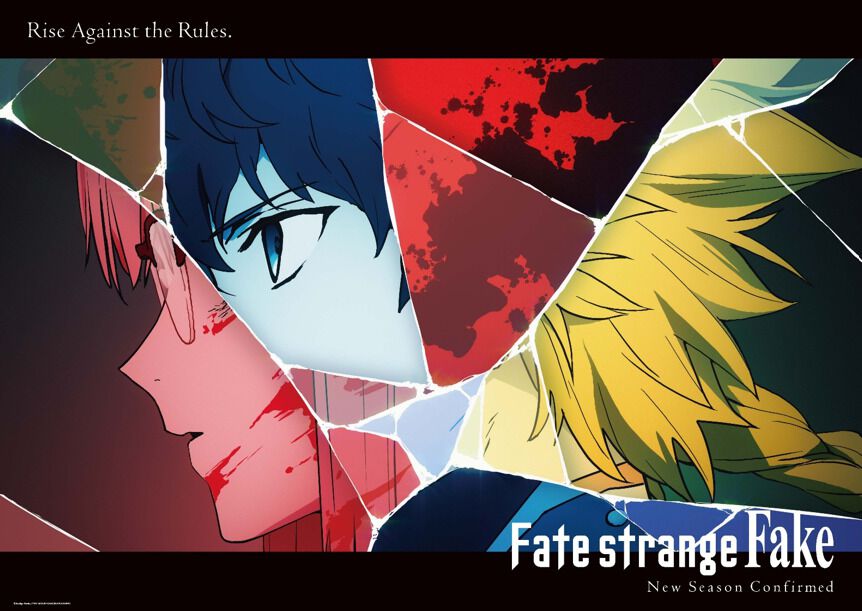
A shatter-and-rebuild visual for a shatter-and-rebuild franchise
The key visual for the new Fate/strange Fake season doesn’t just introduce characters — it shows them breaking apart and reforming. Ayaka, Saber, and Sigma are depicted in fragments that somehow hold together. That imagery is almost too literal to be accidental for a series built around the concept of a false Holy Grail War and identities that don’t quite stick.
The announcement landed at Anime NYC on August 22, 2026, timed to catch the growing English-speaking fanbase that has made the Fate franchise one of the most profitable anime licensing properties in the world. A-1 Pictures confirmed the renewal on the same stage where the first season’s final episode had aired nine months earlier, in March. The gap between seasons is shorter than many recent anime renewals — and it suggests the studio and Aniplex are treating this property with more urgency than a typical back-burner sequel.
Why the venue choice matters
Anime NYC isn’t the usual stage for a Japanese production company to announce a season renewal. Most studios pick Tokyo or Osaka for those reveals. Doing it in New York signals where the revenue is flowing. The Fate franchise generates billions across merchandise, games, and streaming, and North America accounts for a meaningful share. A-1 and Aniplex aren’t hiding that they want American fans to hear the news first.
This isn’t the first time the franchise has pivoted toward Western audiences. Fate/Grand Order has spent years localizing content for English-speaking players, and the anime adaptations have consistently received early simulcasts on Crunchyroll. But the placement of this announcement is a deliberate signal: the second season won’t be an afterthought for the international market.
The visual tells you what the story does next
The key visual’s composition — characters literally fragmenting and recombining — maps onto the narrative arc that Season 1 left dangling. The first season ended at a point where Ayaka’s relationship with Saber had deepened significantly, and Sigma’s own conclusions about the Grail War were left hanging. The voice actors’ comments confirm this. Inoue Yuuki, who voices Saber, framed the break as something he himself was eagerly waiting to resolve. Kawara Taketo, who plays Sigma, ended his message with a plea that his character be rewarded for the path he’s chosen.
That kind of emotional framing from the cast is unusual for a routine renewal announcement. It suggests the new season isn’t just continuing the story — it’s responding directly to fan investment in the character dynamics that emerged in Season 1. The shattered-then-recombined visual is a promise that the series will explore what happens when identities break under pressure and get rebuilt differently.
What stays the same, what changes
A-1 Pictures remains the studio. Directors Enomoto Shun and Sakazume Takane are returning. Composer Sawano Hiroyuki is still on board. The core creative team hasn’t shifted, which matters for a franchise that already struggled with uneven adaptation choices in its first season. Sawano’s soundtrack alone gives the series a recognizably cinematic texture that separates it from the more game-adaptation-heavy entries in the Fate lineup.
The writing staff, however, is worth watching. Series composition is handled by Daitou Daisuke, who also worked on Fate/Apocrypha. That’s a mixed track record — the earlier series was ambitious but visually constrained by its budget. The new season will have roughly a year to develop, which is tighter than most anime but longer than the typical six-month turnaround. Whether that translates to better pacing remains to be seen.
The franchise calculus
Fate/strange Fake occupies a strange position in the TYPE-MOON canon. It’s neither a direct sequel to the original Fate/stay night nor a standalone entry. It exists in a parallel timeline that explores the consequences of a corrupted Grail War set in America — a setting that makes it naturally accessible to Western audiences who may have found the Japan-centered original series harder to enter.
Renewing the series now, after the first season’s mixed reception, is a bet that the franchise can recover ground by leaning into the very elements that made the source material appealing in the first place: moral ambiguity, layered character identities, and a setting that feels fresh within a well-worn genre. The visual of fractured characters reassembling is exactly the kind of marketing hook that works for a property whose entire premise is about falsehoods becoming real.
Who wins, who loses
Fans of the light novels win — the adaptation is finally catching up to material that’s been available in Japanese since 2015. The voice cast wins, with three main actors publicly expressing genuine excitement rather than the obligatory press-release enthusiasm. Aniplex wins, because a second season locks in merchandise sales and streaming engagement for another cycle.
The likely losers are viewers who treated the first season as a one-off curiosity. The renewal commitment means the series has moved from experiment to priority, and priority slots demand longer attention spans. If the new season doesn’t deliver on the visual promise of its key art, the franchise risks fatigue — a real threat for Fate, which already has half a dozen active anime adaptations competing for screen time.
The second season’s release date hasn’t been announced yet. Given the March-to-August gap between Seasons 1 and 2’s announcement, a late 2027 premiere seems plausible. Whatever the timeline, the message from Anime NYC is clear: Fate/strange Fake isn’t fading into the franchise’s crowded catalog. It’s being pushed toward the center.