The FBI Probe of Jensen Huang Is Bigger Than One Scandal
Trump confirmed the FBI is investigating Jensen Huang's ties to an alleged Chinese spy, escalating what was personal scandal into a national security flashpoint with implications for U.S. chip policy.
The FBI probe has arrived, and it changes everything
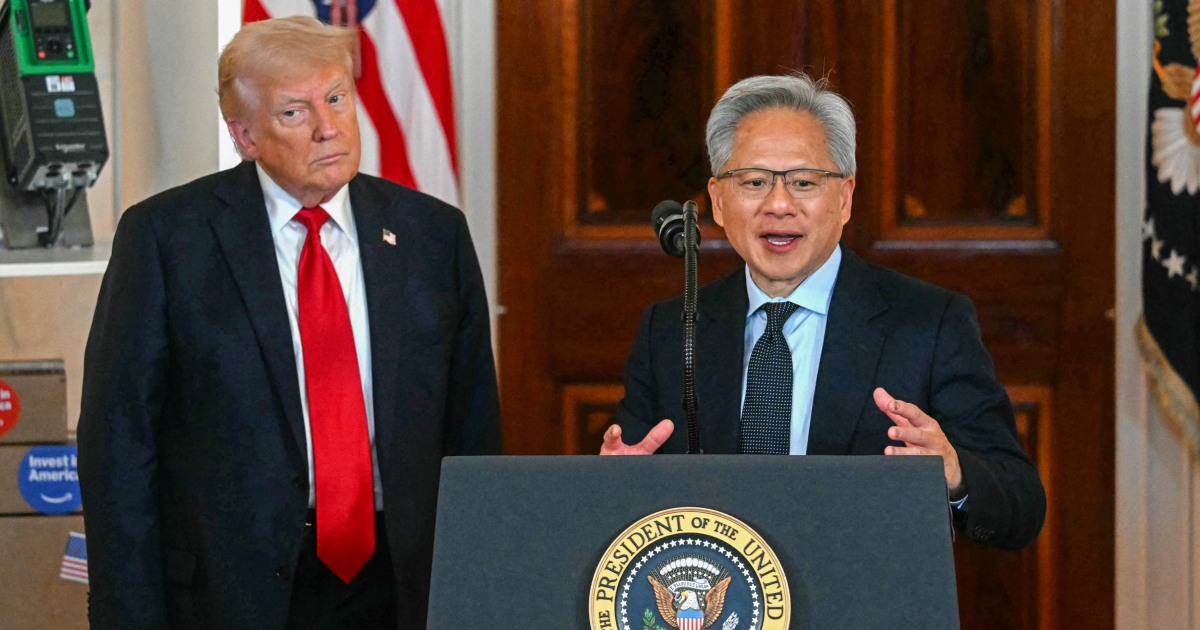
Donald Trump did not mince words at his impromptu White House briefing Monday morning. The FBI is investigating the affair between Nvidia CEO Jensen Huang and Alice Huang, a woman U.S. intelligence agencies determined is a Chinese spy.
Huang told the president directly — through a phone call Trump initiated himself — that he had no knowledge of her identity. “I really believe him,” Trump said.
Believing Jensen Huang personally is not the same thing as clearing him strategically. The distinction matters because this moment sits at the collision point of three forces: the weaponization of semiconductor dominance, the expanding repertoire of Chinese intelligence operations, and a Washington that treats every Chinese tie in tech leadership as evidence of either negligence or conspiracy.
What we know, and what remains unclear
Nvidia announced its independent investigation Sunday night. The board cited “recent reporting” that its founder and CEO had been the target of a foreign intelligence effort. By Monday, the probe had escalated from a corporate matter to a federal one.
Trump confirmed the FBI was involved. He also said he spoke with Huang earlier that day — a call framed casually as checking whether Huang was “feeling all right.” That phrasing carried obvious weight. The president was signaling both concern and containment.
Alice Huang and Jensen Huang are not related. The affair is real. Her status as a Chinese spy is, according to multiple NBC sources familiar with the matter, confirmed by U.S. intelligence agencies. What remains officially unconfirmed is the full scope of what she may have extracted, whether consciously or inadvertently, during their relationship.
Nvidia shares fell 4.2% on Monday, making them the worst performer in both the Dow and Nasdaq. The selloff bucked broader market momentum — a sign that investors see structural risk here, not just headline drama. Trading volume spiked to nearly triple the daily average within the first hour after the news broke, suggesting institutional investors moved quickly to reduce exposure ahead of regulatory developments that could linger for months.
The Federal Bureau of Investigation has, according to people familiar with the inquiry, already begun executing search warrants and summoning documents. No charges have been filed, but the procedural machinery of a federal criminal investigation is now in motion — a process that typically unfolds over many months, if not years.
This is not just about one marriage
Chinese intelligence operations against American technology leaders predate this scandal by decades. The playbook is well documented: cultivate relationships, extract proprietary information, build leverage. But this case illustrates something more insidious than classic industrial espionage.
Huang is not merely a CEO with access to trade secrets. He is the leader of the company whose chips power the most advanced artificial intelligence systems on Earth. Nvidia’s GPUs underpin training infrastructure at Google, Meta, OpenAI, Anthropic, and dozens of others. A compromise at the executive level does not mean stolen blueprints — it means influence over the direction of AI development, the timing of export controls, and the flow of information to Beijing.
That is why Rep. Hakeem Jeffries called for a full congressional briefing on Monday. That is why Senators Elizabeth Warren and Jim Banks issued a joint statement demanding Congress take “decisive action” on oversight of AI-linked companies. The bipartisan framing is itself noteworthy. National security concerns over China do not divide along party lines the way most other issues do — and this case is amplifying that pattern.
Defense contractors and semiconductor manufacturers have long operated under an informal understanding that government supervision would be minimal so long as companies self-regulated on export compliance. That tacit social contract is now fracturing. Every major chip firm with significant revenue tied to Chinese markets — Broadcom, Applied Materials, Qualcomm — will face renewed questions about how deeply their own leadership structures may be exposed to similar vectors of penetration.
The bigger question: systemic scrutiny
The immediate fallout will focus on Huang. Will he stay? Trump thinks so — he has now said twice in two days that Huang should remain CEO. “He’s an amazing guy,” Trump said, adding, “I hope there’s no problem.”
But the real story unfolding behind the personal drama is far wider. The FBI probe establishes precedent. When the director of the United States’ most valuable company is formally under investigation for exposure to Chinese intelligence, every other CEO of a major technology firm with significant operations in Asia will feel the chill.
The questions Congress is now raising — about oversight, about AI-linked companies, about foreign ties in leadership positions — could reshape the competitive landscape for American chipmakers. Export control enforcement, background vetting standards, and even investor confidence will come under scrutiny that did not exist six months ago.
Legislators on both sides of the aisle are already drafting proposals that would require public disclosure of any romantic or familial relationships board members and C-suite executives maintain with individuals holding ties to adversarial nations. The legislation would draw direct criticism from civil liberties groups, who argue such provisions constitute a form of mandatory coming-out requirement dressed in national security language. But the political calculus favors regulation. In a climate where skepticism toward Big Tech runs deep across party lines, executives with international connections become politically vulnerable regardless of actual culpability.
China’s Ministry of State Security has spent years refining its human intelligence methods. They do not need to steal Nvidia’s next-generation GPU architecture to win. They only need to ensure that the people running America’s most critical technology company are compromised enough to hesitate — to slow-walk cooperation, to leak selective information, to prioritize personal safety over institutional loyalty.
Whether that happened here remains unanswered. The FBI investigation will determine that. But the damage to trust is already done. Even if Huang is ultimately cleared of any wrongdoing, the mere existence of credible allegations creates a lingering shadow over decisions made at Nvidia and, by extension, decisions made by every company relying on Nvidia hardware. Clients will scrutinize their own supply chains. Competitors will exploit uncertainty. Markets hate ambiguity more than they hate bad news.
Second-order consequences already emerging
The ripple effects are multiplying faster than most observers anticipated. Within hours of Trump’s announcement, several prominent hedge funds disclosed reduced Nvidia positions, citing “uncertainty around governance risk frameworks.” Short interest in the stock climbed to its highest level since early 2024. Options traders priced in elevated volatility through the remainder of the year, with put-call ratios shifting sharply bearish.
Internationally, reactions were swift and telling. Chinese state media initially downplayed the story, calling it “internal affairs.” But within forty-eight hours, the Global Times published an editorial warning against what it termed “American paranoia infecting global technology cooperation.” The subtext was clear: Beijing sees the probe not as accountability but as retaliation against Chinese technological advancement — a narrative designed to rally domestic support and weaken Western cohesion on export restrictions.
European Union officials privately expressed concern that the episode could accelerate decoupling beyond what Brussels considers prudent. Several EU member states with significant semiconductor investments in the United States viewed the investigation through the lens of competitive fairness. If America can investigations its most celebrated industry leader overnight, they reasoned, what prevents similar treatment of European champions like ASML or Infineon under different circumstances?
Within the Biden-era policy apparatus that remained operational during the transition period, career officials at the Department of Commerce and the Office of the Director of National Intelligence convened emergency coordination meetings. Standard operating procedure for investigations involving dual-use technology companies typically requires interagency consultation before public announcements. Whether that protocol was followed here has become a minor internal dispute — one that reveals how little established procedure exists for scenarios of this magnitude.
What happens next
Expect pressure on Nvidia to expand cooperation with federal investigators. Expect congressional hearings. Expect a reckoning inside the company over how deeply embedded these vulnerabilities are across executive ranks.
On Capitol Hill, expect both parties to use this moment to push for stronger safeguards around AI and semiconductor leadership — even if they disagree fiercely on almost everything else. Warren and Banks writing together is the kind of signal that rarely comes twice in the same week.
For Huang, the path forward is narrow but passable. Trump’s backing provides political cover. But political cover is not legal immunity. If the FBI determines that Huang’s ignorance was genuine — as the president believes — then the investigation may close without charges. If it finds negligence, coercion, or complicity, the consequences extend far beyond a single boardroom. Potential outcomes range from criminal prosecution and disgorgement of compensation to civil penalties and lifetime bans from serving as an officer of any publicly traded company.
Investors preparing for prolonged volatility should watch three specific indicators closely: whether the Justice Department opens a formal grand jury proceeding (a strong signal of impending indictment), whether additional associates of Alice Huang are brought into the investigation (suggesting a broader network), and whether Nvidia’s audit committee appoints outside counsel with prior counterintelligence experience rather than relying solely on internal investigators.
One thing is certain: the era of treating Chinese commercial ties as routine business is over. Jensen Huang’s story is the opening chapter — not the whole book. The investigation will consume attention for quarters. Its conclusions will shape policy, markets, and the strategic posture of American technology leadership for years.