A Fly Brain Just Played Doom. The Results Say Something About Intelligence Itself.
Scientists mapped the complete male fruit fly connectome, and someone immediately trained it to play Doom. The experiment isn't about gaming — it's a probe into how learning emerges from neural architecture.
The Bizarre Intersection Nobody Asked For
A complete wiring diagram of a fruit fly’s brain has been published, and within days someone had already trained it to play Doom. The story sounds like a tech Twitter joke — until you realize it’s actually asking one of the most serious questions in neuroscience: what does intelligence require, and how much of it can emerge from a structure as small as 130,000 neurons?
The mapping project, led by HHMI Janelia Research Campus and Google Research, released MaleCNS v1.0 on September 3, 2026 — the full connectome of an adult male fruit fly brain and central nervous system. Female connectomes had already been published by the FlyWire consortium, so the dataset now covers both sexes. The data is openly accessible through the Neuroglancer tool, which means anyone with a browser can explore the neural circuitry of a creature that has served as a model organism for over a century of biology.
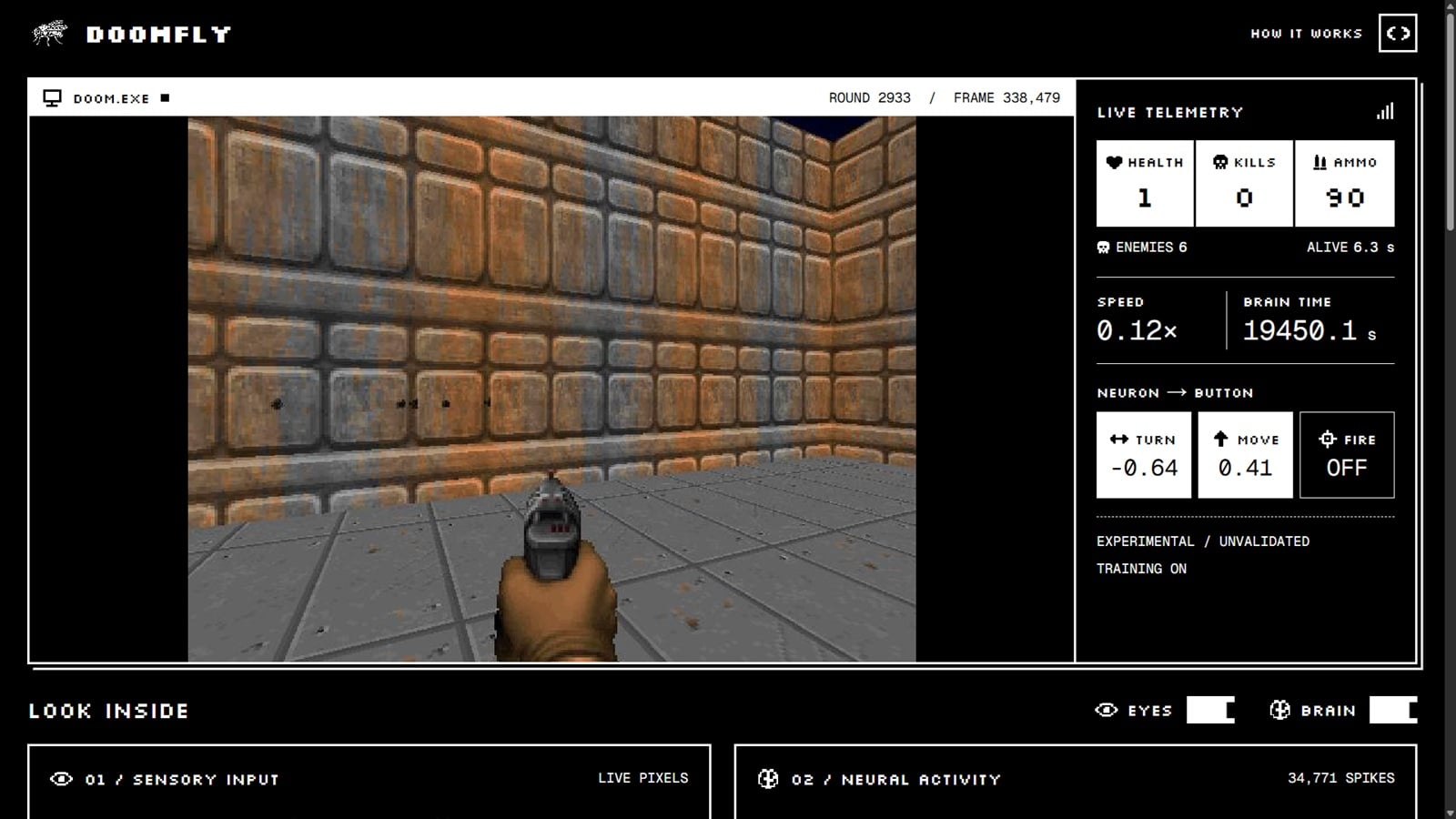
Coinbase engineer Alex Wormuth didn’t wait long before repurposing the dataset. His project, DOOMFLY, maps each frame of the 1993 first-person shooter onto the fly’s sensory neurons. Neural activity is then translated into controller inputs — DNp20 activations correspond to turning, DNpe017 to movement and shooting. When the virtual fly takes damage, dopamine PPL101 cells receive an artificial aversive signal, mimicking the reinforcement learning loop that real organisms use to associate harm with behavior.
What Happens When You Give a Fly a Gun
The results, so far, are exactly what you’d expect: nothing. Wormuth reported roughly 3,000 attempts with no measurable improvement in survival time. The agent doesn’t learn to avoid demons. It doesn’t learn to manage ammunition. It just keeps dying, over and over, with the same undifferentiated neural noise driving its responses.
That’s the interesting part. If you gave this same training setup to a mammalian cortical model, even a simplified one, you’d likely see at least marginal improvement after a few hundred episodes. The absence of learning in the fly model tells us something specific about the architecture: the circuits that enable reinforcement-based adaptation in insects may be fundamentally different from those in vertebrates, or they may simply not be represented in the current MaleCNS dataset.
The experiment is not claiming that fruit flies can play Doom. It’s a stress test for the connectome itself — a way of checking whether the wiring diagram contains enough functional information to support even rudimentary learning in a novel environment.
Why Doom, Not Pong
The choice of Doom over something simpler like Pong is deliberate. Doom presents a high-dimensional perceptual problem: navigation, threat recognition, resource management, spatial reasoning under time pressure. It engages visuospatial processing, working memory, and rapid decision-making — the same cognitive domains that real fruit flies use when navigating complex environments, avoiding predators, and locating food.
Fruit flies already solve a version of this problem in nature. Their brains are optimized for detecting motion, calculating trajectory, and generating evasive maneuvers — all in a neurometric budget that makes even modest mammalian processors look extravagant. If the connectome contains the right circuitry, exposing it to Doom’s perceptual demands should reveal whether those circuits can be repurposed for something completely outside their evolutionary context.
So far, they can’t. Or at least, the signal isn’t strong enough to drive adaptation.
The Data Problem
One constraint is immediately apparent: MaleCNS v1.0 captures the static wiring diagram, not the dynamic properties of the neurons themselves. Connectomes tell you who is connected to whom, but not how strongly, not how plasticity works, not which neuromodulators are present at each synapse. Reinforcement learning requires more than topology — it requires the ability to adjust connection weights based on experience, and that mechanism is largely invisible in a structural map.
This is the same limitation that plagues all connectome-based AI research so far. The C. elegans connectome, with its 302 neurons, was completed decades ago. Researchers have built simulation models from it, but they consistently struggle to reproduce the worm’s full behavioral repertoire. The missing piece is almost certainly in the details: ion channel densities, modulatory tone, developmental history.
The fly brain is roughly 400 times larger than C. elegans. Adding that complexity should help, but it also means the gap between structure and function grows proportionally.
What Comes Next
Google Research has already signaled that whole-fish brain mapping is on the horizon. Zebrafish connectomes would open a dramatically different research space — vertebrate neural architecture, layered cortex analogs, and a jump in computational complexity that could finally push these models past the threshold where simple reinforcement becomes visible.
Wormuth has suggested the DOOMFLY experiment will continue running. Whether survival time improves after millions of attempts remains to be seen. There’s also the question of sex differences: the female connectome exists but hasn’t been used in the same way, and biological literature suggests meaningful neuroanatomical differences between male and female Drosophila that could affect learning behavior.
The Real Story Here
The viral headline — fly plays Doom — obscures what’s actually happening. A complete neural wiring diagram is now being used as training data for AI agents in games that evolved forty years before the mapping project began. That timeline compression is the real novelty.
Twenty years ago, the idea of training a virtual organism on a connectome from scratch would have been science fiction. Today it’s a weekend project by a Coinbase engineer. The democratization of neuroscience data is happening faster than the field anticipated, and the experiments it enables will increasingly look like this: unconventional, slightly absurd, but genuinely probing the boundaries of what we understand about intelligence.
The fly probably won’t clear Doom. But the failure itself is data — and data is what the connectome projects were always meant to produce.
The source material for this analysis comes from AUTOMATON’s coverage of the MaleCNS v1.0 release and the DOOMFLY experiment. The connectome data is publicly available through HHMI Janelia Research Campus and Google Research.