France's Black Thursday Protests Signal a Deeper European Crisis
France's Black Thursday protests, drawing over 600,000 across 250 rallies, reveal how economic anxiety is fueling a pan-European wave of civil unrest with sweeping implications for EU governance and social contracts.
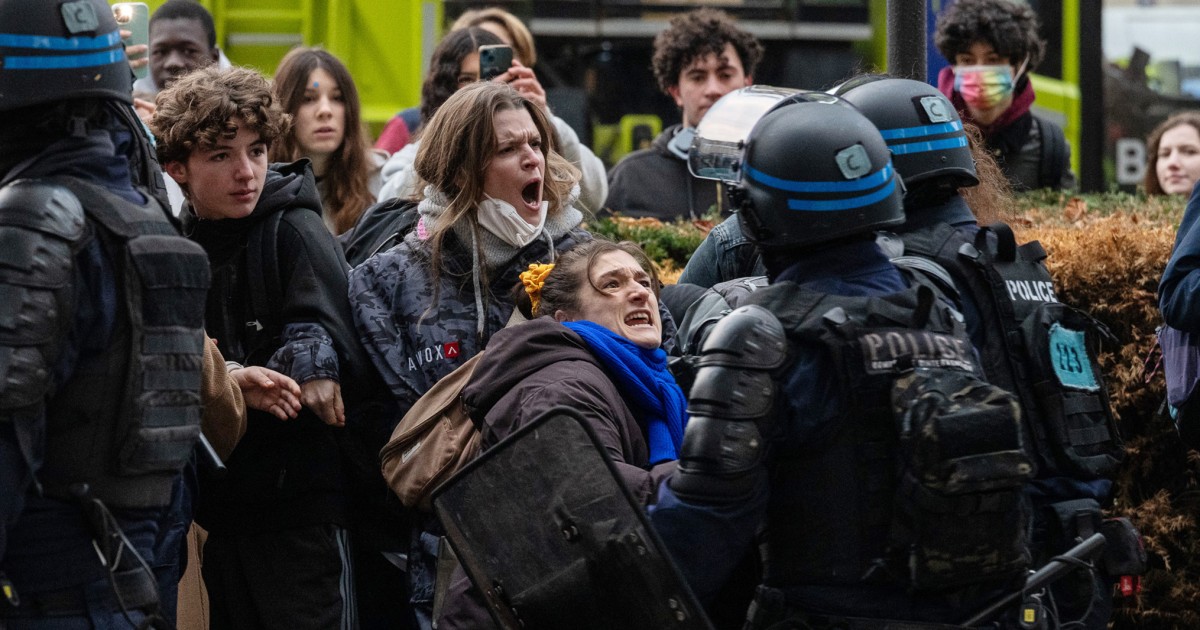
The Streets Are Speaking
Six hundred thousand people did not stay home on Thursday in France. They flooded into 250 cities and towns, converging on Paris, Lyon, Toulouse, Rennes, Bordeaux, and Orleans — demonstrating not just against their government but against the kind of politics that has failed to stop prices from rising faster than wages.
What began as a localized blockade at a single high school in Créteil, a southeastern suburb of Paris, had metastasized into the most coordinated day of civil action France has seen in years. The trigger was staff shortages at the Antoine de Saint-Exupéry High School — a specific, bureaucratic grievance that most observers would have dismissed as another complaint in an already crowded queue of French institutional failures. The grievance, almost instantly, was everything.
By evening, unions had issued a blunt warning: the country is on the brink of recession. “Everything is going up except wages and pensions,” said a joint statement from the CGT, CNT, and UNEF. “Anger is immense.” The phrasing was deliberate — this was not a call for reform. It was a diagnosis of terminal decline.
Local organizers in Lille reported over 15,000 participants marching from the Gare du Nord through the city center, while Marseille saw an estimated 8,000 demonstrators block the port district for nearly four hours. In Strasbourg, students from the University of Strasbourg joined faculty members from the medical school in a procession that stretched across the European quarter — a symbolic routing through the heart of EU institutional architecture. These were not spontaneous gatherings. They were the product of a decentralized mobilization network that had been building since the student-led actions last autumn, coordinated through encrypted messaging channels, student union federations, and trade union hotlines that circulated route plans and legal observation protocols by mid-morning.
Beyond France
The spectacle of tear gas near the Eiffel Tower and water cannons deployed in Lyon tells a story that extends far beyond Macron’s remaining months in office. The president, who leaves office in May 2027, convened a defense and security meeting Wednesday ahead of the protests. Interior Minister Laurent Nuñez deployed 70,000 officers — armored vehicles, drones, helicopters — to contain what was always going to be ungovernable with crowd control alone.
The irony, if there is one, is that the very infrastructure of state response mirrors the problem: institutions designed for order are being asked to manage grievances that have no negotiating endpoint. When a 59-year-old man died in October after leaving a tear-gassed demonstration at Paris’ Place de la République, and when a 15-year-old was maimed by a sting ball grenade last month, the state’s security apparatus stopped being a neutral force and became a symbol of the confrontation itself. Medical NGOs reported treating at least 340 injuries across the Paris region alone on Thursday, with fractures from baton strikes and respiratory complications from tear gas exposure accounting for the majority. The hospital system, already strained by its own funding crises, absorbed the overflow without public comment — another layer of institutional failure going unacknowledged.
The Real Cost
What makes Thursday’s protests structurally different from France’s periodic explosions of discontent is the coalition. This was not simply public sector workers. It was high school students, university students, teachers, parents, and politicians — all operating under the same pressure of a cost-of-living crisis that has eroded purchasing power across income brackets. A teacher in Créteil earning €2,100 net per month reported spending 62 percent of her salary on housing and groceries combined. A delivery driver in Lyon described choosing between heating his apartment and filling his vehicle’s tank. These are not marginal cases; they are the median experience of French households since inflation accelerated in 2022.
The presence of Palestinian flags, climate warnings, and anti-AI signage on protest placards signals a generation of activists linking economic precarity to geopolitical and technological anxiety in ways older protest movements did not. Young demonstrators in Nantes chanted slogans connecting the cost of their university meals to France’s military support for Israel. Climate activists in Toulouse linked fuel subsidies for corporations to the unsubsidized price of household heating oil. This convergence of causes is not accidental coordination but a reflection of how the same macroeconomic forces — energy dependency, wage stagnation, public service erosion — press differently on different constituencies while producing identical outcomes: resentment without outlet.
The numbers matter here. Six hundred thousand in a single day exceeds the turnout of most major French demonstrations since the Yellow Vests peaked in 2018. It also exceeds what any polling model would have predicted for a Wednesday protest during a lame-duck administration. Something shifted in the French public’s calculation of risk and reward — or more precisely, something shifted in its calculation of what staying home would cost it.
The European Problem
France is not alone. The economic architecture of the European Union has been under stress for years, but the pressure point is now visible in real time. Inflation, stubbornly above central bank targets in several member states, has collided with stagnant wage growth and aging pension systems that were never designed for the current macroeconomic environment.
The French unions’ recession warning is not a fringe prediction. It is the baseline scenario for much of continental Europe as energy costs remain elevated, productivity growth stays flat, and fiscal constraints — both domestic and EU-imposed — limit the room for stimulus. Germany, France’s largest economy, posted near-zero growth in the fourth quarter of last year. Italy faces a public debt burden exceeding 140 percent of GDP with no political coalition capable of proposing structural reform. Spain’s youth unemployment rate remains above 30 percent. The cohesion that once made the EU a project worth defending is fraying at the edges.
The question is whether Brussels is prepared to respond to political instability with more austerity or with the fiscal flexibility that crises of this scale require. So far, the answer from EU institutions has been silence. There was no statement from Brussels on Thursday. The European Commission has not flagged France’s unrest as a systemic risk. That silence will be read differently in Berlin, in Madrid, in Athens — and in the capitals where far-right parties are already measuring their own protest movements against France’s.
The second-order effects are already visible. Insurance premiums for commercial properties in central Paris rose 18 percent over the past week as retailers in the Tuileries and Le Marais districts hedged against repeated closures. Tourism operators reported cancellations spiking ahead of the summer season, with British and German travel agencies adding “civil disturbance” to their risk advisories for French destinations. The CAC 40 dipped 1.2 percent on Thursday afternoon. These are small numbers in isolation but signal a broader recalibration: investors and consumers alike are pricing in the possibility that France’s political instability is no longer episodic but structural.
What Happens Next
Macron’s government faces a choice that has no clean answer. Crack down harder and risk legitimizing the protesters’ narrative of state violence. Concede on wages and pensions and set a precedent that could unravel the fiscal discipline the EU demands. Neither path is politically sustainable.
The more likely outcome is a stalemate — sporadic concessions on specific cost-of-living measures, a few symbolic appointments, and a prolonged period of managed tension that does not resolve the underlying economics. That is how France governs through crisis. But the management of crisis, not its resolution, is exactly what the protesters are rejecting.
The students who started this in Créteil did not plan a national uprising. They planned a blockade. What happened next suggests that the architecture of European discontent is more fragile than policymakers in any capital have been willing to acknowledge. The protest cycle that began with gilets jaunes in 2018 has not ended; it has migrated, reorganized, and accumulated enough mass to destabilize the assumptions that underpin France’s postwar settlement and, by extension, the EU’s project of managed integration.
Thursday was not the end of the cycle. It was the proof that the cycle has accelerated — and that the institutions designed to contain it are running out of time, legitimacy, and distance between their own failures and the streets where the consequences play out.