A 3.2-Billion-Light-Year Ring That May Rewrite Cosmology
A structure spanning 3.2 billion light-years has been reported at the edge of the observable universe, challenging the cosmological principle that underpins modern physics. Why Japan's astronomy press is breaking this story matters — and what it means for Lambda-CDM matters more.
A Ring Too Big to Ignore
The discovery of a structure approximately 3.2 billion light-years across, sitting at a comoving distance of roughly 9.2 billion light-years from Earth, is not simply another entry in a growing list of cosmic anomalies. It is a direct confrontation with the cosmological principle — the foundational assumption that the universe is homogeneous and isotropic at large scales. That principle is the bedrock of the Lambda-CDM model, the standard framework of modern cosmology. If the Giant Ring is real, the bedrock cracks.
What makes this particular finding worth watching goes beyond its sheer size. A Japanese-language astronomy outlet, sorae, carried detailed coverage of the work by Alexia Lopez and Roger G. Clowes of the University of Central Lancashire well before mainstream English-language science press took it up. That sequencing is itself noteworthy. Japan’s popular astronomy media has developed a habit of covering ultra-large-scale structure discoveries with a level of depth and speed that often precedes Western coverage. It reflects both a strong domestic culture of amateur and professional astronomy engagement and a growing appetite in Japanese scientific journalism to interpret frontier data rather than simply report it. For English-speaking readers, the lesson is practical: Japanese astronomy outlets are worth monitoring when cosmology hits a turning point.
The Structure Itself
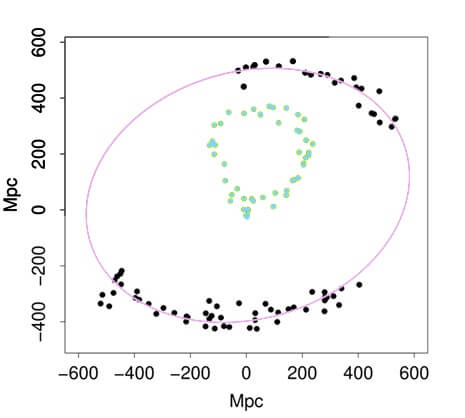
Lopez and Clowes previously identified two separate ultra-large-scale structures in the same region of sky toward Ursa Major. The first, dubbed the Giant Arc, stretches roughly 3.3 billion light-years. The second, the Big Ring, forms a ring-like structure about 1.3 billion light-years across. What the new report frames as the Giant Ring is an attempt to unite these observations: the existing Giant Arc plus a previously identified feature nicknamed the Northern Arc combine into a single, much larger annular structure.
The critical observation is that both the Big Ring and the larger Giant Ring sit at approximately the same comoving distance — roughly 9.2 billion light-years. They are not merely aligned by chance on the sky. They occupy the same region of three-dimensional space, nested one inside the other, at a redshift that places them in the early universe, well within the epoch when such enormous structures should not have had time to form under standard cosmology.
The authors acknowledge, however, that the Giant Ring as a complete circle cannot yet be confirmed. The structure is so vast that parts of it fall outside the survey area used to detect it. The arc segments identified so far are consistent with a ring, but the proof remains incomplete. This is honest reporting, and it matters. Overclaiming would undermine the already fragile case for any structure of this scale.
Why the Size Is a Problem
Under Lambda-CDM, the universe becomes homogeneous at scales above roughly 300 million light-years. Galaxies cluster, filaments stretch across hundreds of millions of light-years, and vast voids exist, but nothing on the order of gigaparsecs should hold together as a single gravitational structure. The cosmic microwave background, the primary evidence for large-scale homogeneity, shows temperature fluctuations at the level of one part in 100,000. Structures as large as the Giant Ring would require density fluctuations far larger than what the model predicts.
The tension is not new. The Huge-LQG, the Hercules-Corona Borealis Great Wall, and the Sloan Great Wall have all posed similar challenges in recent years. Each one has been met with the same counterargument: statistical artifact. Given enough sky and enough galaxies, some arrangement will inevitably look impressive purely by chance. This is sometimes called the anywhere effect — the observation that in a sufficiently large dataset, rare patterns will appear everywhere you look.
The Giant Ring pushes past that rebuttal in at least one important way. A single ultra-large-scale structure could plausibly be dismissed as a fluctuation. Two such structures — the Giant Arc and the Big Ring — existing independently would be more suspicious still. Three, nested within each other at the same distance, in the same patch of sky, moves the probability of coincidence into genuinely uncomfortable territory. That is the argument Lopez and Clowes are making, and it is a stronger one than any single previously reported structure could sustain.
The Conformal Cyclic Cosmology Angle
Lopez has floated an explanation that deserves attention even if it remains speculative: Roger Penrose’s conformal cyclic cosmology, or CCC. In Penrose’s framework, the universe undergoes infinite cycles, each beginning with a Big Bang and ending in an exponentially expanded state that becomes the seed for the next. Violations of conformal invariance in the previous cycle — specifically, the evaporation of supermassive black holes through Hawking radiation — would produce concentric spherical shells of gravitational wave energy that imprint themselves on the geometry of the next universe.
If those shells were real, they would appear as large-scale spherical or ring-like overdensities distributed across cosmic time. The Giant Ring and the Big Ring, at roughly the same distance, could represent two such shells. This is elegant. It is also not yet verified. CCC itself remains a minority position in cosmology, and no smoking-gun observational signature has been confirmed. But the appeal of a mechanism that turns an anomaly into a prediction — rather than treating each large structure as a standalone embarrassment for Lambda-CDM — is exactly why physicists should keep an open mind.
What Would Actually Change
If the Giant Ring is confirmed as a real structure and not an artifact of survey geometry or statistical selection, the implications are layered. The most immediate impact is on the cosmological principle. Homogeneity at large scales is not a minor detail — it is what allows the Friedmann equations to describe the universe’s expansion at all. Without it, the entire edifice of standard cosmology needs revision, not tweaking.
A less dramatic but perhaps more likely outcome is that Lambda-CDM requires modification rather than replacement. Several cosmologists have proposed adjustments to the model that could accommodate rare, extremely large structures without abandoning the framework entirely. These include modifications to the initial power spectrum of density fluctuations or allowances for non-Gaussianity in the early universe. Whether any of those adjustments can accommodate a structure of this scale without becoming ad hoc is the question that will drive the next round of research.
The more speculative outcome is that something entirely new is needed. Conformal cyclic cosmology is one example. Others exist — theories involving primordial black holes, modified gravity, or topological defects in the early universe. None of them are currently preferred by the data. But the appearance of structures like the Giant Ring shifts the burden of proof toward the standard model.
Why This Matters Beyond Academia
The public fascination with the Giant Ring is not just about big numbers. It is about the story that the discovery tells: the universe is stranger than the textbooks say, and the textbooks are already rewriting themselves. That narrative has traction because it is true. Cosmology in the 2020s is in a period of genuine unrest. The Hubble tension, the nature of dark energy, the growing catalog of ultra-large-scale structures — each one is a thread that, if pulled, might unravel the current consensus.
For readers outside the physics community, the deeper takeaway is about how science handles its own uncertainty. Lopez and Clowes are not claiming that the Giant Ring disproves Lambda-CDM. They are claiming that it demands a more careful analysis of whether ultra-large-scale structures are real or illusory. Their paper is as much a methodological argument as a discovery claim. That is the kind of restraint that makes science worth following.
The fact that a Japanese outlet broke the story in Japanese, with detailed figures and context, ahead of English-language coverage, is a reminder that the geography of scientific communication is changing. The best astronomy journalism does not need a single language center. It needs eyes everywhere, and the willingness to listen when someone in Manchester, or Tokyo, or anywhere, spots something the rest of us missed.