Gravity-Powered Messaging Just Broke Through Walls—and It Could
Physicists in Australia sent a message through a brick wall using nothing but an elevator, a counterweight, and Earth's gravitational field. The experiment proves that information can ride gravity itself—a channel no material can block.
Gravity Doesn’t Care About Your Walls
A group of physicists at the University of Queensland in Australia just proved something that sounds like science fiction but is grounded in over a century of established physics: you can encode information in gravitational fields, and no known material can block it.
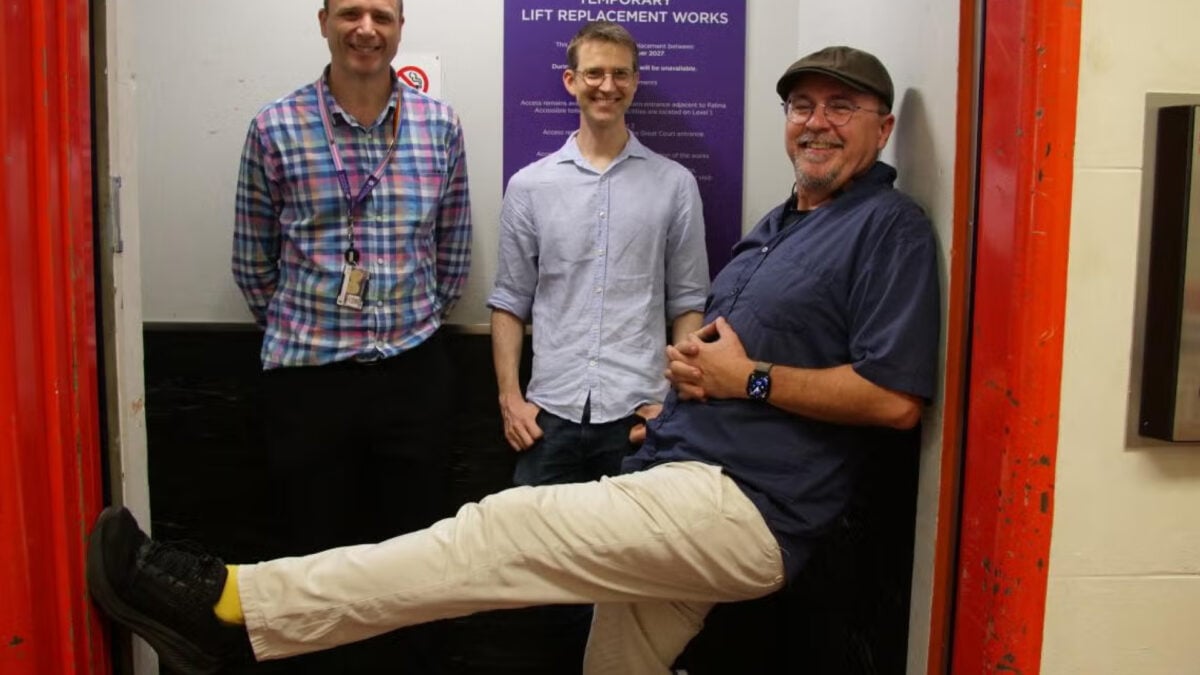
Their experimental setup was almost absurdly simple. They placed a brick wall between two rooms. In one room sat an elevator from the 1950s, its 1.9-ton counterweight moving slowly up and down. In the other room—an adjacent bathroom—a handheld gravimeter detected tiny shifts in gravitational acceleration. Each position of the counterweight represented either a zero or a one. The message, when decoded, read simply: Gravity.
Published in Science Advances, the study asks what the team calls a fundamental question: Can information be transmitted through an unblockable channel?
The answer, apparently, is yes.
Why This Matters Beyond the Lab
Modern wireless communication depends on electromagnetism—radio waves, microwaves, light pulses. These signals are easy to block. A thick concrete wall will kill your Wi-Fi. An underground bunker will isolate you completely. Jamming devices can flood specific frequencies and render receivers useless. Military forces have long sought communication channels that resist both physical obstruction and electronic warfare.
Gravitational fields offer none of these vulnerabilities. Unlike electromagnetic radiation, gravity cannot be shielded. No known material weakens it. It passes through Earth itself with negligible attenuation.
This doesn’t mean gravity-powered cell towers are imminent. The current demonstration transmitted one bit per minute. Sending a single word—the word “Gravity”—took approximately one hour.
Andrew White, a co-author and quantum scientist at Queensland, put it bluntly: the system works, but speed remains the bottleneck. Transmission rate depends on three variables—mass magnitude, movement velocity, and detector sensitivity. The team estimates that scaling up could reach roughly 15 bits per minute over distances of up to 500 meters.
Even 15 bits per minute would represent a radical departure from today’s network architecture. It would enable communication in environments where everything else fails: submarines submerged beyond sonar range, mining operations deep underground, emergency response in collapsed structures, military communications under active jamming.
The Elevator Problem
The choice of equipment deserves attention. The university possessed a 1950s-era elevator—a snail-paced mechanical contrivance that moved its counterweight incrementally between floors. Charles Woffinden, a physicist on the project, noted that anyone who has struggled with phone reception in tunnels or Wi-Fi through solid walls understands the appeal of the approach.
But the elevator itself illustrates why practical deployment requires significant engineering investment. The counterweight’s maximum acceleration was constrained by vintage machinery. Moving it faster would require more massive actuators, stronger structural supports, and precise timing mechanisms. The gravimeter, meanwhile, must distinguish between infinitesimal gravitational perturbations caused by moving mass and environmental noise—seismic vibration, thermal drift, passing traffic.
The researchers positioned the gravimeter in a bathroom precisely because that location minimized foot traffic during testing. Every human step introduces gravitational signature. Every door closure creates air pressure fluctuation. Precision matters.
What Comes Next
Matthew Davis, the study’s corresponding author and a physicist at Queensland, called the experiment a demonstration of possibility rather than practicality. That framing understates the significance slightly. Demonstrating that a new communication channel exists—the same way Hertz demonstrated electromagnetic waves in 1887, years before practical radio—marks genuine progress.
The team’s modeling suggests quantum sensors could dramatically improve sensitivity. Optomechanical gravimeters operating at cryogenic temperatures might detect smaller mass displacements at higher velocities. Such improvements would address both the bandwidth and distance limitations simultaneously.
Other alternatives for near-unblockable communication exist: neutrino beams, gravitational waves from astrophysical events, black hole orbital dynamics. None of these approaches lend themselves to terrestrial implementation. Neutrino detectors require kilometers of ice or water. Gravitational wave observatories like LIGO measure spacetime ripples from merging black holes billions of light-years away. Generating such signals intentionally demands energy comparable to stellar processes.
The Queensland team’s design operates within classical Newtonian physics. No quantum entanglement. No relativistic effects beyond ordinary gravity. It uses equipment available in university laboratories today. That accessibility matters for follow-on research.
The Timeline Question
White acknowledged that the gap between telegraph and mobile phones spanned more than a century. The 19th-century inventors who sent electrical signals across continents had no conception of wireless transmission, let alone cellular networks. Each generation of communication technology required infrastructure investment, standardization battles, and gradual performance improvement.
If the current trajectory holds, practical gravity-encoded communication systems might emerge within decades rather than centuries. Quantum sensor development proceeds rapidly. Commercial gravimeters already serve mineral exploration and nuclear nonproliferation monitoring. Miniaturization continues.
The limiting factor may prove less technical than political. Communication monopolies built around spectrum allocation could resist alternative channel adoption. Regulatory frameworks assume finite electromagnetic bandwidth. Introducing gravity as a parallel information medium would require rethinking those assumptions entirely.
Who Wins, Who Loses
States seeking resilient command-and-control infrastructure stand to gain most immediately. Submarines, deep boreholes, urban bunkers—all currently rely on line-of-sight relay or expensive buoy deployments. A gravity-based fallback channel eliminates those dependencies.
Journalists and activists working in surveillance-heavy jurisdictions might find value in untraceable transmission. Unlike satellite internet terminals, gravity communicators leave minimal electromagnetic signature. Detection requires proximity and precision instrumentation.
Telecommunications companies face competitive threat rather than immediate displacement. Gravity communication serves niches where existing infrastructure fails. Emergency services, scientific expeditions, military operations represent markets large enough to justify specialized equipment despite premium pricing.
The broader implication concerns information theory itself. Shannons’ framework treats all communication channels equivalently—what differs is bandwidth, noise characteristics, and propagation constraints. Adding gravity to the available channel portfolio expands the solution space without eliminating existing options. Multiple simultaneous channels increase resilience through redundancy.
The Word “Gravity”
The transmitted message carries weight beyond its semantic content. A team of physicists chose to send the word describing the force they had just manipulated through solid matter. It reads like deliberate poetry—a reminder that fundamental physics questions often produce applications unforeseen by their originators.
Hertz never imagined radio. Marconi never anticipated the internet. The Queensland team likely envisions eventual practical systems but cannot predict their form. The current demonstration proves concept validity. Translation to deployment requires solving engineering problems that don’t yet exist.
One constraint seems unlikely to disappear entirely: bandwidth will remain low compared to electromagnetic alternatives. Gravity coupling to matter is extraordinarily weak. Generating measurable perturbations requires substantial mass displacement. Detecting those perturbations demands instruments sensitive enough to resolve accelerations smaller than atomic dimensions.
These limitations don’t invalidate the approach. They define its niche. Emergency fallback communication. Underground operations. Submarine networking. Scenarios where no signal reaches anything else.
The experiment succeeded. The message arrived. The word traveled through brick, earth, and conventional wisdom alike, carried on nothing more substantial than the curvature of spacetime itself.