GTA VI's 170 Animals Signal a New Open-World Benchmark
Rockstar's inclusion of over 170 animal species in GTA VI isn't just environmental flavor—it's a declaration that open-world games are entering an era of ecological simulation. Here's what that means for the industry.
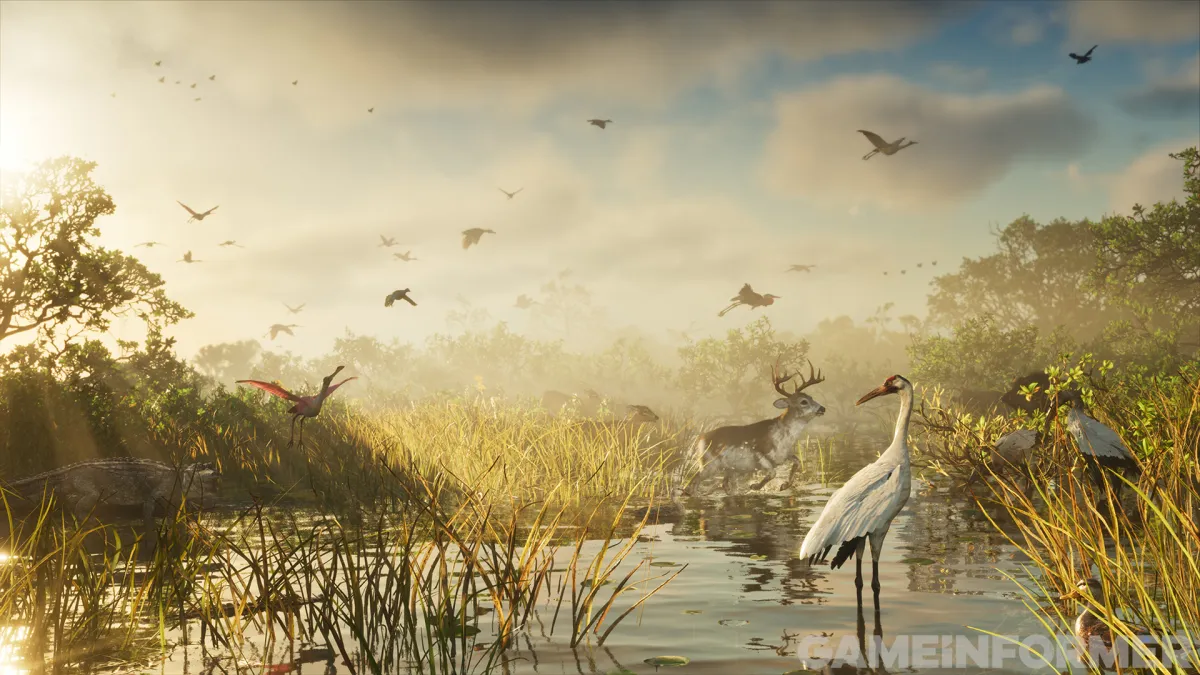
The Ecosystem Is the Story
Rockstar Games has confirmed that Grand Theft Auto VI will feature over 170 animal species populating its virtual state of Leonida, a fictionalized Florida. The announcement landed quietly amid the usual pre-release noise, but the implications ripple far beyond wildlife spotting as a side activity. This is not a novelty feature. It is a statement of technical ambition that recalibrates what players and competitors should expect from open-world games.
Florida is one of the most ecologically chaotic places on Earth. Its native species share habitats with invasive populations that have no natural predators, creating environments where you can watch a manatee glide past while a feral cat prowls a mangrove and a rhesus macaque — yes, real monkeys — patrols nearby. Capturing that biodiversity digitally requires a fundamentally different approach to game design than the one that powered previous entries in the series.
What makes this number significant is not merely the count but what it implies about computational resource allocation. A world running 170 distinct species with meaningful behavioral variation demands AI compute, memory management, and rendering optimization that previous open-world titles simply did not attempt. Red Dead Redemption 2 featured dozens of animal species, but those animals largely inhabited sparsely populated wilderness zones rather than sharing seamless urban-wildland transitions. Leonida appears designed so that ecological complexity penetrates into areas previously reserved for human-only interaction.
Beyond Texture Swaps
The details Rockstar shared with Game Informer reveal a studio building systems, not just assets. Animals in Leonida will demonstrate iridescence, bioluminescence, translucency, and varied feather types, alongside new hair and fur rendering systems. These are rendering breakthroughs that push well beyond the visual fidelity improvements seen in Red Dead Redemption 2, where Rockstar first began treating animal behavior and appearance with serious technical investment.
What separates GTA VI’s approach from past open-world games is the sheer density of life. Previous titles used wildlife as atmospheric background noise — birds circling in the sky, fish jumping occasionally in rivers. Rockstar is stacking 170 distinct species across land, air, and sea, with behaviors that likely respond to player presence, time of day, and environmental conditions. That requires procedural systems, AI decision trees, and rendering pipelines that can handle dozens of living creatures simultaneously without collapsing performance.
The inclusion of categorizable Rare, Discoverable, and Legendary animals signals another shift: Rockstar is designing ecosystems with value gradients. Some creatures exist to be found, creating a hidden layer of exploration that rewards curiosity without explicit markers. This mirrors the design philosophy that made Red Dead’s legendary animals meaningful, applied at a scale the series has never attempted.
Consider what this means for world design. When you have 170 species sharing the same space, you cannot hand-animate each encounter. The world must generate encounters organically through systems that account for species distribution, seasonal migration patterns, predator-prey dynamics, and habitat preference. This is ecological simulation dressed as open-world content, and it represents a generational leap in how game worlds can feel inhabited rather than merely rendered.
The Benchmark Effect
Here is what the broader industry will notice: GTA VI is effectively raising the floor for open-world games. When a title releases with this level of ecological simulation, competitors cannot claim the genre standard was previously untested. Players who experience a living world will find it harder to accept barren landscapes in future releases, regardless of budget or platform.
The companies most vulnerable are those building open-world games on middleware or engines that were not designed for dense biological simulation. Replicating Rockstar’s system-level work requires either significant engineering investment or licensing deals that may not be available to mid-tier developers. This could accelerate a market divide between studios that can afford this tier of simulation and those that cannot.
Sony’s Spider-Man franchise, CD Projekt Red’s next project, and Ubisoft’s ongoing open-world pipeline all face the same question: does your world feel alive in the ways players now expect? The answer will depend on whether those teams invest in systemic depth or continue prioritizing scale of geography over density of life.
There is a secondary effect worth tracking. When a flagship title establishes a new standard, modding communities and fan analysis often reverse-engineer those systems for subsequent games. Rockstar’s own history shows that technical innovations first deployed in Grand Theft Auto and Red Dead Redemption tend to percolate through the industry within three to five years. The animal simulation techniques in GTA VI may well become table stakes for open-world development long before the next generation of consoles arrives.
Why Florida Matters
The choice of Leonida as a Florida analogue is not arbitrary. Florida’s ecology is inherently dramatic — a place where invasive species thrive, where human encroachment collides with wetland habitats, and where the natural world constantly reasserts itself. Rockstar has built its best worlds around specific cultural and geographic identities. Vice City defined the ’80s Miami fantasy. Leonida’s chaotic biodiversity gives the studio something new to explore: a world where nature is simultaneously beautiful, dangerous, and indifferent to human plans.
That indifference may be the most interesting design challenge. Animals that exist independently of the player’s actions create a world that feels real rather than reactive. A flamingo does not care about your mission. An alligator exists on a schedule that predates your arrival. These are small details, but they accumulate into a sense of place that no amount of graphical fidelity alone can purchase.
Florida’s particular ecological tension — between human development and wild landscape — also gives Rockstar a thematic framework that aligns naturally with the Grand Theft Auto series’ long-standing fascination with American excess and environmental contradiction. The game’s world can simultaneously satirize human hubris and celebrate the stubborn persistence of natural systems. That duality was always possible in Vice City’s neon-drenched surface. It becomes structurally embedded when 170 animal species are woven into the world’s code.
The Technical Architecture Behind the Wildlife
What has not been fully disclosed but can be inferred from Rockstar’s developmental trajectory involves the underlying engine architecture supporting this ecological ambition. The RAGE engine, already refined through multiple generations of Red Dead Redemption and Grand Theft Auto V, has clearly been extended to support concurrent simulation of hundreds of biological agents with independent behavioral states. This is not simply more polygon counts or better textures — it is a fundamental rethinking of how game worlds process living entities.
Previous Rockstar titles treated animal AI as a secondary concern, often reusing simplified behavior loops across similar species. GTA VI’s approach suggests per-species behavioral trees with distinct hunting patterns, social structures, migration routines, and environmental responses. The computational cost of that approach is substantial, which means Rockstar has likely invested heavily in optimization techniques such as level-of-detail culling for animal AI, predictive spawning based on ecological zones, and shared processing pipelines that prevent individual creature simulations from overwhelming the GPU.
These engineering decisions carry implications beyond GTA VI. Any studio using or licensing RAGE-derived technology will inherit these capabilities, and Rockstar’s public demonstration of ecological simulation at this scale will make those capabilities visible to the entire development community. The benchmark is not just creative — it is infrastructural.
What Comes Next
GTA VI is not expected until 2026, and Rockstar is known for taking the time required to perfect its systems. The 170-species target suggests that development has moved well beyond prototype stages into refinement. What remains hidden — particularly the identities of Rare, Discoverable, and Legendary animals — will likely emerge gradually as Rockstar builds player anticipation through selective reveals.
The studio’s previous cover story approach in Game Informer confirms a pattern: major technical details tend to leak through exclusive interviews before official marketing cycles begin. Rockstar understands that demonstrating technical ambition serves as proof of progress in an era where open-world releases frequently underdeliver on early promises.
For the industry, the measure of GTA VI’s impact will not come from its launch week sales — those numbers are already projected to be historic — but from how many open-world games released in the following two years attempt to match its ecological ambition. If competitors respond with substantive system-level investment rather than superficial creature placement, the entire genre benefits. If they do not, Rockstar’s benchmark will stand as a solitary peak in an otherwise flat landscape.
There is also a consumer expectation dimension that will shape the post-launch environment. Players who grow accustomed to worlds where wildlife behaves with ecological authenticity will apply that standard retroactively. Existing titles will be scrutinized more harshly for their ecological emptiness, and upcoming announcements that omit any mention of living world systems may face disproportionate skepticism. The 170-animal figure becomes a reference point against which every open-world promise is measured.
The Bigger Picture
GTA VI’s animal count is ultimately a proxy for something larger: the question of what players now expect from virtual worlds. Ten years ago, an open-world game with dynamic weather and ambient NPC routines was considered technically impressive. Today, that baseline feels insufficient. The inclusion of 170 species with systemic depth signals that Rockstar has read the market correctly — that players are hungry for worlds that feel genuinely inhabited rather than mechanically populated.
This shift benefits the medium as a whole. When a title of this magnitude invests in ecological simulation, it validates the creative and technical effort required to build such systems. It encourages other studios to think beyond geography and architecture and consider the living systems that make places feel authentic. And it pushes hardware manufacturers to support the computational demands of dense biological simulation, accelerating the entire ecosystem from console design to engine development.
The animals in Leonida are not decoration. They are a measurement of what a game world can be, and they establish a new baseline that every open-world developer will need to address.