GTA VI's Perfect Score Is a Warning Shot to the Industry
With a 99 Metacritic score tying the greatest-reviewed game of all time, Grand Theft Auto VI proves that a decade-long development cycle still pays off — and sends a stark message to every publisher chasing quarterly releases.
The record it actually breaks
Metacritic now has Grand Theft Auto VI sitting at 99 out of 100. That number does not merely signal a great game — it matches Nintendo’s The Legend of Zelda: Ocarina of Time at the summit of aggregated critic scores, a throne the Zelda title has occupied since 1998.
Thirteen years separated those two peaks. A generation of gamers grew up. The industry reshaped itself around live services, day-one patches, and the constant churn of seasonal content. And yet the game that tops the all-time list is one that took over a decade to finish.
That coincidence is the story here.
What critics are actually praising
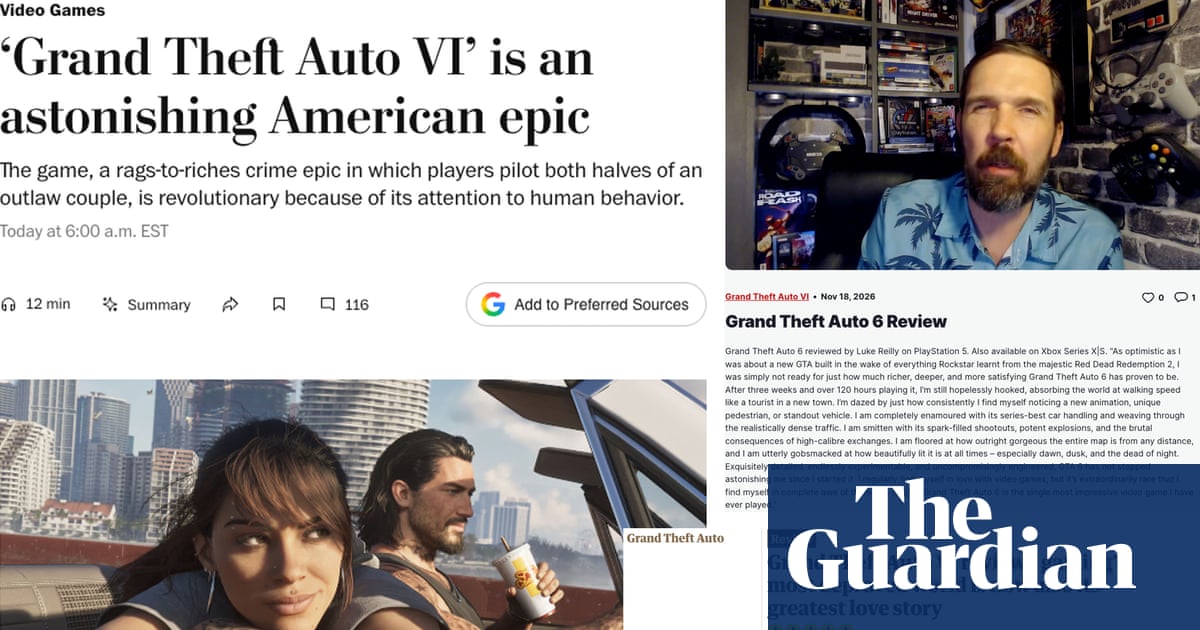
The review roundup reads like a consensus document: five stars from the Guardian, ten out of ten from IGN, another five from Eurogamer, four from the Washington Post, full marks from GamesRadar+ and VGC. Bloomberg called it a masterpiece. Forbes declared it home to the best video-game relationship ever rendered.
But the consistency of praise is not what matters most. It is where the praise lands.
Across outlets, something surprisingly similar kept surfacing: not just technical ambition, but emotional conviction. Keza MacDonald wrote that she was pacing her living room during the final missions, genuinely worried about Jason and Lucia. Luke Reilly logged nearly 120 hours before hitting the credits and still had large unvisited stretches of map. Paul Tassi said he could not recall a better relationship portrayed in any game. Yussef Cole noted that the series, historically fixated on solipsistic male ambition, had produced something tendentious and mature instead.
This is a franchise that built its identity on cynicism delivering a story about attachment. That reversal is quietly radical for a property worth more than any single studio’s annual revenue.
The economics behind the art
Rockstar has not officially confirmed the budget, but estimates place it north of $1 billion. Sensor Tower reported $1.54 billion in digital pre-orders as of November 17. Analysts project first-week sales between $3.25 billion and $5.2 billion.
Consider what those numbers imply for everyone else in the business.
A typical AAA release from a major publisher now costs between $200 million and $400 million to develop and market. The expectation is recovery within weeks, followed by live-service monetization stretched across years. When those projections fail — and they frequently do — studios close, layoffs follow, and franchises go dormant.
Rockstar operated on an entirely different clock. Thirteen years of development. Two delays absorbed without public panic because the momentum never broke — the December 2023 trailer still pulled more than 90 million views in its first day. A product so anticipated that consumers prepaid before seeing a single fully playable hour.
The lesson is blunt: if done right, patience is profitable in a way that quarter-driven publishers have forgotten how to imagine.
Who wins, who loses
Rockstar wins obviously. Take-Two Interactive will post numbers that validate every decision made since 2018. Consumers win through a rare alignment — a game critics and players seem to value equally, a world dense enough that even veteran explorers report uncharted areas after 120 hours.
Competitors lose in a subtler way. Not because they failed, but because GTA VI redraws the ceiling. Every open-world competitor from Ubisoft to EA to Sony’s own studios now has a benchmark that is not incremental but categorical. The bar is no longer ‘close to good.’ It is ’near-perfect across every dimension simultaneously,’ and no studio except the one that made the game is positioned to chase it next year.
The real losers may be the publishers who bet that player attention spans had permanently shortened. GTA VI asks for roughly 120 hours of investment and rewards it generously. If the market accepts that contract, the industry’s obsession with bite-sized experiences and rapid turnaround looks increasingly like a strategy born of caution rather than evidence.
What changes in the months ahead
Several concrete shifts are likely.
First, the pricing floor rises. At £69.99 for the standard edition and £89.99 for Ultimate, Rockstar normalized premium pricing that previously felt controversial. Competitors will test whether audiences pay the same for less certain returns.
Second, delay tolerance increases — or at least, expectations shift. Audiences rewarded a thirteen-year gap with record pre-sales. Publishers with projects stuck in early development will face harder questions about timeline versus quality, and some will choose longer waits rather than ship to mediocrity.
Third, the female-protagonist question gets answered practically rather than rhetorically. Lucas Caminos was not packaged as a diversity checkbox. She was embedded in a partnership narrative that reviewers found emotionally compelling. The next wave of ambitious open-world titles will need to prove their casting and storytelling choices create genuine attachment, not merely representation.
Fourth, the live-service model faces its strongest counterargument yet. GTA VI is overwhelmingly a single-player experience with asynchronous multiplayer elements tucked underneath. It is not a service designed to extract monthly spend. And it is still generating unprecedented hype and pre-order volume. The industry’s fixation on ongoing monetization may look like overengineering next year.
Why this matters beyond gaming
Culturally, the stakes are high too. Vice City — Leonida, as the game calls it — is populated by more than 33,000 individual non-playable characters whose interactions are shaped by race, class, gender, and money. The Washington Post highlighted this as unusually convincing social simulation. That level of detail in a mainstream entertainment product raises the expectation for every open-world game that follows.
Economically, the first-week ceiling is somewhere between $3.25 billion and $5.2 billion. Even the low end exceeds the total lifetime revenue of most AAA franchises. That kind of capital concentration affects retail shelves, marketing budgets, talent recruitment, and which projects get greenlit at every publisher with ambitions larger than their balance sheets can support.
And structurally, the 99 Metacritic score resets a conversation that had gone stale. For years, the dominant narrative in gaming criticism was that nothing new happens, that sequels iterate safely, that the medium had plateaued creatively. GTA VI arrived and dismantled that argument in a single sentence: there is nothing else like it, and the rest of the industry will now measure itself against something real.
Thirteen years passed. The game that emerged holds the highest critical score in history. The industry’s response to that fact will define the next cycle.