GTA VI Modders Hit 60fps With DLSS 5 — The Latency Cost
PC modders are hacking together a workaround to run GTA VI at 60fps via console streaming plus Nvidia's DLSS 5 — but input latency spikes to ~70ms. Here's what this means for the platform war.
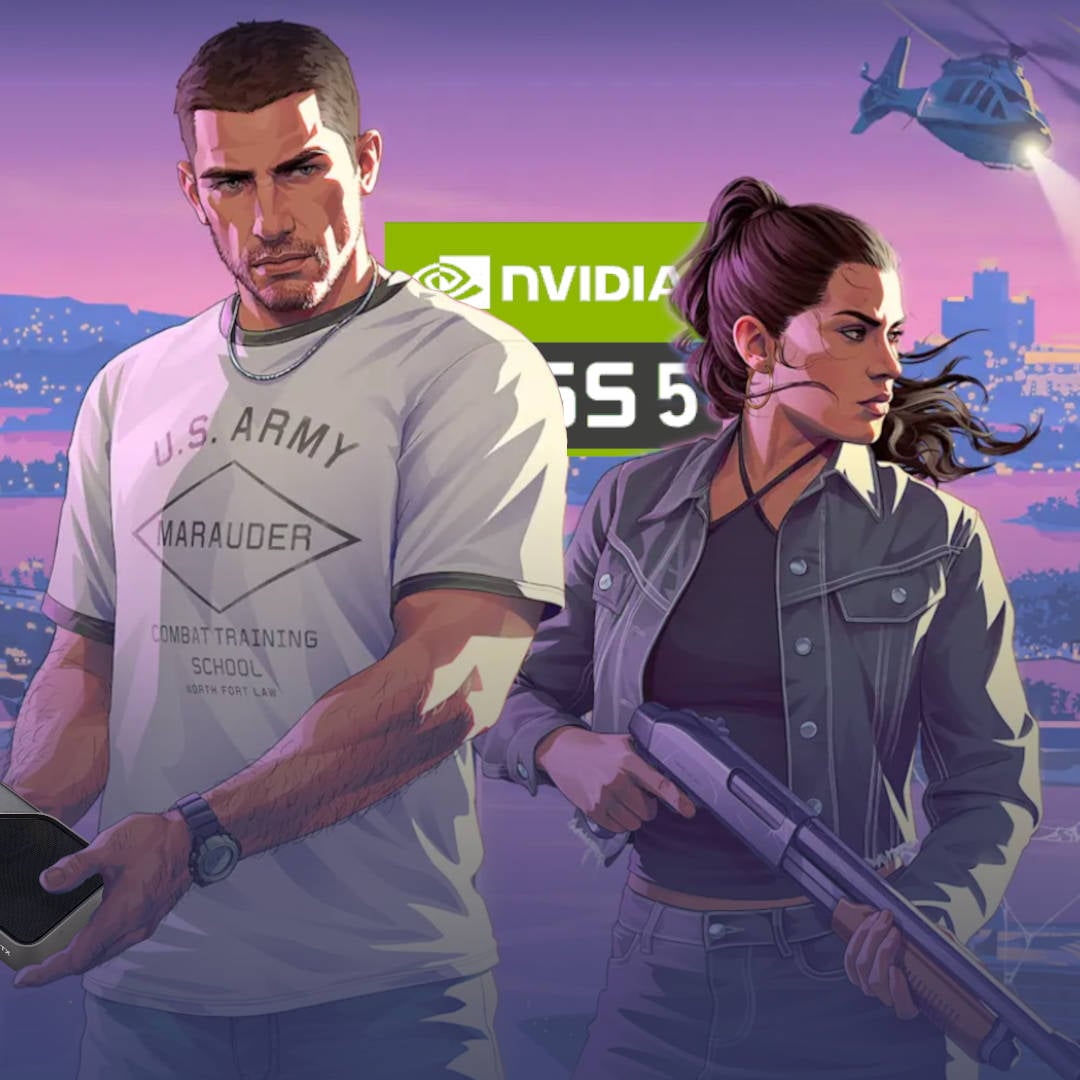
The loophole that wasn’t supposed to exist
A modder has found a way to play Grand Theft Auto VI at 60 frames per second on PC — without ever running the game natively on one. The catch is so structurally ironic it deserves its own footnote.
The method, demonstrated by X user phosphenq, strings together three separate technologies: console remote play or HDMI capture, Nvidia’s brand-new DLSS 5 neural rendering, and frame generation. The result is a visually sharpened, smoother-feeling version of Rockstar’s upcoming title running on a machine that could not otherwise run it. It works because the mod doesn’t touch the game itself — it intercepts the already-rendered video output from a console and enhances it post hoc.
That distinction matters more than it might sound.
How the trick actually works
Veyra-NRVideo, the open-source tool behind this hack, sits between the console’s display output and your PC monitor. It captures whatever stream comes through — whether that’s a PS5 Remote Play session or an HDMI feed from a capture card — then runs the image through a pipeline: frame generation to double or quadruple the apparent framerate, DLSS 5 upscaling and enhancement, and optional HDR conversion.
Phosphenq tested this on an RTX 5080 system using PS5 Remote Play alone, requiring no extra hardware beyond the standard streaming setup. The output ran at 60fps with visibly smoother motion compared to the native 30fps cap on Xbox Series X/S and PS5.
But the tool is working with the game as a dumb video stream. That means everything it does is approximation. Nvidia’s official DLSS implementation relies on access to engine-level data — motion vectors, depth buffers, shader passes — none of which exists in a captured video signal. The enhanced output is a best-effort reconstruction, not the real thing.
The latency tax
Smoothness costs something here, and it isn’t just visual fidelity. The numbers phosphenq published paint a clear picture:
DLSS 5 processing adds roughly 4.1 milliseconds of latency. Frame generation adds another 1.5ms. The base PS5 Remote Play stream carries its own 33ms inherent delay. On top of that, streaming over any network introduces another 10 to 20ms depending on connection quality.
Total input latency lands somewhere around 70ms or more.
For context, 70ms is firmly in cloud-gaming territory — the same realm where people routinely complain about unresponsive controls. Competitive shooters don’t tolerate numbers like that. Racing games feel sloppy. Even a traditionally paced action-adventure game loses its tactile responsiveness at this remove.
Rockstar has been quiet on PC latency specifics, but internal targets for next-gen engines typically aim for sub-50ms total input-to-photon latency. This mod pushes well past that threshold.
Who this actually helps
Let’s be honest about who benefits from this workaround. The people most harmed by the 30fps console cap — simulation-focused players, competitive multiplayer enthusiasts, anyone for whom frame rate directly shapes agency — are also the least likely to use it. By the time you add a 70ms latency tax, the experience is worse than native 30fps on controller, not better.
What this really helps is the aesthetic experimenters and content creators. Streamers can overlay a polished 60fps-looking feed while running a console instance. YouTube reviewers gain a talking point. Tech enthusiasts get proof that the bottleneck isn’t impossible to break.
And crucially, it proves the GPU horsepower exists. An RTX 5080 handling this pipeline comfortably suggests that Rockstar’s PC port, when it arrives, could absolutely target higher framerates — assuming they allocate the right resources rather than shipping a console-routed build with minimal desktop optimization.
What this signals about the platform gap
The deeper story here isn’t the hack itself. It’s what the hack reveals about Rockstar’s launch strategy.
GTA VI launching exclusively on console first — a move Rockstar parent Take-Two has confirmed multiple times — creates an artificial scarcity that modders immediately set out to dismantle. They didn’t do it because the game is unplayable on console. They did it because PC players were promised earlier access and got nothing.
This is the same pattern we’ve seen before with other late-arriving PC ports. The console-only window creates a pressure valve of disappointment that leaks into forums, YouTube, and eventually GitHub. Each workaround becomes informal benchmarking data that third-party reviewers and tech journalists use to question Rockstar’s engineering choices.
Nvidia’s DLSS 5 integration — even unofficial — will be quoted in coverage as “GTA VI at 60fps” until someone provides clearer caveats. That framing advantage belongs entirely to the modders, not Rockstar.
The official path forward
Nvidia has made clear that true DLSS 5 requires game-engine access. Motion vectors, historical frames, and rendering buffer passthrough aren’t things you can extract from a compressed video stream without significant artifacting. Phosphenq acknowledged this — the 1080p cap from PS5 Remote Play further limits what the neural renderer can work with, and visual artifacts are expected.
When Rockstar ships the PC version, presumably with proper API-level DLSS support, the entire exercise becomes academic. Native integration means zero streaming overhead, accurate motion vectors, full resolution scaling, and latency that stays within acceptable bounds. The difference between 70ms and sub-30ms isn’t incremental — it’s existential to how a game feels.
Until then, though, the mod stands as a live demonstration. It shows what the hardware can do. It shows what the current console experience lacks. And it gives everyone covering the game’s launch cycle another data point to argue about.
Who wins, who loses
Modders win — they proved a constraint was solvable with enough tinkerering. Nvidia gets exposure for DLSS 5 in a high-profile title before the PC port exists. Console owners keep their locked 30fps experience. PC gamers get a taste of what’s possible and then have to wait longer for it.
Rockstar loses the simplest metric: credibility on performance promises. Every article that mentions “60fps GTA VI on PC” — even to discuss the latency tax — reinforces the narrative that the console versions underperform. The studio can’t control that frame.
The wider industry learns that console exclusivity windows remain porous boundaries, and that GPU makers can insert themselves into conversations about games that haven’t touched their platforms yet. All of that reshapes the conversation before a single native PC frame renders.