GTA6s 99-Metacritic Score Signals a New Era for AAA Gaming
Rockstar's $3 billion open-world epic earns near-universal acclaim, but its real impact goes beyond sales records—it rewrites what players expect from live-service games and sends shivers through every rival publisher still chasing the same ceiling.
A Score That Forces the Whole Industry to Look Up
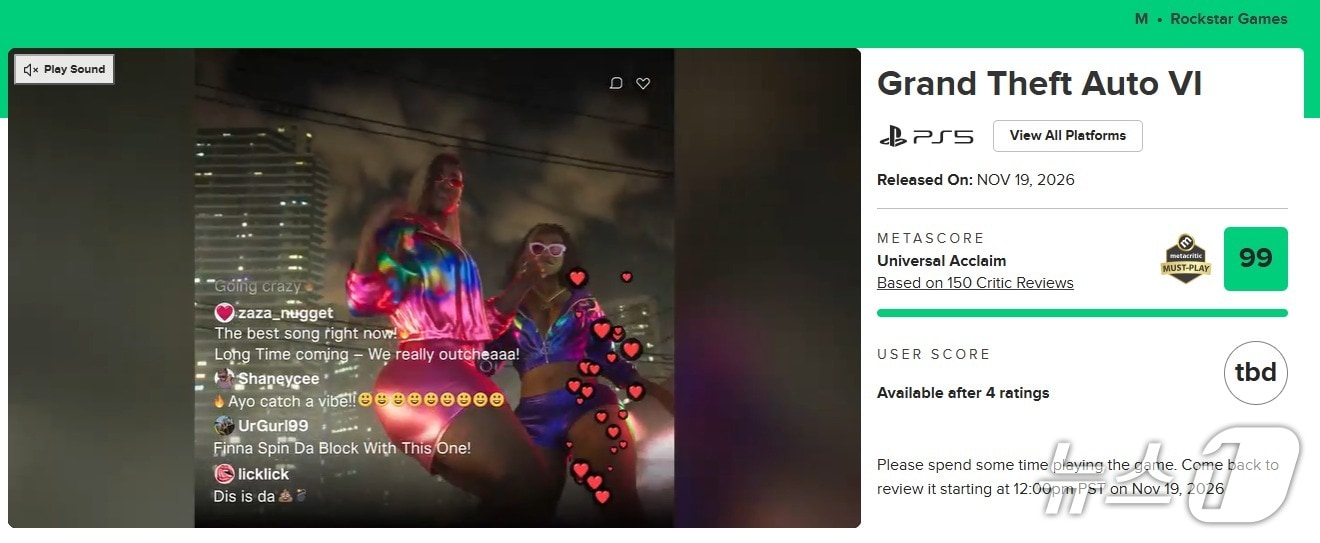
The critic scores came in fast and furious. By the end of the first review cycle, Metacritic had assigned Grand Theft Auto VI a 99 out of 100 across 150 professional reviews — every single one classified as overwhelmingly positive. It tied with Legend of Zelda: Ocarina of Time for the site’s highest-ever aggregate rating, then vaulted past it on internal ranking. IGN, GameSpot, and Game Informer each awarded a perfect 10. VGC, Eurogamer, and The Guardian all handed out five stars.
These numbers are extraordinary. They are not the only thing extraordinary about this launch. GTA6 is the fourth entry in a franchise whose latest numbered installment — GTA5 — arrived in 2013. Thirteen years passed before this followed. Development began in earnest around 2019, when Rockstar spent an estimated $3 billion bringing Leonida, a fictionalized Florida, and Vice City to life. The studio bet that patience would still pay off in an era defined by quarterly earnings calls and perpetual live-service loops. The initial verdict says it bet right.
But reading the reviews narrowly misses the larger signal. The real story is not that a game got good marks. It is that Rockstar has redrawn the line between a premium single-player experience and a live-service platform — and now every publisher operating at the top tier must explain why their next launch does not look closer to this.
The Three-Billion-Dollar Gamble, Explained
$3 billion sounds like a number pulled out of thin air until you remember it is roughly what half a dozen AAA AAA titles cost combined. In fiscal year 2024, Take-Two reported total research and development expenditure approaching that range across its entire portfolio. GTA6 alone absorbed the lion’s share. For context, most flagship AAA releases land in the $150 to $300 million bracket. Rockstar chose to spend ten times that figure and take thirteen years delivering.
The logic is straightforward even if the execution is audacious. GTA Online — the persistent multiplayer layer added to GTA5 in 2015 — became one of the most profitable gaming ecosystems ever built. According to publicly reported figures, it has generated well north of $17 billion in cumulative revenue. Rockstar has watched that revenue persist for nearly a decade while most live-service titles burn bright and die within two or three. The lesson they extracted was simple: build something vast enough that players never finish it, then update it slowly.
With GTA6, Rockstar has doubled down on that model with even greater ambition. The critics consistently praised the game’s world density, its NPC AI routines, and the way its dual protagonists — Lucia and Jason — anchor a narrative that blends the franchise’s signature satire with something resembling emotional weight. VGC described it as closer to a Red Dead Redemption 2 sequel than a traditional GTA entry, which is high praise for a series that produced one of the finest open-world games ever made. IGN called it the most impressive game the reviewer had personally experienced. None of these comments come from studios trying to protect turf. They come from journalists who cover dozens of releases each year.
Why Live-Service Players Will Have Higher Expectations Now
Here is the subtle shift that most coverage is missing. For the past several years, live-service gaming has been dominated by battle passes, seasonal content calendars, drop-rate economies, and the implicit promise that your dollars buy incremental cosmetics or progression boosts. Games like Destiny 2, Warframe, and Fortnite perfected those models because they offered a different kind of engagement loop — one built on habit formation rather than narrative immersion.
GTA6 does not reject that infrastructure. It inherited it. GTA Online remains part of the package and will continue to function as the primary long-term revenue stream. But what Rockstar has demonstrated is that a live-service game does not need to prioritize those lighter mechanics at the expense of cinematic-scale world design and player-driven exploration. The expectation now is that a $70 title can offer both.
Competitors who launched ambitious single-player campaigns followed by hollow post-launch support structures are immediately exposed. Publishers who treated live-service as synonymous with endless cosmetic microtransactions face a credibility gap. Players saw what $3 billion can produce when directed toward environmental storytelling, systemic depth, and character work. The bar moved upward overnight.
This is also why the performance critiques — the 30 frames per second target on PS5, occasional frame drops in crowded districts, the awkward controls that The Guardian flagged — matter disproportionately. When you price your ambition at this level, anything less than technical polish reads as negligence. Even a few percent of negative coverage on top of an otherwise universal acclaim creates a rhetorical opening that competitors will happily exploit.
Who Actually Loses From This
Wall Street will treat GTA6 as a validation of premium pricing. Take-Two shares typically react positively to strong launch windows, and industry analysts expect the title to generate $8 billion to $10 billion in first-year revenue if pre-order figures hold and day-one sell-through mirrors GTA5’s momentum. The company’s leadership has been patient for years; the market will reward that patience with higher multiples and presumably more confidence in greenlighting expensive, long-cycle projects going forward.
Sony faces a complicated dynamic. GTA6 launched simultaneously on PlayStation 5 and Xbox Series X/S, which removes the exclusivity premium that traditionally bolstered first-party platform holders. Yet Sony benefits indirectly. A dominant third-party release on a platform reinforces that platform’s relevance and keeps hardware engaged during a period when the generation’s midlife slump tends to erode install base enthusiasm. Bloomberg and other outlets have noted that GTA6’s release coincided with heightened investor scrutiny of Sony’s own upcoming catalog, suggesting the stock reaction to Rockstar’s success is entangled with nervousness about whether Sony can match the momentum with its own first-party slate.
Microsoft gains nothing directly from GTA6’s quality, but it gains from availability. Having the game on Xbox Series X/S alongside PS5 prevents a platform-level embarrassment. The more painful reality is that Rockstar’s excellence highlights everything else on the shelf that falls short. Players who buy a $70 game and encounter that level of polish will compare it against whatever mid-tier release launched three weeks earlier on the same console.
Nintendo sits on the outside looking in. The Switch lifecycle is concluding, and a game this technologically ambitious will feel distant from the handheld experience Nintendo has cultivated for seven years. That distance may actually help Nintendo’s positioning among consumers tired of photorealistic competition, but it also underscores that the company’s next console must deliver something visually and mechanically comparable, or risk looking irrelevant to the core gaming demographic that spends the most time in AAA single-player experiences.
Japanese publishers face a parallel anxiety. Capcom, Konami, Square Enix, and FromSoftware have all invested heavily in proving that regional studios can compete globally, but Rockstar’s trajectory demonstrates that global reach requires budgets most European and Asian publishers cannot independently muster. The gap is widening between studios capable of sustaining $1 billion-plus development cycles and everyone else. Smaller publishers will respond by either doubling down on niche specialization or seeking acquisition partners willing to absorb risk.
What Happens Next
The most consequential impact of GTA6 will arrive months or years from now, not during launch week. Take-Two has signaled that Rockstar plans to invest in the game’s online component for many years. If that commitment holds, the title functions as a sustained revenue engine similar to the one GTA Online has provided — but one anchored by a stronger single-player foundation that reduces the churn rate typical of live-service fatigue.
Other publishers will adjust their roadmaps. Mid-tier studios with planned live-service launches will face tougher internal debates about scope versus ambition. EA, Ubisoft, and Activision Blizzard will each need to answer whether their next flagship matches the world-building standard Rockstar just set or settles for familiar formulas. Investors will measure those answers against Take-Two’s stock performance.
Critics and consumers will develop shorter patience for incomplete launches. The technical shortcomings reviewers flagged — the帧率不稳定 and control awkwardness — already generated measurable social media conversation. The threshold for acceptable polish has moved. Future releases that ship broken will face steeper backlash.
And the industry will quietly recalibrate its understanding of what constitutes a safe investment. Thirteen years ago, GTA5 proved that a sprawling open-world crime drama could generate generational revenue. Rockstar proved again that waiting longer and spending more can yield a culturally dominant product. The formula is now validated at the highest level. Whether other publishers have the discipline to follow the same patience-heavy path — or simply copy the surface features without the underlying commitment — will determine which studios thrive and which fade over the coming generation.