Why Gulf Mediators Keep Hitting a Wall With Trump on Hormuz
Qatar, Oman, and Pakistan are pushing for a phased reopening of the Strait of Hormuz, but Washington is refusing to return to the June ceasefire deal that could make it happen. The stalemate reveals a widening gap between regional diplomacy and American strategy.
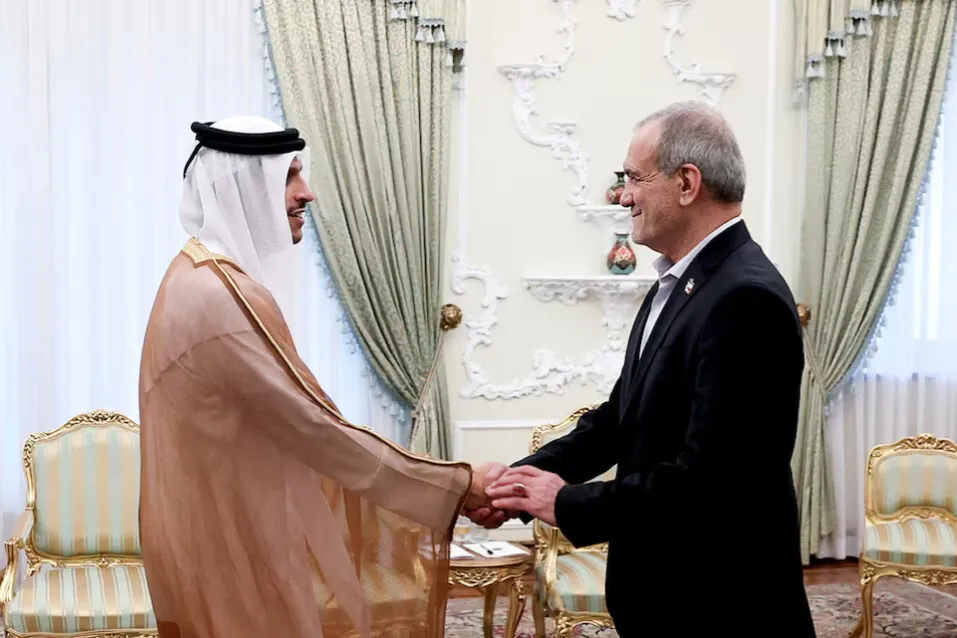
The Mediators Are Trying. Trump Is Not.
Six months into what has become an intermittent war between the United States and Iran, the maritime chokepoint of the Strait of Hormuz sits closed to normal commercial traffic. Shipping insurance premiums have skyrocketed. Global oil markets are on edge. And the small Gulf states that have spent decades positioning themselves as indispensable intermediaries are running out of clever things to say.
The latest round began on October 27, when Qatar’s Prime Minister Sheikh Mohammed bin Abdulrahman Al Thani landed in Tehran and immediately went to work. He met sequentially with Foreign Minister Abbas Araghchi, Parliament Speaker Mohammad Bagher Ghalibaf, President Masoud Pezeshkian, and National Security Council Secretary Mohsen Rezaei. The package he carried was specific: a phased framework that would establish a temporary joint navigation corridor in the strait, begin mine-clearance operations, and move toward a return to the June ceasefire memorandum of understanding that briefly opened the waterway.
It went nowhere visible.
What the Korean Press Gets Right
The Hankyoreh article tracking this diplomatic churn contains a detail that English-language outlets have largely dropped. Iran’s National Security Council, through Rezaei’s comments to Lebanon’s Al Manar television, confirmed that Tehran is preparing a formal conditions list for reopening — and that list explicitly includes ending all wars across West Asia, referencing the broader regional conflict involving Lebanon and other fronts.
Western reporting has focused almost entirely on the transactional question: will the U.S. lift sanctions and return to the June MOU terms? The Korean coverage pushes further, asking what the mediators are actually achieving on the ground and why their proposals keep stalling. That framing matters because it surfaces the real power dynamic here: the Gulf states are not neutral facilitators. They are existential stakeholders trying to prevent a regional war from swallowing their economies, and they know it.
Oman has been holding separate talks with Iran on establishing a new transit corridor spanning both Omani and Iranian territorial waters. Pakistan’s Army Chief General Asim Munir flew to Tehran on October 24 for meetings with President Pezeshkian and other officials. Qatar followed days later with a deeper portfolio. None have produced a breakthrough. And the Wall Street Journal reported on October 27 that the bottleneck is not Tehran — it is Washington.
Trump’s Calculation
According to the Journal, President Donald Trump has no attachment to the June MOU, which many analysts outside the U.S. viewed as favoring Iranian positions. He is instead waiting to see whether his administration’s newly launched economic exclusion campaign against Iran is producing results before committing to any diplomatic reset. The implication is blunt: Trump is testing whether economic pressure alone can force concessions that diplomacy previously secured on less favorable terms for the U.S.
This is a high-stakes gamble. Iran’s conservative establishment has issued warnings — relayed through state media and parliamentary channels — that any move away from the June agreement’s terms is unacceptable. Article 5 of that MOU, which committed both sides to taking necessary measures for the resumption of Hormuz navigation, is being interpreted by Tehran as granting Iran unilateral authority over the conditions for reopening. That interpretation gives Iran leverage it did not have before the deal and gives the Gulf mediators a problem they cannot solve through persuasion alone.
Who Loses When Diplomacy Freezes
The immediate losers are commercial shippers. The Strait of Hormuz carries roughly 20 percent of global oil consumption and an estimated 30 percent of liquefied natural gas traded internationally. Every week it remains disrupted, freight costs climb and uncertainty infects energy markets from Tokyo to Rotterdam. European refineries dependent on Gulf crude have already begun rerouting shipments around Africa’s southern tip, a detour that adds ten to fourteen days to delivery windows and inflates costs across the continent’s supply chains. The ripple effects are visible in diesel prices at the pump in southern Europe and in reduced refinery throughput in Germany and Italy.
The mediators lose credibility. Qatar and Oman have built foreign-policy relevance on precisely this kind of back-channel diplomacy. Repeated failures erode the perception that they can deliver what larger powers cannot — access to Tehran when Washington and Tel Aviv are talking past each other. For Doha, the stakes are personal: Sheikh Mohammed bin Abdulrahman has staked his own political capital on these shuttle missions, and every dead end weakens his position relative to rivals within the Qatari leadership who favor a harder line on Iran or a closer alignment with Riyadh over mediation.
Iran gains short-term leverage but compounds its long-term isolation. Holding the strait hostage to unresolved regional grievances may extract concessions from nervous Gulf neighbors, but it also reinforces the American argument that economic pressure, however painful, is the only language Iran understands. There is also a domestic contradiction at play: the Iranian regime is using the Hormuz crisis to project strength abroad while simultaneously deepening its economic dependence on China, whose state-owned trading houses have quietly stepped in to purchase Iranian oil at discounted rates through alternative routes that bypass American sanctions.
The Second-Order Effects
Beyond the shipping lanes and the press briefings, the stalemate is reshaping regional alignments in ways that extend far beyond the strait itself. The United Arab Emirates, watching Qatar’s diplomatic efforts stall, has accelerated military cooperation with Israel and Jordan, signing additional defense agreements in recent weeks that include missile-defense coordination and intelligence sharing on Iranian proxy networks. Saudi Arabia, though publicly quiet, has increased its troop deployments along the Yemeni border as Houthi activity has intensified in response to the Hormuz impasse.
China, meanwhile, has doubled down on its economic engagement with Tehran while carefully avoiding direct military involvement. Beijing’s state media has framed the crisis as evidence of American recklessness, a narrative that resonates across the Global South. The P5+1 framework, already weakened, appears further adrift — European powers are issuing increasingly urgent calls for de-escalation but lack the leverage to shape outcomes on the ground.
Even Pakistan’s role is fracturing. General Munir’s October visit was intended to position Islamabad as a neutral bridge between Tehran and Washington, but Delhi has responded by tightening security cooperation with Islamabad’s regional rival, signaling that the mediation corridor is narrowing from multiple directions.
What Comes Next
The phased framework Qatar proposed — joint corridor, mine clearance, conditional return to MOU terms — remains the most concrete roadmap on the table. Its survival depends on whether Trump decides the economic campaign is working well enough to negotiate from strength, or whether shipping disruptions and market volatility force a reckoning sooner. European capitals are quietly preparing contingency plans for a prolonged closure, including strategic petroleum release coordination and emergency LNG routing through the eastern Mediterranean — moves that would further marginalize Gulf mediation if they become necessary.
Iran’s conditions list, expected to include a broader West Asia ceasefire, raises the bar significantly. Even if Washington were inclined to deal, the linkage to Lebanon and other theaters complicates any bilateral arrangement. That linkage is Iran’s strategic design: it transforms a narrow maritime dispute into a proxy for every unresolved grievance in the region. The question is whether the Gulf states will continue to absorb the consequences of that linkage or push Tehran to decouple the two issues — a question Qatar has been too hesitant to ask openly.
The Gulf states will not stop trying. Their geography makes stopping impossible. But without U.S. willingness to engage seriously with the phased approach, their diplomacy risks becoming performance rather than process — meetings in Tehran and Muscat that generate statements but no shipping lanes. The meders know this. Trump knows they know this. And every day the Strait remains closed, the distance between what diplomacy could achieve and what politics allows grows just a little wider.