Hebron Evictions Are Part of a Long-Term Demographic Strategy
Israel's forced removal of 250 Palestinian families from Hebron is framed as a security response but fits a well-documented pattern of demographic engineering across the West Bank. Legal constraints exist but are increasingly bypassed.
A Security Operation With a Demographic Shadow
The Israeli military says its operation in Hebron is targeted. It is responding to a Friday ambush that killed two soldiers and wounded three others, and it insists the raid is limited to the neighbourhoods from which the gunmen operated. But on the ground the picture is harder to reconcile with that framing.
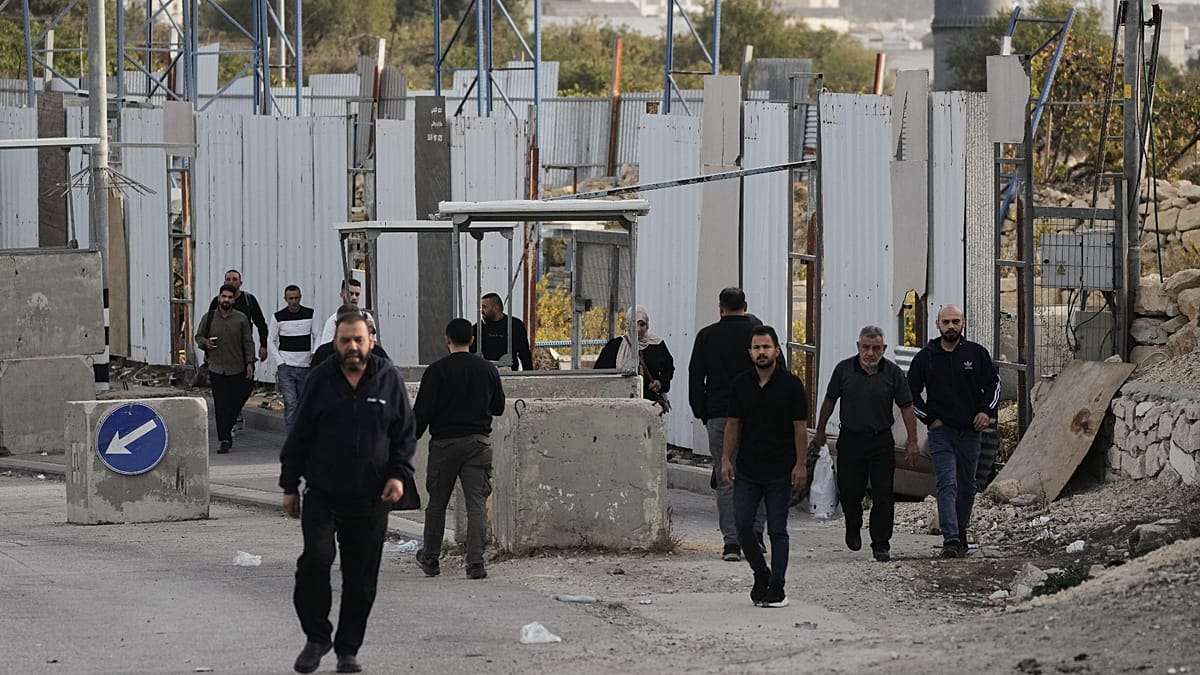
Israeli troops have marked buildings with X symbols in the Ein Dir Baha area. Hundreds of residents are leaving through designated checkpoints under duress. The mayor and local activists say roughly 250 families — about 1,200 to 1,500 people — have been pushed out. The governor puts the number lower at 150 families, but either way the scale is significant for a single urban neighbourhood.
What matters less is the precise headcount. It is the pattern that should concern observers.
The Precedent Is Older Than This Week
Hebron is not the first place where Israel has used a security incident to justify broad displacement. The West Bank has seen repeated cycles of this since the Second Intifada, and arguably since the occupation began in 1967. The legal architecture that enables it has simply become more systematic over time.
The primary tool is a 1967 British-derived military order that allows an occupying power to declare areas “closed military zones” and evacuate civilians from them. The order is supposed to be temporary and proportionate. In practice, it has been used to relocate entire communities for years, often under the cover of immediate security needs and rarely reversed afterwards.
Another mechanism is home demolition. Israeli courts have issued thousands of orders to demolish Palestinian structures in the West Bank, particularly in Area C, which falls under full Israeli civil and military control. Many of those homes are classified as “without building permits” — a category that effectively covers the vast majority of Palestinian construction, since the permit process in Area C is widely regarded as near-impossible to navigate.
Then there is the settlement enterprise itself. The expansion of Israeli communities on land expropriated for “state security” or purchased from private owners — often under disputed circumstances — reshapes demographics by design. Roads built to connect settlements cut through Palestinian territory. Checkpoints and barriers channel movement. The effect is not always declared in policy documents, but it is unmistakable in practice.
Hebron Fits the Template
The Hebron operation follows the same sequence: an attack, a security response, displacement, and institutional justification. What is notable about this cycle is how quickly the humanitarian consequences become normalised.
Residents were told to leave through designated exit points. Military vehicles patrol streets that were once home. Buildings are marked. The mayor says authorities are scrambling to find shelter and aid for the displaced. The governor calls it collective punishment. The Israeli military calls it precise, targeted, and thorough.
These are not just competing narratives. They are competing legal frameworks.
The Law Exists — And Is Being Tested
International humanitarian law is clear on this point. The Fourth Geneva Convention, to which Israel is a party, prohibits the forced transfer of protected persons from occupied territory. Article 49 states that an occupying power may not deport or transfer parts of its own civilian population into the territory it occupies, nor forcibly remove protected persons from it. The prohibition on collective punishment is equally well established.
Israel disputes the application of the Fourth Geneva Convention to the West Bank, arguing that the territory was not sovereignly held by a legitimate state before 1967. Most of the international community disagrees. The International Court of Justice has weighed in. The International Criminal Court is currently examining situations in Palestine.
Domestic Israeli law offers some constraints — or at least some procedure. Military orders can be challenged in Israel’s military court system. Human rights organisations such as Yesh Din and B’Tselem routinely file petitions. Courts have on occasion ordered the suspension of demolitions or the reopening of evacuated areas. But the success rate is low, and the process is slow. By the time a ruling arrives, the facts on the ground have usually changed.
The Political Timing Is Not Coincidental
This operation comes just days before Israel’s general election. Netanyahu is facing a tightly contested race against a coalition led by former military chief Gadi Eisenkot. Security credentials are a central campaign issue. So far this week, the operation has served its purpose on that front.
National Security Minister Itamar Ben-Gvir has gone further than most, calling for the dismantling of the Palestinian Authority altogether. His position is not marginal within the current government. Netanyahu has repeatedly stated his opposition to a Palestinian state. The political landscape in Israel is shifting, and the West Bank is where that shift is being felt most directly.
The timing does not explain the policy. But it does explain the pace.
What Happens Next
If the pattern holds, the displacement in Hebron will not be reversed. The X marks on the buildings are likely to remain. The families may be allowed back after a period — or they may not. Historical precedent suggests the latter is more common than the former.
Settler violence is already escalating alongside these operations. Yesh Din recorded 672 incidents over a 26-day period, nearly half connected to the olive harvest. That is not a separate phenomenon from the displacement. It is part of the same ecosystem: intimidation, displacement, consolidation.
The Palestinian Authority is weakened. Its authority in Hebron is already limited by the city’s division into H1 and H2, with Israel controlling most of the older city centre. The US and European powers have issued statements but no concrete action. The ICC process is ongoing but proceeds at a glacial pace.
The Real Question Is Not This Operation
The Hebron evictions will be reported as a response to violence. That is the official story, and it contains a partial truth. Two soldiers were killed. An attack happened. A security response followed.
But the deeper story is not about Hebron alone. It is about what Hebron represents. It is about a strategy that has been unfolding for decades — one that uses security operations, legal mechanisms, and political timing to reshape who lives where. The law provides some friction. The politics provide little. And the people caught in the middle — the 250 families, the residents of Ein Dir Baha, the families who will come next — have no seat at the table.
That is the pattern. Hebron is just the latest instance.