Why Europe's First Images of Dimorphos Crater Matter for Earth
ESA's Hera probe has arrived at the Didymos system, delivering humanity's first close-up images of the asteroid DART hit in 2022. The photographs are more than scientific curiosity—they represent a milestone in how nations defend Earth from space threats.
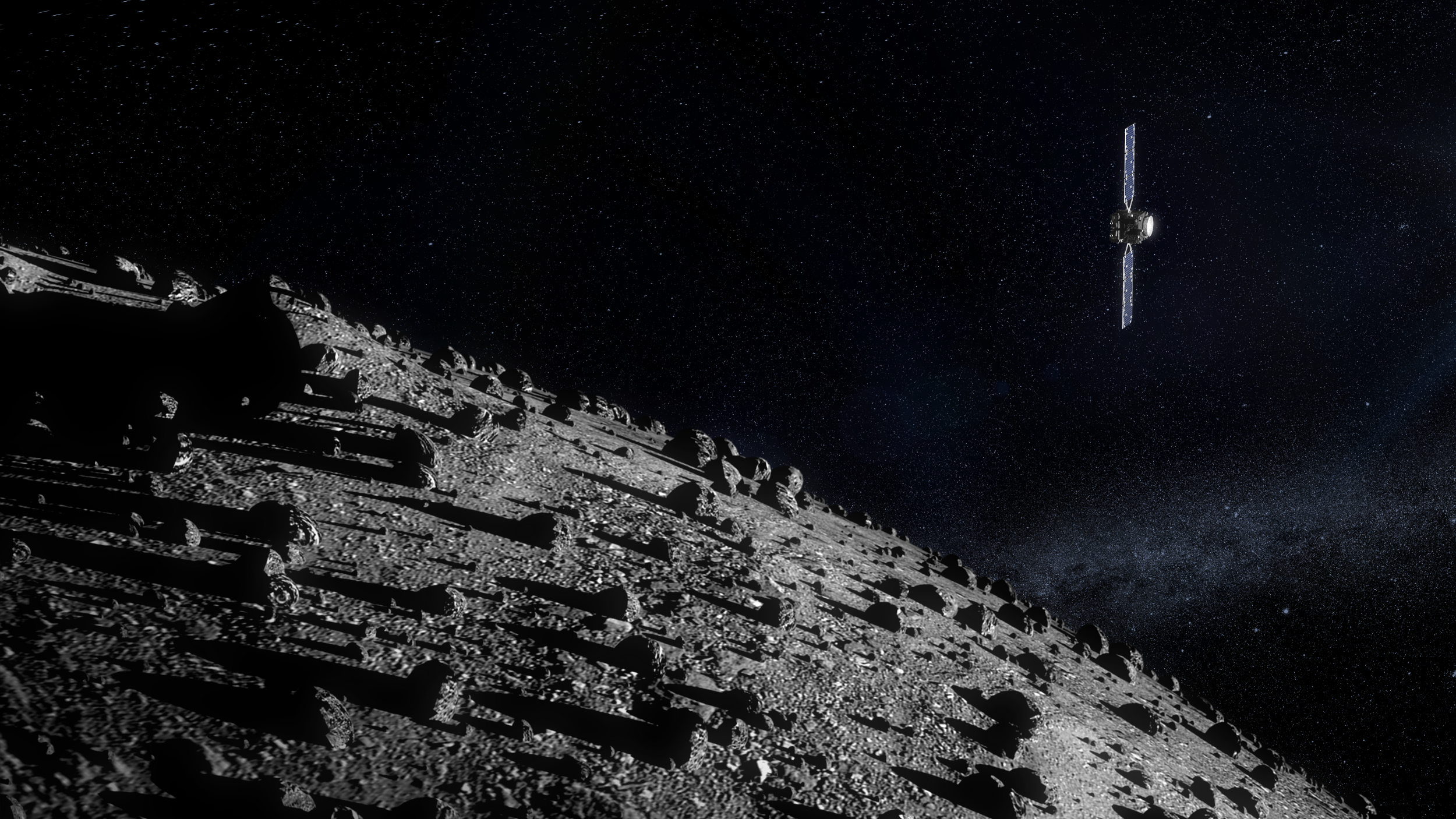
The Crash Scene Is Now Open for Inspection
Two years after NASA chose to intentionally smash a spacecraft into a passing asteroid, the forensic team has finally arrived.
On Wednesday, November 25, 2024, ESA released its first close-up images of Dimorphos—the small moonlet of the Didymos binary asteroid system—captured by its Hera probe en route to its final destination. The photos show a dark, rugged landscape orbiting against the black void, with its larger companion visible nearby. But what matters most is what lies just out of view: the fresh scar left by DART, humanity’s first-ever experiment in deflecting a space rock.
The livestream event was open and free—a deliberate choice. This moment belongs to everyone.
From Kinetic Impact to Crater Analysis
Let’s remember what happened here. In September 2022, NASA’s Double Asteroid Redirect Test slammed a 610-kilogram spacecraft into Dimorphos at roughly 6.6 kilometers per second. The goal wasn’t destruction but deflection—proving that kinetic impacts could alter an asteroid’s trajectory before it ever posed a threat to Earth.
It worked. Dimorphos’ orbital period around Didymos shortened by more than 30 minutes, a dramatic shift that confirmed the fundamental physics behind planetary defense. The world watched, and nothing happened to Earth. Which was precisely the point.
But knowing that a deflection works is not the same as understanding how it works. That gap is exactly why Hera exists—and why those first images matter so much.
Patrick Michel, Hera’s principal investigator, put it plainly: “How did the impact change Dimorphos? What is the mass of the asteroid and which of its properties explain its response to DART impact?”
These aren’t abstract questions. They’re the difference between testing a theory and building a protocol. Between hoping a future deflection mission succeeds and knowing it will.
A European Probe, an American Strike, a Shared Mission
Perhaps the most underreported aspect of this story is who built what and when.
Hera launched on October 7, 2024, aboard a SpaceX Falcon 9 from Cape Canaveral. It spent two years traveling through interplanetary space before arriving at its target. Along the way, it paused near Mars to image the tiny moon Deimos and captured one of the most striking views of the Didymos system: Dimorphos casting its shadow across the larger asteroid in a deep-space eclipse.
But the partnership runs deeper than shared trajectories. DART was NASA’s mission. Hera is ESA’s. Together, they form a single scientific operation split across continents, budgets, and institutions—and it is arguably the most complete planetary defense exercise ever conducted.
That cooperation is not guaranteed. Space has always been a domain of competition, occasionally collaboration, frequently tension. The fact that ESA and NASA agreed on objectives, shared data openly, and synchronized their efforts across a multi-year timeline speaks to something larger than engineering competence.
It speaks to a willingness to treat asteroid deflection as a human problem requiring collective solutions.
Why the Crater Photographs Change Everything
For all the excitement surrounding Hera’s arrival, the real value will come from months of detailed inspection once the probe settles into orbit. Hera carries a suite of instruments—visible and infrared cameras, radar systems—and will deploy six cubesats to study both Didymos and Dimorphos simultaneously. The goal is to map the DART impact crater, measure the ejected material, determine the internal structure of Dimorphos, and assess how much mass was displaced.
Every data point feeds a simple question: If we need to deflect a real threatening asteroid tomorrow, do we know enough to do it safely?
Right now, the answer is no. We have one successful test case—one carefully chosen target (Dimorphos is small, roughly 160 meters across) orbiting a binary system where gravitational dynamics are relatively predictable. Hitting a dangerous asteroid—larger, faster, with an uncertain composition and rotation—is a very different challenge.
The images Hera provides today are the beginning of an answer. They show a surface that appears fractured and uneven, evidence of the violent energy transferred during the collision. They reveal shadows and topography that scientists can now analyze in ways impossible from Earth-based observation alone.
What’s remarkable about this moment is that none of it would be possible without prior international coordination. DART had to transmit its data to the global community. ESA had to agree to follow up with a dedicated mission. Engineers on both sides had to ensure the targets and timelines aligned. It is easy to take this for granted. It should not be.
The Window Before It Matters
Here is the uncomfortable truth about planetary defense: the best time to test these techniques is when no one is watching. Dimorphos was chosen specifically because it posed zero risk to Earth. It was a proving ground, not a crisis response.
If a genuine threat were discovered today—say, an asteroid on a collision course decades away—would humanity move fast enough? The science says yes, we could deflect it. The politics say the outcome is less certain.
What Hera demonstrates, quietly and systematically, is that the technical infrastructure for planetary defense exists. Data flows between agencies. Launch schedules coordinate across atlases. Scientists publish results in real time rather than hoarding them for institutional advantage.
Ian Carnelli, Hera’s mission manager, framed it accurately: “Through many years of hard work our international collaboration managed to do just that, and for the very highest of intentions: to help make Earth safer.”
That intention is rare in space operations. It may not last forever. But for now, it is real—and the first images from Hera prove it.
The crash scene is open. The investigation has begun.