Hormuz's Toll: Why Seoul's Deployment Math Just Got Harder
The US-Iran tanker war in the Strait of Hormuz is reshaping the calculus around South Korea's potential troop deployment — and not in Seoul's favor.
The Tit-for-Tat That Keeps Getting Bigger
The United States and Iran are locked in a cycle of escalation in the Strait of Hormuz that no amount of rhetorical minimization can disguise.
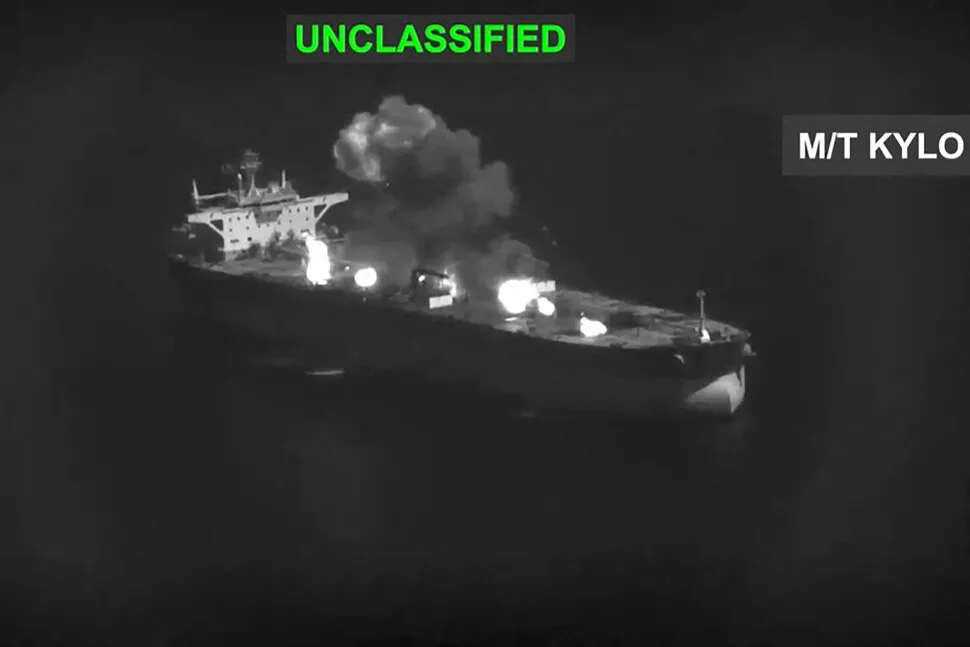
On May 5, US Central Command confirmed that Iranian Revolutionary Guard Corps vessels had fired ballistic missiles at an American aircraft carrier and a guided-missile destroyer operating in the strait. Washington’s response was swift and deliberate: three Iranian oil tankers were struck. One, the Dawny near Iran’s largest oil export terminal at Kharg Island, was put out of action. A second, the Stark 1 near Jask, suffered the same fate. The third, the Kailo, operating in the Gulf of Oman, was ordered abandoned and then destroyed entirely.
Iran’s IRGC Navy immediately claimed responsibility for hitting three tankers transiting what it called the strait’s “unapproved routes,” along with three US-linked vessels in other waters. It framed the strikes as retaliation and warned other ships against using those passages. Washington has not independently confirmed the Iranian claims.
What is clear is the trajectory. Since May 30, when US forces struck Iranian rocket launchers used for mining operations in the strait, each side has responded with escalating force — Iran attacking US bases in Jordan and Kuwait, the US targeting IRGC facilities and Iranian oil infrastructure. The pattern is unmistakable: every American strike has been met with a proportional, sometimes larger, Iranian response.
The Oil-on-Oil Doctrine
Central Command Commander Brad Cooper articulated the strategy plainly. “If they attack two of our ships, we take out three of theirs,” he said, adding that the US would target additional Iranian oil运输 vessels if necessary.
This is a deliberate economic-strangulation approach — targeting Iran’s ability to export crude rather than its military forces directly. The logic is cold: hurt Iran where it hurts most, in its revenue stream, and hope the pressure forces a retreat before the conflict expands further.
But the doctrine carries enormous second-order consequences. The Strait of Hormuz handles roughly 21 million barrels of oil per day — about 20 percent of global consumption. Any sustained disruption sends shockwaves through energy markets and threatens the economies of Japan, South Korea, and China, which depend on Middle Eastern crude flowing through those narrow waters.
Washington’s Word Game
Here is where the situation gets politically complicated for Seoul. The Trump administration is actively downplaying the scale of the conflict ahead of November’s midterm elections. Trump called the situation “intermittent” and dismissed it as “small potatoes.” Vice President JD Vance refused to call it a war.
These are not innocent descriptions. They are framing choices with direct implications for how the US asks its allies to behave. If the conflict is “not a war,” then allied military contributions can be framed as limited operational support rather than participation in an active combat zone. That framing makes political cover easier for allies like South Korea, whose constitution and domestic politics impose constraints on deploying troops to overseas conflicts.
But the gap between that framing and the reality on the ground — US warships under fire, Iranian oil tankers sinking, mines being laid — is widening by the day. That gap is exactly where Seoul’s dilemma lives.
Seoul’s Calculus
South Korea is reviewing options for a military contribution to ensure navigation safety in the Hormuz strait. The configurations being considered — missile corvettes, mine countermeasures vessels, and support ships — are deliberately non-offensive in design. They are the kinds of platforms a middle power can deploy without triggering the kind of escalation that would draw it into a wider war.
That distinction, however, is evaporating. Even a mine-clearing vessel operating in or near the strait would be in waters where combat is actively occurring. An IRGC fast-attack craft does not distinguish between a US destroyeron patrol and a Korean support ship on a humanitarian mission. Both are American-aligned assets operating in Iranian waters.
The risk calculus for Seoul is brutal either way. Deploy troops and naval assets, and South Korea becomes a target — potentially a low-priority one, but a target nonetheless. Iran has already signaled it views US-linked vessels as legitimate military objectives, and it has warned against using “unapproved routes.” Stay on the sidelines, and Washington escalates its pressure on Seoul politically, possibly through trade leverage or diplomatic isolation at a moment when Washington needs allied cohesion most.
The Regional Realignments
This is not just about Hormuz. The deployment question sits at the intersection of three forces that will shape East Asian security for years.
First, US pressure on allies to contribute to Middle East operations is becoming a recurring feature of American strategy. The expectation is no longer just collective defense of the Atlantic basin — it is global burden-sharing, and South Korea, as a mid-tier ally with significant naval capability, is on the list.
Second, Japan is watching closely. Tokyo has already discussed contributing to Hormuz security operations and could move faster than Seoul if the US prioritizes allies willing to act. A Japan-in, Korea-out scenario would reshape alliance dynamics in Northeast Asia in Washington’s favor — and in Seoul’s disadvantage.
Third, Iran’s deterrence strategy is evolving. By targeting commercial shipping and framing the conflict as a defense of sovereign navigation rights, Tehran is attempting to internationalize the costs of the confrontation. Every Korean or Japanese tanker caught in the crossfire strengthens Iran’s argument that the US is dragging allies into a war they do not want.
What Comes Next
The Trump administration’s description of the conflict as “intermittent” and managed is a political construct, not a military reality. The US-Iran exchange of strikes across the strait is real, ongoing, and expanding in scope. South Korea’s decision on whether to deploy — and on what terms — will be made in a theater that is getting more dangerous by the day.
If Seoul sends ships, it does so into waters where American warships are under missile fire and Iranian oil infrastructure is being systematically targeted. If it holds back, it does so knowing Washington will notice, and that Japan may fill the gap.
The Hormuz crisis is not just a Middle Eastern problem. It is a test of alliance management, of escalation control, and of how middle powers navigate conflicts they did not start and cannot afford to ignore.