Houthi Strikes Hit Riyadh’s Financial Heart — And It Changes
Houthi missiles striking Riyadh’s King Abdullah Financial District and an Aramco tower mark a dramatic escalation. Here’s why this shifts the conflict from proxy skirmish to global energy shock.
The Target Wasn’t Just a Building
The strike on Riyadh’s King Abdullah Financial District (KAFD) on November 8 is the most consequential escalation in the Saudi-Yemen conflict yet — not because of what was damaged, but because of what was chosen.
According to Reuters and AFP, multiple missile and drone attacks struck high-rise buildings inside the financial district. Aramco Tower suffered direct hits from falling debris, confirmed by Saudi Arabia’s Energy Ministry, which described only “minor damage” and no casualties. But the symbolism cuts deeper than the physical toll: this is the architectural showcase of Crown Prince Mohammed bin Salman’s Vision 2030, the gleaming proof that Saudi Arabia can reinvent itself beyond oil.
Goldman Sachs and other global blue-chip firms have offices here. It is the kingdom’s attempt to brand itself as a financial hub for the Gulf region and beyond. That it was targeted sends a deliberate message — one that goes far beyond retaliation for airstrikes on Sanaa.
What makes this incident so jarring is the juxtaposition. Glass facades shattered across floors occupied by analysts who commute from airports like King Khalid International — a facility the Houthis also claimed to target. The strike collapsed two realities at once: the carefully curated image of a modernizing Riyadh and the underlying vulnerability that version depended on being unchallenged.
What Happened
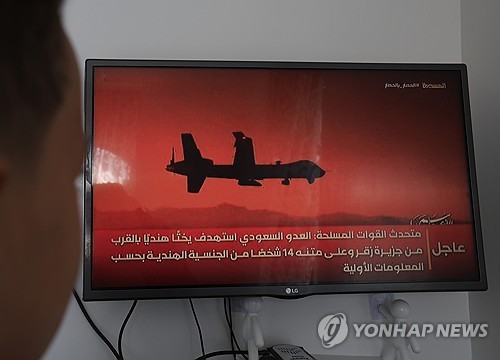
Yahya Sarieh, the Houthi military spokesperson, claimed responsibility for four precision operations across the kingdom, deploying a mix of ballistic missiles, cruise missiles, and drones. The declared targets read like a strategic checklist:
Riyadh’s King Khalid International Airport. Aramco’s central oil storage tanks. The KAFD itself. Aramco facilities at Abqaiq — the single most critical node in global oil infrastructure. Saudi army concentrations in Marib and Al Mudaraba in Harj.
The Saudi-led Arab Coalition said it intercepted some of the incoming missiles over Riyadh airspace. Whether all were stopped remains unclear — and that uncertainty is exactly the point.
No injuries have been reported so far, but the absence of casualties does not minimize the gravity. The Houthis have expanded their reach from border skirmishes and Red Sea shipping attacks into the heart of Saudi economic infrastructure. This is no longer a war fought on Yemen’s periphery.
Local residents described the strikes as sounding like successive thunderclaps — a pattern consistent with layered intercept attempts. Those who work in KAFD recounted evacuation orders, elevator lockdowns, and a sudden suspension of trading-floor activity. For a district designed to project permanence and order, the disruption was visceral.
Why This Matters Beyond the Region
Abqaiq is not just another facility. It processes roughly five million barrels of crude daily — roughly 5% of global supply passing through a single site. When the Houthis targeted it before and missed, the world largely absorbed the threat as background noise. This time, they struck directly at the crown jewel of Saudi urban modernity while simultaneously claiming hits on oil infrastructure.
Aramco is not merely a Saudi company. It is one of the most valuable publicly traded corporations on Earth, a cornerstone of global energy security, and the fiscal engine that funds Saudi Arabia’s ambitious spending programs. Damage to its assets — even minor damage with falling debris — triggers immediate market anxiety.
Oil prices did not spike catastrophically after this strike, likely because Saudi Arabia still controls its production capacity and the incident was contained. But financial markets price in future risk, not just present reality. Every successful Houthi strike that penetrates Saudi airspace erodes the assumption that Riyadh’s energy infrastructure is secure — and that assumption has underwritten everything from commodity pricing to portfolio allocations for the past two decades.
Insurance carriers operating in the Gulf are already reassessing risk models. Marine hull premiums for vessels transiting the Bab el-Mandeb Strait climbed another 12 percent following the attack, according to sources familiar with underwriting markets. Reinsurance firms in London and Zurich are circumspect about commenting, but policy renewals coming due in early 2025 are expected to carry steeper terms.
Second-Order Effects Already Visible
The ripples began within hours. Trading desks in Dubai adjusted positioning, widening spreads on Arabian Gulf petroleum products. Equity researchers covering Aramco issued brief notes emphasizing operational continuity while downplaying material impact — standard crisis comms that nonetheless registered the shift.
On the diplomatic side, Qatar and Oman, both maintaining channels with Sanaa, reportedly urged de-escalation behind closed doors. Washington is facing pressure from congressional allies to respond visibly without triggering a wider regional war. The Pentagon has existing force posture in the Persian Gulf; any kinetic response will be measured against the memory of previous Aramco incidents that drew America back into cycles it never fully exited.
For ordinary Saudis and Yemenis alike, the psychological toll is real. The narrative that the Gulf states enjoy a bubble of safety — insulated from the chaos next door — has developed a crack. That narrative matters to foreign investors, to expatriate retention, and to the domestic social contract Riyadh has built around prosperity.
Who Wins, Who Loses
The Houthis win strategically. They demonstrated operational capability to strike deep into Saudi territory with precision weapons — something they have struggled to credibly claim since the early days of the Yemen war. They forced Saudi Arabia into a defensive posture it cannot easily project publicly without revealing vulnerabilities.
Saudi Arabia loses credibility on multiple fronts. The kingdom has spent years projecting strength through military intervention in Yemen and diplomatic normalization efforts across the region. A missile landing in its financial district undermines that image overnight. More practically, every intercept success costs money and depletes stockpile reserves that may be needed elsewhere.
Global consumers stand to lose if this pattern continues. The Red Sea disruptions already raised insurance premiums and shipping times. Add sustained strikes on Saudi infrastructure, and the threat migrates from regional instability to systemic energy risk.
What Comes Next
Saudi Arabia will almost certainly respond — either with kinetic strikes against Houthi positions inside Yemen or through expanded air campaigns. Either option risks broadening the war and drawing in Iran more explicitly, which has supplied the Houthis with technology and training over many years.
For now, the immediate question is whether Abqaiq and Aramco’s broader pipeline network face renewed targeting. If the Houthis can coordinate strikes on both urban centers and oil infrastructure simultaneously, they force Saudi Arabia to defend everywhere — and defense everywhere is defense nowhere.
The longer trajectory is what should concern global markets. The Houthi campaign is evolving from asymmetric harassment into coordinated strikes against economic symbols and energy nodes. Each escalation raises the probability of a larger confrontation — and in that scenario, the world does not need another Abqaiq-style catastrophe to feel the pain. Markets move on expectation, and expectations just shifted.
The real test will come in the coming weeks. If Riyadh absorbs this strike without a proportional response, it signals either restraint or impotence — both damaging to the kingdom’s standing. If it retaliates decisively, the door opens to a cascade neither side wanted and the world cannot afford. Either path confirms what the November 8 strikes made unmistakably clear: the old assumptions about this conflict no longer hold.