How Radio Waves from Beta Pictoris b Change Everything We Know About Exoplanets
Astronomers have detected radio emissions from an exoplanet for the first time — and the signal reveals something we can't learn any other way: a magnetic field measuring 1.25 kilogauss, thousands of times stronger than Earth's. This isn't just a new detection. It's a new way of seeing alien worlds.
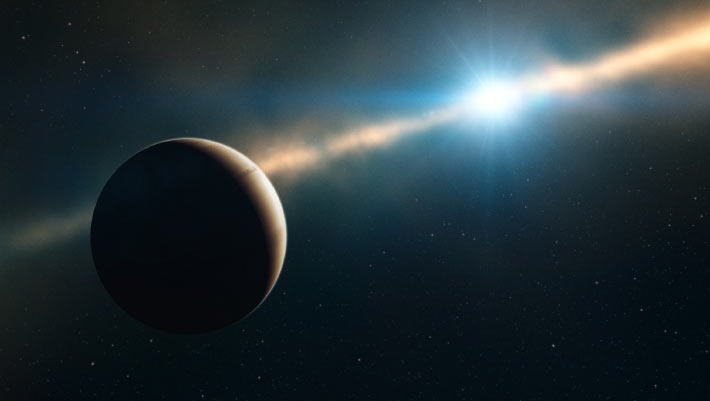
The Signal Behind the Noise
Astronomers have spent nearly two decades hunting for something elusive: direct evidence of a magnetic field around an exoplanet. On Friday, a team led by Kevin Ortiz Ceballos from the Center for Astrophysics | Harvard & Smithsonian announced they had found it — not by inference, not by modeling, but by listening.
Using South Africa’s MeerKAT radio telescope array, the team detected auroral radio bursts emanating directly from Beta Pictoris b, a gas giant roughly 9 to 13 times the mass of Jupiter that orbits its star at about 8 astronomical units. The signal carried the unmistakable fingerprint of electron cyclotron maser instability — the same physical mechanism that produces Jupiter’s decametric radio bursts and Earth’s northern lights.
The discovery, reported on arXiv this month, marks the first unambiguous tracing of radio emission to an exoplanet itself rather than its host star. That distinction matters. For decades, radio astronomers could point at a distant star and pick up flares, coronal mass ejections, or stellar wind interactions — but they could never isolate the planet’s own voice. Now they can.
A Magnetic Field Measured
The most striking result of the detection is not merely that Beta Pictoris b emits radio waves, but what those waves reveal about the planet’s interior. The highest frequency of electron cyclotron maser emission depends directly on the strength of the magnetic field at its source. By analyzing the cutoff frequency of the observed bursts, the team calculated a minimum surface magnetic field of approximately 1.25 kilogauss — roughly 2,500 times stronger than Earth’s field and well within the range predicted by dynamo scaling models for young, massive gas giants.
This is a first. Prior to this work, exoplanet magnetic fields existed only in simulations. They were inferred from transit observations, modeled from planetary mass and rotation rates, or assumed based on Solar System analogs. None of those approaches gave a number. This one does.
The consistency with theoretical predictions is reassuring — it confirms that the same convective dynamo processes governing planetary magnetism in our own system appear to operate at scale across the galaxy. But the real significance lies ahead. A direct measurement is a calibration point. It means the method works, and it means we can now use it elsewhere.
Why Beta Pictoris b Was the Right Target
The paper notes several reasons Beta Pictoris b was ideal for this kind of observation. The planet is among the most massive known in its system, which amplifies the strength of any magnetic emission. Its orbit reaches an angular separation of up to 0.55 arcseconds from its host star — large enough for MeerKAT to resolve the two sources and attribute the signal correctly. And critically, Beta Pictoris is magnetically quiet, reducing the noise floor of stellar radio emission that has historically swamped any planetary signal.
The system sits just 63 light-years away in the constellation Pictor and is remarkably young — about 23 million years old. Youth matters here. A younger planet retains more internal heat, drives a more active dynamo, and should therefore produce stronger radio emission than an older, cooler world like Jupiter. That makes young, massive gas giants the lowest-hanging fruit for this technique, but it also means the method will need refinement before it can reach smaller, older planets.
What Comes Next
The implications for the search for habitable worlds are immediate and practical. A planet’s magnetic field is widely considered a prerequisite for surface habitability — it deflects stellar wind and atmospheric erosion, shields the surface from ionizing radiation, and may play a role in regulating climate over geological timescales. Without a magnetic field, even a planet in the habitable zone could be stripped bare, like Mars.
Until now, the only way to assess an exoplanet’s magnetosphere was indirect. Transit observations might hint at atmospheric loss rates; X-ray absorption could suggest interaction with the stellar wind. But none of those methods measure the field directly. Radio detection does.
Ortiz Ceballos and colleagues note that the technique could, in principle, be extended to terrestrial planets orbiting nearby red dwarfs — the most common stars in the galaxy and the primary targets of current habitability surveys. The challenge is sensitivity. Beta Pictoris b is enormous and close. A rocky planet with an Earth-strength field would emit signals thousands of times fainter. Upcoming instruments like the Square Kilometre Array (SKA), currently under construction in Australia and South Africa, should bridge that gap within the next decade.
That timeline is also relevant to a broader question: how many exoplanets might we listen for once we know what to look for? The current estimate of confirmed exoplanets exceeds 5,500. If even a fraction of them harbor detectable magnetospheres, radio astronomy could become a routine complement to optical and infrared surveys — not a replacement, but a parallel channel of information that no single instrument can provide on its own.
The Quiet Star
There is one more detail worth noting. Beta Pictoris itself is a relatively ordinary A-type star, famous in exoplanet circles for its prominent debris disk — a structured ring of gas and dust that mirrors the architecture of our own Kuiper Belt. The system already hosts at least two other planets besides Beta Pictoris b, making it one of the most studied multi-planet systems beyond the Solar System.
The fact that the host star is magnetically quiet was essential to this discovery. Stellar radio emission is noisy, variable, and often orders of magnitude brighter than any planetary signal. Had Beta Pictoris been an active flare star, the planet’s auroral bursts would have been lost in the glare. This is a reminder that the success of the observation depended as much on the star’s temperament as on the planet’s size or the telescope’s sensitivity.
It is also a reminder that nature still selects the targets we can observe. The most exciting planets are not always the easiest ones to study. Beta Pictoris b was bright, massive, close, and lucky — surrounded by a quiet star at just the right orbital phase. Future discoveries will depend on finding more systems like this one, or building instruments capable of extracting signals from the noise that surrounds them.
The Window Opens
What makes this paper significant is not just the result — a single detection around a single planet — but what it proves possible. For the first time, astronomers can measure an exoplanet’s magnetic field directly. They can distinguish planetary emission from stellar emission. They can confirm that a physical mechanism understood in our own Solar System operates identically across interstellar distances.
The method is now validated. The technique is proven. And the question is no longer whether we can listen to other worlds, but how many we can hear.
The answer will come from instruments still being built and from systems we have not yet observed closely enough. Beta Pictoris b was the proof of concept. The rest of the galaxy is waiting to be heard.
Reference: Kevin N. Ortiz Ceballos et al. 2026, “Discovery of radio emission from the exoplanet β Pictoris b,” arXiv: 2609.16720.