How Russia Is Handing Iran a Decades-Old Missile Dream
Russia has been quietly funneling ramjet propulsion technology to Iran since 2023 under a program called C430L. The transfer bypasses sanctions and could upend Middle Eastern deterrence — but it also exposes Russia's growing dependency on Tehran.
The Missing Piece in Middle East Deterrence
For years, Western intelligence assessments of Iran’s missile program have told a familiar story: Tehran has mastered ballistic missiles and drones, but remains stuck on the supersonic cruise missile front. A ramjet engine — the heartbeat of any missile that needs to fly at multiple times the speed of sound while staying low and maneuverable — was always described as the next frontier Iran had yet to breach.
That assessment may now need revision.
According to a Financial Times investigation published on September 1, Russia has been running a covert multi-year program, designated C430L, that transfers ramjet propulsion technology directly to Iran. The program, led by state weapons exporter Rosoboronexport and missile design bureau NPO Mashinostroyeniya, was formally contracted with Iran’s Ministry of Defense and Armed Forces Logistics in November 2023. It continued through at least June 2026, even after the onset of war between the US-Israel coalition and Iran.
The significance is not merely technical. It is structural. Russia is not supplying Iran with finished missiles. It is teaching Iran how to build them. That distinction shifts the geography of deterrence in the Gulf for decades to come.
How C430L Actually Worked
Ramjet engines differ fundamentally from rocket motors. A rocket carries its own oxidizer; a ramjet ingests atmospheric air, compresses it, mixes it with fuel, and ignites the mixture. This allows sustained flight at supersonic speeds for far longer ranges than a ballistic trajectory. For a cruise missile, that means it can curve toward a target rather than arc high into space — making it dramatically harder for layered air-defense systems to detect and intercept.
The FT’s analysis of leaked Russian correspondence, travel records, and military patents shows that Russian engineers did not simply hand over a blueprint. They engaged in iterative design support. Iranian test data on ramjet propulsion units was sent back to Russia for analysis, after which Russian specialists forwarded specific questions and recommendations covering fuel systems, combustion stability, air intakes, and engine nozzles.
In April 2025, Rosoboronexport proposed deploying approximately 20 Russian experts to Iran for on-site technical consultation. The proposal was never formally denied in the documents examined by the FT, though whether it was executed remains unclear.
Fabian Hinz, a senior arms-control analyst at the UK’s Chaillot Paper and the Institute for Security Studies, called the transferred technology “very strategically sensitive” and noted that Iran had sought it for decades.
This is the difference between selling a fish and teaching someone to fish in waters that no Western sanctions regime can control.
Why Russia Agreed
The partnership makes sense only if you view it through Moscow’s post-2022 reality. Since the full-scale invasion of Ukraine, Russia has been operating under a sanctions architecture that has systematically cut it off from the very supply chains — microelectronics, precision bearings, advanced metallurgy — that sustain a modern defense industrial base.
Iran, conversely, has spent a decade building clandestine pathways for exactly those items. The two countries have complementary scarcities: Russia has design expertise and operational experience that Iran lacks; Iran has manufacturing capacity, sanctions-circumvention networks, and a willingness to absorb technical know-how that Russia can no longer find domestically.
The C430L arrangement, therefore, is not merely an act of strategic solidarity. It is a form of industrial barter. Russia trades intellectual property for survival capacity. In return, Iran gains a technology that would otherwise have taken another decade or more of expensive and uncertain indigenous development.
Who Loses When This Works
The most immediate casualty is the US and Israeli assumption that Iran’s cruise-missile capabilities remain constrained. A supersonic ramjet-powered cruise missile, if successfully deployed, would compress the decision time for any defending force in the Persian Gulf to seconds rather than minutes. Existing interceptors like the Arrow-3 and Patriot PAC-3 are optimized for ballistic trajectories and predictable flight paths. A low-altitude, supersonic, maneuvering target is a qualitatively different problem.
Gulf states — Saudi Arabia, the UAE, Qatar — which have invested heavily in layered air defense, find their investments depreciating in real time. Israel, already operating under a doctrine of preemptive strikes against Iranian nuclear and missile facilities, now faces the prospect that every successful strike accelerates Iran’s ability to replace what was destroyed with something faster and harder to kill.
But there is a second, less-discussed loser: the non-proliferation regime itself. The C430L program demonstrates that even the most sophisticated sanctions apparatus cannot prevent the transfer of foundational military technology when both parties are motivated enough and operate outside the transparency frameworks that govern conventional arms trade.
What Hasn’t Been Proven
The FT’s reporting does not confirm that a Russian-assisted supersonic cruise missile has entered Iranian service. The program’s final phase — discussed in a June 2026 Rosoboronexport letter — has not been shown to have been executed. No flight-test footage, no deployment evidence, no captured hardware has surfaced.
That uncertainty matters. An unproven missile program is a strategic signal, not a strategic capability. But signals are also weapons. The very existence of C430L, confirmed through leaked documents, forces adversaries to plan for a threat that may or may not materialize — and that is the essence of deterrence by ambiguity.
The SCO Connection
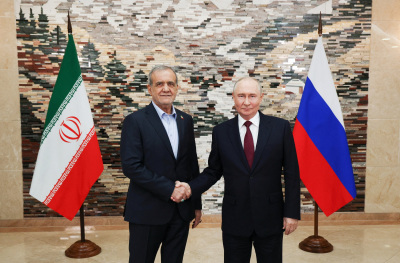
The timing is not accidental. The FT report appeared on September 1, the same day Russian President Vladimir Putin and Iranian President Masoud Pezeshkian met on the sidelines of the Shanghai Cooperation Organisation summit in Bishkek, Kyrgyzstan. The SCO has become Russia’s primary multilateral venue for institutionalizing partnerships with countries that are also under Western sanctions — China, India, Iran, and Central Asian states. Military-technical cooperation along the lines of C430L fits naturally within that architecture.
For China, the implications are subtle but real. Beijing has long preferred to keep its military-technical relationships with Iran at arm’s length, partly to avoid secondary sanctions. Russia’s willingness to go further signals a narrowing gap between Moscow and Tehran that Beijing may find either useful or uncomfortable, depending on the outcome.
What Comes Next
If C430L produces a deployable system, the Middle East’s balance of power shifts in ways that no current defense posture adequately addresses. If it stalls at the prototype stage, it still represents a diplomatic and symbolic victory for both governments — proof that sanctions cannot isolate them from each other.
Either way, the program marks the end of an era in which the West could treat Iran’s missile gap as a technical problem with a time limit. The gap is closing because a sanctioned Russia, desperate for strategic partners and industrial lifelines, is actively filling it.
The question is not whether Iran will eventually field a supersonic cruise missile. It is whether theWest will have built the right defenses before the first one flies.