Hyundai's SDV Gamble: Why 2028 Changes Everything for Korean Auto
Hyundai's first software-defined vehicle launches in 2028 with Level 2+ autonomy powered by NVIDIA chips. The real story is the data flywheel strategy — one Western desks barely mentioned.
The Number That Changes Everything
Seventy million vehicles. That is Hyundai Motor Group’s annual global sales volume, spread across 190 countries. In the traditional automotive world, that number signals manufacturing muscle. In the software-defined vehicle era, it signals something far more dangerous to competitors: a data machine.
At its CEO Investor Day on August 26, Hyundai unveiled a roadmap that reveals how aggressively it is pivoting from a hardware manufacturer to a software company that happens to build cars. The centerpiece arrives in 2028: the first mass-produced software-defined vehicle (SDV) from Hyundai, built on NVIDIA silicon and equipped with what the company calls Level 2+ autonomy.
Western auto coverage will note the NVIDIA partnership and the Level 2+ label and move on. That would be a mistake. The strategic architecture behind those choices — the data flywheel, the in-house AI model, the 100-megawatt data center — is where Hyundai is making a bet that could redefine the competitive position of the entire Korean auto industry.
The Data Flywheel
Park Min-woo, president of Hyundai’s Advanced Vehicle Portfolio (AVP) division and CEO of 42dot, framed the strategy in a way that cuts against conventional automotive thinking. “Cars must evolve from products whose features are fixed at the point of sale into products that learn and grow the more you use them,” he said.
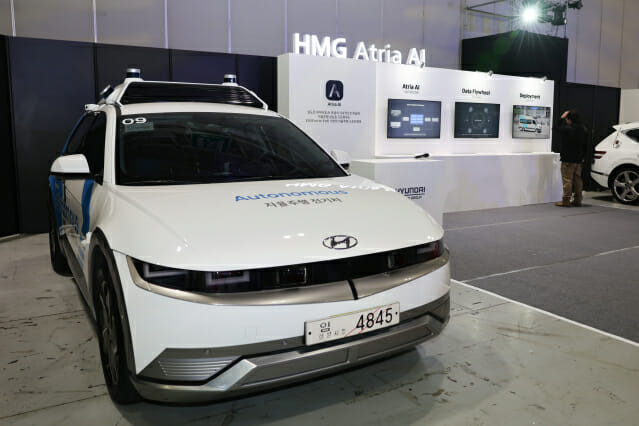
The mechanism is what Hyundai calls a data flywheel. Vehicles collect driving data. That data trains the in-house Atria AI model. Improved AI is pushed back to the fleet through over-the-air updates. More customers using the system generates more data. The flywheel spins faster as the vehicle population grows.
This is not a novel concept in theory. Tesla demonstrated its value years ago. What is distinctive about Hyundai’s approach is the explicit commitment to internalize the entire loop — data collection, AI training, and deployment — rather than outsourcing to third-party cloud platforms. The company is building its own 100-megawatt AI data center at Sinmanjin, operational from 2029, capable of housing more than 50,000 GPUs.
“Simply selling more vehicles is not enough,” Park emphasized. “What matters is how quickly we can increase the share of vehicles collecting and utilizing data in the same standardized structure.”
That last point is quietly critical. Hyundai acknowledges that scale alone is useless if the data is fragmented across different sensor systems, formats, and architectures. Standardizing on NVIDIA’s platform across Hyundai, Kia, 42dot, and Motoring — each of which previously operated with different sensor configurations — is an infrastructure decision with enormous strategic implications.
Atria AI and the Hard Problems
The Atria AI model takes an end-to-end approach, integrating perception, decision-making, and control into a single neural network rather than relying on modular rule-based systems. This is the architecture direction most autonomous driving researchers consider the right one for reaching higher autonomy levels.
The bottleneck, as any autonomous driving team will tell you, is not everyday driving. It is the rare, high-severity edge cases — the pedestrian who steps off a curb into darkness, the vehicle swerving from an unseen collision, the unexpected road debris at highway speed. These events are infrequent by definition, which makes them expensive to capture in meaningful quantities.
Hyundai’s answer is to consolidate driving data from all group entities and deploy Atria AI into the Gwangju autonomous driving validation program starting this year. Real-road edge-case collection is now a formal part of the training loop, not an afterthought.
Data will be analyzed across three dimensions: system stability, core driving scenario success rates, and automated parking performance. When anomalies appear, those specific clips feed directly back into model retraining, with quantitative validation on whether the fix actually improved outcomes.
The Timeline Nobody Is Watching
Here is what the headline numbers obscure: Hyundai is committing to a three-year progression from Level 2+ to Level 4, with the 2028 SDV as the starting point and scaled deployment of Atria AI across the mass-production lineup beginning in 2029.
Level 2+ means the system handles steering and acceleration within defined operating conditions, but the driver must remain engaged and ready to intervene. It is a meaningful step beyond basic adaptive cruise and lane-keeping — wider highway coverage, more complex urban scenarios, improved handling of construction zones and恶劣 weather — but it stops short of taking responsibility for the driving task.
Level 4, the company’s stated medium-term target, removes the human from the loop entirely within a defined operational design domain. No driver intervention required. The transition between those two levels is where most automakers have stalled or retreated.
Hyundai is betting that the data flywheel closes that gap faster than competitors who are still treating autonomous driving as a separate engineering problem rather than a software iteration problem.
Who Wins and Who Loses
The winners in this scenario are clear. NVIDIA benefits from a major automotive platform lock-in. Hyundai’s software division, 42dot, gains strategic importance beyond its current mobility services role. The Gwangju validation ecosystem and the Sinmanjin data center become infrastructure assets that raise barriers to entry for any competitor without equivalent scale.
The losers are the traditional tier-one suppliers whose value proposition — proprietary ADAS stacks sold as bolt-on systems — erodes when the OEM owns the full stack from silicon to OTA update. Bosch, Mobileye, and similarly positioned suppliers face a structural headwind that has nothing to do with technology superiority and everything to do with who controls the data loop.
Tesla faces the most interesting competitive dynamic. Its first-mover advantage in data collection remains real, but Hyundai’s 70-million-vehicle fleet — if it can standardize data collection across that population — offers a different kind of scale: geographic breadth across 190 countries, diverse driving conditions, and the manufacturing capacity to deploy software updates at a velocity Tesla cannot easily match outside North America.
What Western Coverage Is Missing
n
Most English-language reporting on Hyundai’s SDV announcement focuses on the NVIDIA partnership or the Level 2+ label. Those are surface-level observations. The actual story is the institutional commitment to internalize the entire data value chain — from silicon selection through data center construction through OTA deployment — and to treat autonomous driving performance as a function of data velocity rather than algorithmic breakthrough.
This is a fundamentally different competitive logic from the one that has governed the automotive industry for a century. Hyundai is not just building better cars. It is building a data company that manufactures vehicles. The 2028 SDV launch is not the destination. It is the first data point in a flywheel that the company plans to spin for decades.